
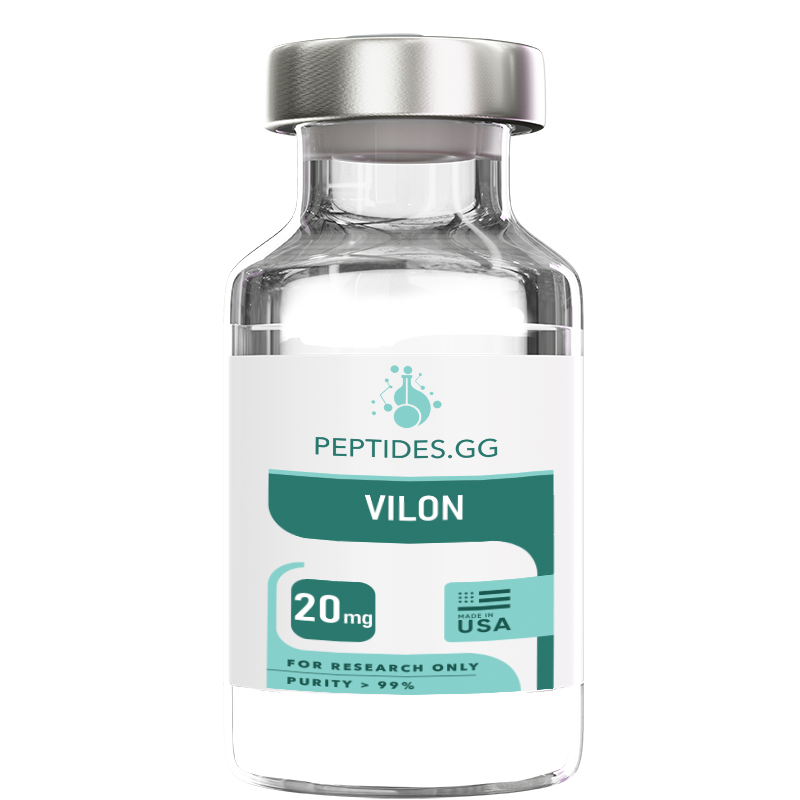
Vilon serves as a research tool for investigating thymus-specific bioregulation and immune organ tissue function in laboratory settings.
Research Disclaimer: Peptides.GG sells this and all other peptides for Research Only and not for human consumption.
Vilon (Bioregulator)
$60.00
- Free Delivery on all orders over $200
- Earn 5% Store Credit with Every Order
- Same Day Shipping Before 1 PM PST
- 10% Discount for Cryptocurrency Payments
14-day money-back guarantee
If you are not satisfied with the product, simply return it and we will refund your money
Vilon serves as a research tool for investigating thymus-specific bioregulation and immune organ tissue function in laboratory settings.
Research Disclaimer: Peptides.GG sells this and all other peptides for Research Only and not for human consumption.
Frequently Asked Questions About Vilon (Bioregulator)
What is Vilon?
Vilon is a synthetic bioregulatory dipeptide composed of the amino acid sequence Lysine-Glutamic Acid (KE), developed within the peptide bioregulation research program at the St. Petersburg Institute of Bioregulation and Gerontology. Supplied for laboratory research use only; not for human consumption.
What is the amino acid sequence of Vilon?
Vilon has the amino acid sequence Lys-Glu (KE); L-lysyl-L-glutamic acid. Its molecular formula is C₁₁H₂₁N₃O₅ and its molecular weight is ~275 Da.
What is Vilon studied for in research?
In preclinical and in vitro research, Vilon is used as an immune bioregulator research tool to investigate thymic and immune tissue and related tissue-specific peptide-signaling pathways. Supplied for laboratory research use only; not for human consumption.
Why is Vilon considered an immune bioregulator?
The Khavinson bioregulation hypothesis proposes that short, organ-specific peptides act as endogenous molecular messengers that influence tissue homeostasis through targeted gene-regulatory interactions. Vilon is studied within this framework as an immune bioregulator — a research tool for investigating signaling in thymic and immune tissue.
What size is Vilon available in?
Vilon is supplied as a lyophilized (freeze-dried) powder in 20mg. The lyophilized format is preferred for research because it eliminates solution-phase degradation during storage and allows precise gravimetric preparation of research concentrations at the point of use.
How is Vilon stored and handled in the laboratory?
Vilon is supplied as white to off-white lyophilized powder. It is highly soluble in water and aqueous buffer systems at physiological pH; limited solubility in non-polar organic solvents. For research handling, the lyophilized powder is kept sealed, cold, and protected from light until use. Each batch is third-party tested and supplied with a certificate of analysis.
Related products
-

Thymulin
$40.00 Select options This product has multiple variants. The options may be chosen on the product pageSize: 10mg
-
Crystagen
$55.00 Select options This product has multiple variants. The options may be chosen on the product pageSize: 20mg
-
Thymosin Alpha-1
$55.00 – $95.00 Select options This product has multiple variants. The options may be chosen on the product pageSize: 5mg, 10mg
Research Overview
Vilon is a synthetic bioregulatory dipeptide composed of the amino acid sequence Lysine-Glutamic Acid (KE), developed within the peptide bioregulation research program at the St. Petersburg Institute of Bioregulation and Gerontology. As a defined two-residue synthetic compound, Vilon differs fundamentally from organ-derived tissue extract bioregulators: its precise chemical identity is fully characterized, its sequence is invariant across production lots, and its structure-activity relationships can be systematically dissected through residue-level modification. The KE dipeptide sequence is classified as an immune system bioregulator, with laboratory research focusing on its interactions with thymic tissue biology, T-cell developmental programming, and broader immune regulatory pathways in preclinical model systems. Vilon’s compact molecular architecture makes it a particularly tractable tool for mechanistic dissection of how minimal peptide sequences encode tissue-specific immunomodulatory information.
Scientific interest in Vilon is grounded in the hypothesis, central to Khavinson-class bioregulation research, that short peptides derived from or mimicking organ-derived signals can modulate gene expression in a tissue-selective manner through interactions with nuclear regulatory machinery and transcription factor networks. Vilon’s KE sequence has been identified in research contexts as a thymic-relevant dipeptide signal, with laboratory investigations examining its effects on thymocyte differentiation, T-cell subset programming, and cytokine expression in lymphoid cell culture systems. Researchers studying thymic biology and immunosenescence frequently include Vilon in experimental panels alongside structurally characterized thymic peptides such as Thymogen (Glu-Trp) and Crystagen, enabling systematic comparison of how different minimal dipeptide sequences encode distinct immunoregulatory activities within the thymic peptide research toolkit.
Beyond conventional thymic immunology, Vilon has attracted significant research attention for its proposed interactions with DNA and chromatin regulatory systems. Preclinical studies have investigated the capacity of the KE dipeptide to interact directly with specific DNA base sequences, influencing chromatin compaction and gene accessibility in ways that may underlie its observed effects on lymphoid cell transcriptional programs. This peptide-DNA interaction research places Vilon within a broader literature on bioactive peptides that regulate gene expression through epigenetic mechanisms rather than classical receptor-mediated signaling cascades. Comparisons with larger thymic peptides such as Thymosin Alpha-1 and thymic metallopeptides such as Thymulin allow researchers to contextualize Vilon’s minimal-sequence activity against established benchmarks in thymic immunology, while comparisons with innate immune peptides such as LL-37 illuminate the boundary between adaptive thymic signaling and broader antimicrobial defense mechanisms.
Molecular Characteristics
Complete Specifications:
- Classification: Synthetic bioregulatory dipeptide (immune system / thymic)
- Sequence: Lys-Glu (KE); L-lysyl-L-glutamic acid
- Molecular Weight: ~275 Da
- Molecular Formula: C₁₁H₂₁N₃O₅
- Source Material: Chemically synthesized; not derived from biological tissue extract
- Appearance: White to off-white lyophilized powder
- Solubility: Highly soluble in water and aqueous buffer systems at physiological pH; limited solubility in non-polar organic solvents
The molecular architecture of Vilon is defined by the pairing of lysine and glutamic acid — two residues with opposing charge character that together endow the KE dipeptide with a zwitterionic profile at physiological pH. Lysine contributes a positively charged epsilon-amino group (pKa ~10.5), while glutamic acid contributes a negatively charged gamma-carboxylate group (pKa ~4.1). This charge complementarity is considered analytically significant for Vilon’s proposed peptide-DNA interaction mechanism: the lysine amino group can engage negatively charged phosphate backbone oxygens of DNA, while the glutamic acid residue may interact with nucleobase functional groups or histone surface residues in chromatin-associated contexts. The resulting capacity for electrostatic and hydrogen bond-mediated interactions with polynucleotide structures distinguishes Vilon’s interaction mode from peptides that operate exclusively through G-protein-coupled receptor engagement.
At approximately 275 Da, Vilon is one of the smallest synthetic bioregulatory peptides in the Khavinson research series. This minimal molecular mass falls well below the threshold for passive membrane permeability restrictions, supporting rapid cellular uptake and potential nuclear access in lymphoid cell populations. The free N-terminus on lysine and free C-terminus on glutamic acid contribute additional charge character that influences receptor engagement and DNA binding geometry; researchers designing SAR studies systematically evaluate how N-terminal acetylation, C-terminal amidation, and D-amino acid substitutions at each position alter the biological activity profile of the native KE sequence.
Pharmacokinetic Profile in Research Models
Absorption and Lymphoid Tissue Distribution
- Rapid systemic distribution is observed following parenteral administration in rodent research models; at 275 Da, Vilon distributes freely into lymphoid tissue compartments including thymus, spleen, and lymph nodes with minimal molecular size-related barriers to tissue penetration
- Thymic tissue distribution is assessed by LC-MS/MS quantification of the KE dipeptide in thymic homogenates at defined time points following intraperitoneal or subcutaneous administration in rodent research protocols
- Plasma protein binding is expected to be minimal at 275 Da; ultrafiltration assays in rodent and human plasma confirm the predominantly free peptide fraction available for tissue uptake across lymphoid compartments
- Nuclear localization studies in primary thymocytes and T-cell lines using fluorescently labeled Vilon analogs characterize subcellular distribution patterns and residence times in nuclear versus cytoplasmic compartments following peptide internalization
Bioactivity Dynamics in Immune Research Models
- Thymocyte culture systems from neonatal, adult, and aged rodent thymus are used to characterize Vilon-induced changes in surface marker expression (CD4, CD8, CD3, CD25, CD44) at 24, 48, and 72 hours post-treatment by multicolor flow cytometry
- Human peripheral blood mononuclear cell (PBMC) culture systems serve as an accessible in vitro platform for characterizing Vilon effects on T-cell subsets, cytokine secretion profiles, and proliferative responses to mitogenic stimulation
- concentration-response relationships are established across a concentration range spanning sub-nanomolar to micromolar levels in standardized lymphocyte assay systems with multiple biological replicates to define the biologically active concentration window
- Receptor-level interaction studies using competitive binding assays and surface plasmon resonance assess whether Vilon engages defined receptor proteins or instead operates primarily through direct DNA/chromatin interactions in lymphoid cell nuclei
Metabolic Considerations
- As a dipeptide, Vilon is subject to rapid hydrolysis by dipeptidases and aminopeptidases in serum-containing biological matrices; plasma stability time-course assays by LC-MS/MS establish the half-life of intact KE in rodent and human plasma to guide experimental design
- Metabolic products — free lysine and glutamic acid — are endogenous amino acids that re-enter normal cellular biosynthetic pools, simplifying metabolic clearance profiling and eliminating concerns about accumulation of pharmacologically active catabolites
- Protease inhibitor co-administration strategies have been explored in research settings to extend Vilon half-life in complex biological matrices, enabling investigation of whether sustained versus transient KE exposure produces quantitatively different transcriptional outcomes
- Renal filtration is the dominant elimination route given Vilon’s minimal molecular weight; urinary recovery assays in rodent models confirm rapid systemic clearance of intact dipeptide and free amino acid metabolites following single-administration administration
Research Applications
Thymic Function and T-Cell Development Research
- Thymocyte subset distribution analysis by multicolor flow cytometry (CD4−CD8− DN, CD4+CD8+ DP, CD4+ SP, CD8+ SP populations) in Vilon-treated fetal thymic organ cultures and postnatal thymic explant preparations
- T-cell receptor (TCR) beta-chain repertoire diversity analysis by deep sequencing in thymocyte populations from Vilon-treated research animals to characterize effects on the clonal diversity of the developing T-cell repertoire
- Positive and negative selection checkpoint studies in murine thymic slice preparations examining whether Vilon alters MHC-peptide-dependent thymocyte survival or deletion thresholds
- Thymic epithelial cell (TEC) marker expression profiling (Aire, FOXN1, DLL4, CCL25) in Vilon-treated thymic stromal preparations to assess effects on the epithelial microenvironment that supports T-cell education
Thymic T-cell development is the central process by which a self-tolerant, immunocompetent T-cell repertoire is established during ontogeny and maintained across the lifespan. Vilon’s classification as a thymic bioregulatory dipeptide places it squarely within this research domain, providing a chemically defined minimal-sequence probe for investigating how short peptide signals modulate the transcriptional programs governing thymocyte fate decisions.
Immunosenescence and Age-Related Immune Decline Models
- Aged rodent cohort studies comparing thymic mass, cellularity, and naive T-cell output between Vilon-treated and vehicle-control animals across longitudinal preclinical research protocols with defined treatment durations
- Thymic involution markers (perivascular space expansion, adipocyte infiltration, cytokeratin network disruption) assessed histologically in Vilon-treated aged research animals versus age-matched controls
- Peripheral naive-to-memory T-cell ratio analysis by flow cytometry (CD62L, CCR7, CD44, CD45RA markers) in Vilon-treated aged rodent cohorts to characterize systemic immunological aging phenotypes
- Senescence-associated secretory phenotype (SASP) cytokine profiling in thymic stromal cells from aged research animals enrolled in Vilon protocols, to characterize the inflammatory microenvironment of the involuting thymus and potential bioregulatory peptide effects on stromal senescence
Immunosenescence — the age-associated decline of thymic output and peripheral T-cell diversity — represents a major frontier in preclinical immunology research. Vilon serves as a molecularly defined probe in this field, enabling researchers to investigate whether minimal thymic bioregulatory sequences retain the capacity to modulate thymic epithelial programming and T-cell developmental kinetics in aged tissue contexts, with complementary studies alongside Thymulin enriching the mechanistic landscape.
Peptide-DNA Interaction and Epigenetic Research
- Surface plasmon resonance and isothermal titration calorimetry binding studies characterizing the thermodynamics of Vilon-DNA interaction, including binding affinity, stoichiometry, and sequence selectivity for specific DNA motifs relevant to immune gene regulatory regions
- Circular dichroism spectroscopy examining changes in DNA secondary structure geometry (B- to A-form transitions, local groove geometry alterations) following Vilon binding to defined oligonucleotide sequences
- ChIP-seq and ATAC-seq profiling in Vilon-treated lymphoid cell populations to identify genomic loci where the peptide interaction correlates with changes in chromatin accessibility or histone modification patterns at immune gene regulatory elements
- Molecular dynamics simulation studies modeling Vilon-DNA complexes at atomic resolution to characterize binding geometry, preferred intercalation or groove-binding modes, and the contribution of individual KE residues to DNA recognition specificity
The peptide-DNA interaction research program for Vilon represents a mechanistically distinctive area within bioregulatory dipeptide science. By investigating how a two-residue sequence directly engages genomic DNA and chromatin, researchers are probing a gene regulatory mechanism that bypasses classical surface receptor pharmacology and operates at the most proximal level of transcriptional control. This work connects Vilon research to the broader field of peptide-based epigenetic modulators.
Immune Regulation and Cytokine Biology Research
- Cytokine secretion profiling (IL-2, IL-4, IL-10, IL-12, IFN-γ, TNF-α) in Vilon-treated murine splenocyte cultures stimulated with concanavalin A or anti-CD3/CD28 to characterize effects on T-helper cell polarization programs
- Regulatory T-cell (Treg) frequency and FOXP3 expression analysis by flow cytometry in Vilon-treated thymic and peripheral lymphoid cell populations from preclinical research cohorts
- NK cell cytotoxicity assays and natural killer cell activation marker profiling in Vilon-conditioned bone marrow-derived cell preparations to examine effects at the innate-adaptive immune interface alongside comparisons with LL-37
- Comparative immunology experiments pairing Vilon with Thymogen (Glu-Trp), Thymosin Alpha-1, and Thymulin in standardized lymphocyte assay systems to establish a mechanistic fingerprint that distinguishes KE dipeptide activity from related but structurally distinct thymic peptide tools
Laboratory Handling and Storage Protocols
Lyophilized Storage
- Store lyophilized Vilon at −20°C in sealed, desiccated conditions protected from light to prevent moisture uptake and photochemical degradation of the dipeptide powder
- Allow sealed vials to equilibrate to room temperature before opening to minimize condensation-driven hydrolysis of the dipeptide bond on contact with atmospheric moisture
- Pre-aliquot lyophilized material into single-experiment quantities before use to eliminate repeated freeze-thaw cycling of the primary stock vial
- Lyophilized Vilon is stable for up to 24 months at −20°C under recommended storage conditions with packaging integrity maintained throughout the storage period
Quality Assurance and Analytical Testing
- Purity Analysis (HPLC): Each production lot of Vilon is verified at ≥98% purity by reverse-phase HPLC with UV detection at 220 nm, confirming minimal presence of synthesis byproducts, free amino acid contaminants, or dipeptide degradation products in the research-grade material.
- Structural Verification (ESI-MS): Electrospray ionization mass spectrometry confirms the molecular ion at m/z consistent with the Lys-Glu dipeptide (MW ~275 Da), verifying sequence integrity, absence of racemization artifacts, and absence of unintended chemical modifications introduced during solid-phase synthesis.
- Amino Acid Analysis: Compositional analysis by amino acid analyzer confirms a 1:1 molar ratio of lysine to glutamic acid following acid hydrolysis, verifying sequence fidelity at the residue level for each production lot.
- Endotoxin Testing: Endotoxin levels are confirmed below 1 EU/mg by the Limulus amebocyte lysate (LAL) assay, a critical specification for primary thymocyte and lymphocyte culture applications where endotoxin contamination activates TLR4-NF-κB signaling and directly confounds immune cell activation and cytokine secretion endpoints.
- Certificate of Analysis: A batch-specific certificate of analysis accompanies each research shipment, providing HPLC chromatogram, mass spectrometric data, amino acid analysis results, endotoxin test data, and all relevant quality documentation required for institutional research compliance records.
Research Considerations
Investigators designing Vilon-based experiments should address the following experimental design factors:
- Dipeptidase Sensitivity: Vilon is a dipeptide and will be rapidly hydrolyzed to free lysine and glutamic acid in serum-containing biological matrices. Researchers should validate intact KE stability in their specific experimental system by HPLC time-course assay before conducting concentration-response studies to ensure that observed biological effects are attributable to the intact dipeptide rather than its constituent free amino acids.
- Free Amino Acid Controls: Include equimolar free lysine, equimolar free glutamic acid, and equimolar lysine + glutamic acid mixture as controls in all primary Vilon experiments to distinguish dipeptide-specific biological effects from non-specific responses to the constituent amino acids released during hydrolysis.
- Concentration Range Selection: The research literature on Vilon spans a wide concentration range; pilot concentration-ranging experiments within each specific cell type and assay system are necessary to establish the biologically meaningful working concentration before undertaking mechanistic studies.
- Model System Selection: Thymic bioregulatory dipeptide effects can differ substantially between species and between ex vivo thymic cultures versus peripheral lymphocyte assays. Independent validation of key findings across multiple model systems is recommended before drawing broader mechanistic conclusions.
- Positive Controls: Include established thymic peptide research compounds (Thymogen, Thymosin Alpha-1, Thymulin) as positive reference controls in immunological assay systems to enable inter-assay normalization and cross-study comparability with published preclinical literature.
Mechanistic investigation priorities for ongoing Vilon research include:
- Identification and structural characterization of the specific DNA sequence motifs and chromatin contexts within which Vilon binding produces measurable changes in gene accessibility, using SELEX-based oligonucleotide selection and genome-wide ATAC-seq approaches
- Delineation of intracellular trafficking pathways following Vilon internalization in thymocytes, using compartment-specific fluorescent reporter systems to determine whether nuclear access is required for observed transcriptional effects
- Investigation of potential cooperativity between Vilon and endogenous thymic transcription factors (FOXN1, Aire, TCF7) at shared genomic regulatory loci using co-immunoprecipitation and proximity ligation assay approaches
- Structure-activity relationship studies systematically evaluating D-Lys-Glu, Lys-D-Glu, Ac-Lys-Glu-NH₂, and single residue substitution analogs to map the contribution of each chemical feature to the biological activity profile of the native KE dipeptide
Compliance and Safety Information
- Regulatory Status: Vilon is supplied exclusively as a research compound for laboratory use. It has not been evaluated or approved by the FDA, EMA, or any other regulatory authority for human or veterinary medical use.
- Intended Use: This material is intended solely for in vitro laboratory research and preclinical investigations conducted by qualified scientific personnel within institutionally approved research frameworks.
- NOT Intended For: Human consumption, in vivo administration to humans, veterinary use, food, drug, cosmetic, or household applications. Not for use outside of professional research laboratory settings.
- Safety Protocols: Handle according to institutional biosafety guidelines. Wear appropriate personal protective equipment (gloves, lab coat, eye protection) when handling lyophilized powders and solutions. Consult the material safety data sheet (MSDS) provided with each shipment. Dispose of all research materials in accordance with applicable institutional and governmental regulations governing peptide research compounds.