

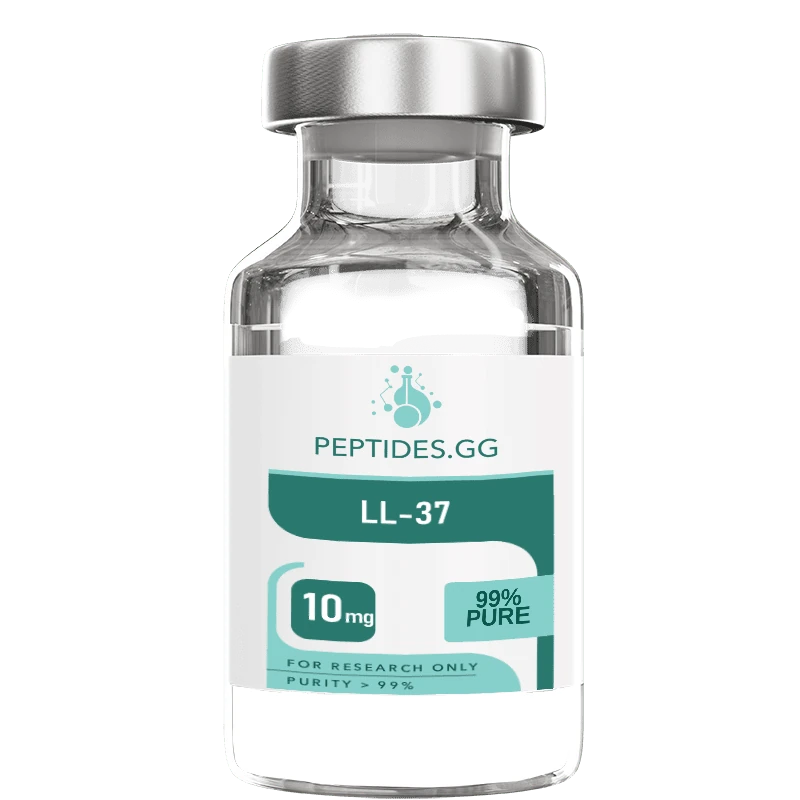
The LL-37 peptide is a synthetic 37-amino-acid sequence supplied as a lyophilized research chemical for in vitro laboratory investigation. Third-party lab tested for purity.
Peptides.GG is a chemical supplier and is not a compounding pharmacy under 503A or 503B. Statements have not been evaluated by the US FDA. Products are not intended to diagnose, treat, cure, or prevent any disease. For research use only — not for human consumption.
LL-37 Peptide
$80.00 – $150.00
- Free Delivery on all orders over $200
- Earn 5% Store Credit with Every Order
- Same Day Shipping Before 1 PM PST
14-day money-back guarantee
Not satisfied? Return any unopened product within 14 days of delivery for a full refund — we send the return label.

The LL-37 peptide is a synthetic 37-amino-acid sequence supplied as a lyophilized research chemical for in vitro laboratory investigation. Third-party lab tested for purity.
Peptides.GG is a chemical supplier and is not a compounding pharmacy under 503A or 503B. Statements have not been evaluated by the US FDA. Products are not intended to diagnose, treat, cure, or prevent any disease. For research use only — not for human consumption.
Frequently Asked Questions About LL-37
What is LL-37?
LL-37 is a synthetic 37-amino-acid peptide corresponding to the biologically active C-terminal fragment of human cathelicidin (hCAP-18), the only cathelicidin found in humans. It is released from the hCAP-18 precursor through proteolytic cleavage by proteinase-3 and is studied as a research tool for innate-immunity and antimicrobial-peptide biology. It is supplied strictly as a research compound for laboratory use and is not for human consumption.
What is the molecular profile of LL-37?
LL-37 is a cationic peptide with molecular formula C₂₀₅H₃₄₀N₆₀O₅₃, a molecular weight of 4,493.34 Da, and CAS registry number 154947-66-7. Its 37-residue sequence (LLGDFFRKSKEK-IGKEFKRIVQRIKDFLRNLVPRTES) folds into an amphipathic α-helix in membrane-mimetic environments, creating separate hydrophobic and cationic faces; multiple lysine and arginine residues give a net positive charge of about +6 at physiological pH. It is supplied as a white to off-white lyophilized powder soluble in water, PBS, and physiological buffers.
What is LL-37 studied for in laboratory research?
In preclinical and in vitro research, LL-37 is used as a tool across several areas: antimicrobial-mechanism studies against gram-positive and gram-negative bacteria and fungi, innate-immunity and host-defense investigations (neutrophil, monocyte, and mast-cell chemotaxis), inflammatory-signaling research, and tissue-repair and angiogenesis models. Typical protocols include minimum-inhibitory-concentration assays, membrane-permeabilization studies, leukocyte-migration assays, and scratch and wound-closure models. Supplied for laboratory research use only; not for human consumption.
How does LL-37 act in research models?
Reported research mechanisms include direct interaction with microbial membranes through electrostatic attraction to negatively charged surfaces followed by membrane disruption and pore formation, as well as receptor-mediated effects on host cells — chemotaxis through formyl peptide receptor-like 1 (FPRL1) and migration and angiogenesis signaling through EGFR and VEGFR2 transactivation. Its amphipathic α-helical structure is central to these membrane interactions. These mechanisms are investigated in cell-culture and animal models, not in humans.
What forms does LL-37 come in, and how is it stored?
LL-37 is offered as a lyophilized powder and, in some research formats, as a solution, supporting different in vitro protocols. The lyophilized powder is kept sealed and desiccated at -20°C to -80°C, protected from repeated temperature fluctuations, with stability data available for 12+ months at -20°C. Because its activity in membrane assays is sensitive to ionic strength, researchers often account for salt concentration when designing experiments.
What purity is LL-37, and is it third-party tested?
Each batch of LL-37 is verified at ≥99% purity by reversed-phase HPLC (UV detection at 220 nm), with identity confirmed by electrospray-ionization mass spectrometry against its 4,493.34 Da molecular weight and by amino-acid analysis. Contaminant testing covers bacterial endotoxin (<5 EU/mg by LAL), heavy metals, residual solvents, and water content by Karl Fischer titration. A Certificate of Analysis accompanies each batch, with third-party analytical verification available on request.
Research References
Peer-reviewed studies and database records underpinning the research described on this page. Links open on PubMed, PubMed Central, or the publisher in a new tab.
- Vandamme D, et al. A comprehensive summary of LL-37, the factotum human cathelicidin peptide. Cell Immunol. 2012. PMID: 23246832 →
- Turner J, et al. Activities of LL-37, a cathelin-associated antimicrobial peptide of human neutrophils. Antimicrob Agents Chemother. 1998. PMID: 9736536 →
- Bals R, et al. The peptide antibiotic LL-37/hCAP-18 is expressed in epithelia of the human lung where it has broad antimicrobial activity at the airway surface. Proc Natl Acad Sci U S A. 1998. PMID: 9689116 →
- Henzler Wildman KA, et al. Mechanism of lipid bilayer disruption by the human antimicrobial peptide, LL-37. Biochemistry. 2003. PMID: 12767238 →
- Porcelli F, et al. NMR structure of the cathelicidin-derived human antimicrobial peptide LL-37 in dodecylphosphocholine micelles. Biochemistry. 2008. PMID: 18439024 →
- Yang D, et al. LL-37, the neutrophil granule- and epithelial cell-derived cathelicidin, utilizes formyl peptide receptor-like 1 (FPRL1) as a receptor to chemoattract human peripheral blood neutrophils, monocytes, and T cells. J Exp Med. 2000. PMID: 11015447 →
- Mookherjee N, et al. Modulation of the TLR-mediated inflammatory response by the endogenous human host defense peptide LL-37. J Immunol. 2006. PMID: 16456005 →
- Tokumaru S, et al. Induction of keratinocyte migration via transactivation of the epidermal growth factor receptor by the antimicrobial peptide LL-37. J Immunol. 2005. PMID: 16177113 →
- Koczulla R, et al. An angiogenic role for the human peptide antibiotic LL-37/hCAP-18. J Clin Invest. 2003. PMID: 12782669 →
- Barlow PG, et al. Antiviral activity and increased host defense against influenza infection elicited by the human cathelicidin LL-37. PLoS One. 2011. PMID: 22031815 →
Related products
-

BPC-157 + TB-500 Blend
$80.00 – $140.00 Select options This product has multiple variants. The options may be chosen on the product pageSize: BPC-157 5mg / TB-500 5mg, BPC-157 10mg / TB-500 10mg
-
KLOW Blend GHK-CU/BPC-157/TB-500/KPV
$120.00 Select options This product has multiple variants. The options may be chosen on the product pageSize: 80mg
-
GLOW(ghk-cu+bpc157+tb500) Blend
$110.00 Select options This product has multiple variants. The options may be chosen on the product pageSize: 70mg
Research Overview
The LL-37 peptide serves as a valuable research tool for investigating innate immune defense mechanisms and antimicrobial peptide biology. This synthetic peptide represents the biologically active C-terminal fragment of human cathelicidin antimicrobial peptide (hCAP-18), released through proteolytic cleavage by proteinase-3. Research applications span antimicrobial activity studies, immune modulation investigations, wound healing research, and host-pathogen interaction studies.
The peptide’s designation LL-37 reflects its composition: beginning with two leucine residues (LL) and consisting of 37 amino acids. LL-37 represents the sole member of the cathelicidin family in humans, distinguished from multiple cathelicidins found in other mammalian species. The peptide plays crucial roles in innate immunity as a first-line defense against microbial pathogens while simultaneously modulating adaptive immune responses.
LL-37 research has contributed significantly to understanding antimicrobial peptide mechanisms, innate immunity pathways, and the bridge between innate and adaptive immune systems. The peptide’s multifunctional properties make it valuable for investigating host defense mechanisms beyond direct antimicrobial activity, including inflammation modulation, angiogenesis, and tissue repair. Immune modulation research also employs Thymosin Alpha-1, a thymic peptide that activates dendritic cells and modulates adaptive immunity through complementary pathways.
Molecular Characteristics
Complete Specifications:
- CAS Registry Number: 154947-66-7
- Molecular Weight: 4,493.34 Da
- Molecular Formula: C₂₀₅H₃₄₀N₆₀O₅₃
- Amino Acid Sequence: LLGDFFRKSKEK-IGKEFKRIVQRIKDFLRNLVPRTES
- Structure: Amphipathic α-helix
- Peptide Classification: Cationic antimicrobial peptide, cathelicidin
- Appearance: White to off-white lyophilized powder
- Solubility: Water, PBS, physiological buffers
The peptide’s 37-amino acid sequence adopts an amphipathic α-helical conformation in membrane-mimetic environments. This structural organization creates distinct hydrophobic and cationic faces enabling membrane interaction and disruption. The sequence contains multiple positively charged residues (lysine, arginine) providing net positive charge (+6 at physiological pH), crucial for electrostatic interaction with negatively charged bacterial membranes.
Antimicrobial and Immunomodulatory Mechanisms
LL-37 demonstrates multiple mechanisms of action:
Direct Antimicrobial Activity:
- Membrane disruption through electrostatic interaction and pore formation
- Broad-spectrum activity against gram-positive and gram-negative bacteria
- Antifungal activity against Candida species and other fungi
- Antiviral effects through envelope disruption and immune modulation
- Biofilm disruption and prevention
Immunomodulatory Functions:
- Chemotactic activity for neutrophils, monocytes, T cells, and mast cells
- Cytokine and chemokine production modulation
- Dendritic cell maturation and antigen presentation regulation
- Inflammatory response balancing (pro- and anti-inflammatory effects)
- Autophagy induction in macrophages
Tissue Repair and Regeneration:
- Angiogenesis promotion through VEGF receptor transactivation
- Keratinocyte and fibroblast migration stimulation
- Wound closure acceleration
- Extracellular matrix remodeling
- Re-epithelialization promotion
Research Applications
Antimicrobial Activity Studies
LL-37 serves as a primary research tool for investigating antimicrobial peptide mechanisms:
- Bacterial Pathogen Research: Investigation of antibacterial activity against diverse gram-positive (S. aureus, MRSA, Streptococcus) and gram-negative (E. coli, P. aeruginosa, K. pneumoniae) bacteria
- Mechanism of Action Studies: Research on membrane disruption, pore formation, intracellular targeting, and bacterial killing kinetics
- Antibiotic Resistance Research: Investigation of activity against antibiotic-resistant strains and mechanisms preventing resistance development
- Biofilm Studies: Examination of biofilm disruption, prevention, and penetration capabilities
- Minimum Inhibitory Concentration: Determination of MIC/MBC values against various pathogens
Research protocols employ bacterial culture assays, membrane permeabilization studies, scanning electron microscopy, and time-kill kinetics experiments.
Innate Immunity and Host Defense Research
LL-37 enables investigation of innate immune mechanisms:
- Pattern Recognition: Research on LL-37 release triggers, including PAMPs and DAMPs recognition
- Neutrophil Function: Studies on neutrophil chemotaxis, activation, and antimicrobial function
- Monocyte/Macrophage Research: Investigation of monocyte recruitment, macrophage polarization, and phagocytic function
- Mast Cell Studies: Research on mast cell degranulation, histamine release, and inflammatory mediator production
- Complement System Interactions: Examination of complement pathway modulation and antimicrobial synergy
Laboratory models include leukocyte migration assays, phagocytosis assays, cytokine measurements, and in vivo infection models.
Wound Healing and Tissue Repair Studies
LL-37 research extends to tissue repair mechanisms:
- Keratinocyte Migration: Investigation of re-epithelialization mechanisms and epithelial cell migration
- Fibroblast Function: Research on fibroblast migration, proliferation, and collagen synthesis
- Angiogenesis Studies: Examination of blood vessel formation through VEGFR2 transactivation and EGFR signaling
- Wound Healing Models: Studies in acute wounds, chronic wounds, and diabetic wound healing models
- Extracellular Matrix Remodeling: Investigation of matrix metalloproteinase modulation and ECM reorganization
Research protocols utilize scratch assays, wound healing animal models, tube formation assays, and histological analysis. Tissue repair research frequently compares LL-37’s wound healing effects with those of BPC-157, which promotes healing through growth factor modulation and angiogenesis pathways, and KPV, a melanocortin-derived anti-inflammatory tripeptide.
Inflammatory Response Modulation Research
LL-37 demonstrates complex immunomodulatory effects:
- Cytokine Regulation: Investigation of pro-inflammatory (IL-8, TNF-α) and anti-inflammatory (IL-10) cytokine modulation
- NF-κB Pathway Studies: Research on transcription factor activation and inflammatory gene expression
- Inflammasome Regulation: Examination of NLRP3 inflammasome modulation and IL-1β production
- Resolution of Inflammation: Studies on inflammation resolution mechanisms and anti-inflammatory effects
- Balance Effects: Research on context-dependent pro- or anti-inflammatory activities
Laboratory models include inflammatory cell cultures, cytokine assays, inflammasome activation studies, and inflammatory disease models. Anti-inflammatory research also investigates Thymulin, a zinc-dependent thymic peptide with distinct immunomodulatory properties affecting T-cell function and cytokine balance.
Viral and Fungal Pathogen Research
Beyond antibacterial activity, LL-37 demonstrates broader antimicrobial properties:
- Antiviral Mechanisms: Investigation of activity against enveloped viruses (influenza, HIV, HSV) and non-enveloped viruses
- Viral Entry Inhibition: Research on envelope disruption and receptor binding interference
- Antifungal Activity: Studies on activity against Candida species, dermatophytes, and other pathogenic fungi
- Fungal Cell Wall Interactions: Examination of chitin binding and cell wall disruption mechanisms
- Combination Studies: Investigation of synergistic effects with conventional antimicrobial agents
Research protocols employ viral infection models, plaque reduction assays, fungal growth inhibition studies, and mechanism-of-action investigations.
Laboratory Handling and Storage Protocols
Lyophilized Powder Storage:
- Store at -20°C to -80°C in original sealed vial
- Desiccated storage environment required
- Protect from repeated temperature fluctuations
- Stability data available for 12+ months at -20°C
Salt Sensitivity Considerations:
LL-37’s antimicrobial activity is sensitive to salt concentration. High ionic strength reduces electrostatic interactions with bacterial membranes, decreasing antimicrobial potency. Researchers should consider physiological salt concentrations when designing experiments and interpreting results.
Quality Assurance and Analytical Testing
The analytical methods below are those commonly used to characterize and verify the identity, purity, and quality of research compounds in this class:
Purity Analysis:
- High-Performance Liquid Chromatography (HPLC): ≥99% purity
- Analytical method: Reversed-phase HPLC with UV detection at 220nm
- Multiple peak integration to ensure accurate purity determination
Structural Verification:
- Electrospray Ionization Mass Spectrometry (ESI-MS): Confirms molecular weight 4,493.34 Da
- Amino acid analysis: Verifies sequence composition
- Peptide content determination: Quantifies actual peptide content by weight
Contaminant Testing:
- Bacterial endotoxin — Limulus amebocyte lysate (LAL) method
- Residual solvents: TFA and acetonitrile within acceptable limits
- Water content: Karl Fischer titration (<8%)
Functional Testing:
- Antimicrobial activity verification against control strains
- Confirmatory activity assays to ensure biological function
Documentation:
- Certificate of Analysis (COA) provided with each batch
- Third-party analytical verification available upon request
- Stability data documented for recommended storage conditions
- Batch-specific QC results traceable by lot number
Research Considerations
Experimental Design Factors:
Researchers should consider several factors when designing LL-37 experiments:
1. Salt Sensitivity: LL-37’s antimicrobial activity decreases with increasing ionic strength. Consider physiological salt concentrations and low-salt conditions for maximal activity assessment.
2. Concentration Selection: Antimicrobial assays typically use 0.5-50 μM LL-37. Cell culture studies for immunomodulation often use 1-10 μg/mL. Optimize concentrations for specific applications.
3. pH Considerations: LL-37 maintains activity across physiological pH range (6.5-7.5) but activity may vary with pH changes affecting charge state.
4. Serum Effects: Serum proteins may bind LL-37 and reduce activity. Consider serum-free or low-serum conditions for in vitro antimicrobial assays.
5. Structural Considerations: LL-37 requires amphipathic α-helical structure for membrane interaction. Organic solvents or denaturing conditions may affect activity.
Mechanism Investigation:
LL-37’s mechanisms involve multiple pathways:
- Direct membrane disruption (carpet model, toroidal pore formation)
- Intracellular targeting (DNA/RNA binding, enzyme inhibition)
- Chemotaxis through formyl peptide receptor-like 1 (FPRL1) and other receptors
- EGFR and VEGFR2 transactivation for cell migration and angiogenesis
- Inflammatory signaling modulation (NF-κB, MAPK pathways)
- Autophagy induction through receptor-mediated pathways
Compliance and Safety Information
Regulatory Status:
LL-37 is provided as a research chemical for in-vitro laboratory studies and preclinical research only. This product has not been approved by the FDA for human therapeutic use, diagnostic purposes, or medical applications.
Intended Use:
- In-vitro antimicrobial studies
- In-vivo preclinical research in approved animal models
- Laboratory investigation of innate immunity mechanisms
- Academic and institutional research applications
NOT Intended For:
- Human consumption or administration
- Therapeutic treatment of infections
- Diagnostic purposes
- Dietary supplementation
- Veterinary therapeutic applications without appropriate oversight
- Any medical applications
Safety Protocols:
Researchers should follow standard laboratory safety practices when handling LL-37:
- Use appropriate personal protective equipment
- Handle in well-ventilated areas
- Follow institutional biosafety guidelines for antimicrobial agent handling
- Dispose of waste according to local regulations
- Consult material safety data sheet (MSDS) for additional safety information
—