
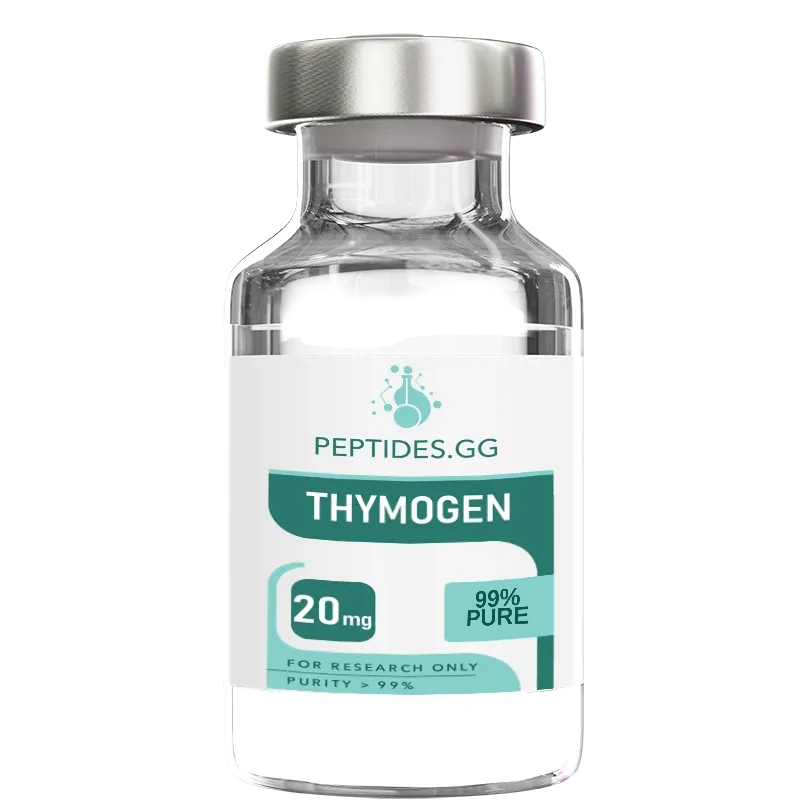
The Thymogen peptide serves as a research tool for investigating thymic peptide bioregulation and immune system modulation. This dipeptide (Glu-Trp) enables research into thymus-dependent immune function, T-cell maturation, and immunoregulatory mechanisms.
Research Disclaimer: Peptides.GG sells this and all other peptides for Research Only and not for human consumption.
Thymogen Peptide
$60.00
- Free Delivery on all orders over $200
- Earn 5% Store Credit with Every Order
- Same Day Shipping Before 1 PM PST
- 10% Discount for Cryptocurrency Payments
14-day money-back guarantee
If you are not satisfied with the product, simply return it and we will refund your money
The Thymogen peptide serves as a research tool for investigating thymic peptide bioregulation and immune system modulation. This dipeptide (Glu-Trp) enables research into thymus-dependent immune function, T-cell maturation, and immunoregulatory mechanisms.
Research Disclaimer: Peptides.GG sells this and all other peptides for Research Only and not for human consumption.
Frequently Asked Questions About Thymogen
What is Thymogen?
Thymogen is a synthetic dipeptide consisting of the amino acid sequence Glu-Trp (glutamyl-tryptophan), originally derived from thymopoietin, a naturally occurring thymic protein. As a thymic bioregulatory dipeptide, Thymogen represents one of the smallest biologically active fragments isolated from thymic tissue extracts and has become a significant subject of immunological research. Supplied for laboratory research use only; not for human consumption.
What is the amino acid sequence of Thymogen?
Thymogen has the amino acid sequence Glu-Trp (EW); L-glutamyl-L-tryptophan. Its molecular formula is C₁₆H₁₉N₃O₅ and its molecular weight is ~333 Da.
What is Thymogen studied for in research?
In preclinical and in vitro research, Thymogen is used as an immune bioregulator research tool to investigate thymic and immune tissue and related tissue-specific peptide-signaling pathways. Supplied for laboratory research use only; not for human consumption.
Why is Thymogen considered an immune bioregulator?
The Khavinson bioregulation hypothesis proposes that short, organ-specific peptides act as endogenous molecular messengers that influence tissue homeostasis through targeted gene-regulatory interactions. Thymogen is studied within this framework as an immune bioregulator — a research tool for investigating signaling in thymic and immune tissue.
What size is Thymogen available in?
Thymogen is supplied as a lyophilized (freeze-dried) powder in 20mg. The lyophilized format is preferred for research because it eliminates solution-phase degradation during storage and allows precise gravimetric preparation of research concentrations at the point of use.
How is Thymogen stored and handled in the laboratory?
Thymogen is supplied as white to off-white lyophilized powder. It is soluble in water and aqueous buffer systems; limited solubility in organic solvents. For research handling, the lyophilized powder is kept sealed, cold, and protected from light until use. Each batch is third-party tested and supplied with a certificate of analysis.
Related products
-

Ovagen
$60.00 Select options This product has multiple variants. The options may be chosen on the product pageSize: 20mg
-
Pancragen
$60.00 Select options This product has multiple variants. The options may be chosen on the product pageSize: 20mg
-
Chonluten
$50.00 Select options This product has multiple variants. The options may be chosen on the product pageSize: 20mg
Certificate of Analysis
Third-party tested · Independent analytical lab
| Tested | Measured | Purity |
|---|---|---|
| Jan 2026 | 25.32mg | 98.51% |
| Dec 2025 | 26.14mg | 99.01% |
Research Overview
The Thymogen peptide is a synthetic dipeptide consisting of the amino acid sequence Glu-Trp (glutamyl-tryptophan), originally derived from thymopoietin, a naturally occurring thymic protein. As a thymic bioregulatory dipeptide, Thymogen represents one of the smallest biologically active fragments isolated from thymic tissue extracts and has become a significant subject of immunological research. Its compact two-residue structure encodes a remarkable degree of biological specificity, making it a valuable research tool for studying how short peptide sequences mediate immune signaling cascades in preclinical models.
The compound’s primary research interest centers on its apparent role in thymic-dependent immune regulation. Laboratory studies have examined Thymogen’s influence on T-lymphocyte maturation pathways, thymocyte differentiation, and downstream cytokine expression patterns. Research utilizing Thymogen as a molecular probe has helped investigators understand the minimal structural requirements for thymic bioregulatory activity — an area of inquiry closely related to work involving Thymosin Alpha-1 and Thymulin, two other well-characterized thymic peptides used in immunological research. Together, these compounds form a complementary toolkit for dissecting the molecular architecture of thymic signaling.
Beyond immunological investigations, Thymogen has attracted attention in gene regulation research, with preclinical studies exploring its capacity to modulate transcription factor activity and influence gene expression profiles in lymphoid cell populations. Its dipeptide simplicity makes it an attractive candidate for structure-activity relationship (SAR) studies, where researchers can systematically evaluate how modifications to each residue alter biological activity. Related thymic bioregulatory compounds such as Crystagen serve as parallel reference points in these comparative investigations.
Molecular Characteristics
Complete Specifications:
- CAS Number: 38101-59-6 (Glu-Trp dipeptide)
- Molecular Weight: ~333 Da
- Molecular Formula: C₁₆H₁₉N₃O₅
- Sequence: Glu-Trp (EW); L-glutamyl-L-tryptophan
- Classification: Thymic bioregulatory dipeptide
- Appearance: White to off-white lyophilized powder
- Solubility: Soluble in water and aqueous buffer systems; limited solubility in organic solvents
The molecular architecture of Thymogen is defined by the pairing of glutamic acid and tryptophan — two residues with distinct physicochemical properties that together confer the compound’s biological activity. Glutamic acid contributes a negatively charged side chain at physiological pH, providing an electrostatic handle for receptor engagement, while tryptophan’s large aromatic indole ring system offers hydrophobic and pi-stacking interactions critical for binding specificity. This combination of polar and nonpolar characteristics gives Thymogen an amphiphilic character well suited to engagement with immunomodulatory receptor complexes at cell surfaces.
At approximately 333 Da, Thymogen falls well below the threshold for most passive membrane permeability barriers, a property that informs its rapid bioavailability profile observed in research models. The dipeptide backbone remains susceptible to peptidase cleavage, a factor researchers must account for when designing in vitro and in vivo experimental protocols. Comparative structural studies with other Glu-Trp-containing sequences have revealed that the free N-terminus and C-terminus are important determinants of receptor engagement, a finding with implications for the design of more protease-resistant analogs in future research programs.
Pharmacokinetic Profile in Research Models
Absorption and Distribution
- Rapid systemic distribution observed in rodent research models following parenteral administration
- Small molecular size facilitates penetration into lymphoid compartments including thymus and spleen in preclinical studies
- Plasma protein binding remains low relative to larger immunomodulatory peptides, supporting free peptide availability in tissue assays
- Research in murine models has demonstrated measurable uptake in bone marrow-derived cell populations
Bioactivity Dynamics
- T-lymphocyte population modulation in culture systems detectable within 24–72 hours of peptide exposure
- concentration-dependent effects on interleukin expression profiles documented in murine splenocyte assays
- Receptor-level interactions appear to operate through low-nanomolar affinity binding in competitive assay formats
- Observable downstream effects on CD4⁺/CD8⁺ T-cell ratios in thymus-based research models
Metabolic Considerations
- Subject to dipeptidase and aminopeptidase activity; half-life in plasma is relatively short, necessitating controlled experimental timing
- Metabolite products (free glutamate and tryptophan) are endogenous amino acids, simplifying metabolic clearance profiling
- Protease inhibitor co-administration has been explored in research settings to extend peptide half-life in complex biological matrices
- Renal filtration is the primary elimination pathway due to low molecular weight; urinary recovery studies support this route in rodent models
Research Applications
Thymic Function and T-Cell Maturation Research
- Investigation of thymocyte proliferation and differentiation stage progression in organotypic thymic cultures
- Studies examining positive and negative selection checkpoint modulation in murine thymic explant models
- Characterization of T-cell receptor (TCR) repertoire diversity in Thymogen-treated preclinical subjects
- Research into CD3⁺, CD4⁺, and CD8⁺ surface marker expression dynamics during lymphocyte development assays
Laboratory investigation into T-cell maturation represents the cornerstone application for Thymogen as a research tool. By providing a defined molecular signal derived from thymic tissue, researchers can interrogate the minimal informational requirements for thymic education of lymphoid progenitors, a question with broad implications for understanding immune ontogeny.
Immunosenescence and Age-Related Immune Decline Models
- Research utilizing aged rodent cohorts to examine thymic involution reversal mechanisms
- Longitudinal studies tracking naive T-cell output from thymus in Thymogen-exposed aged animal models
- Comparative cytokine profiling between young and senescent immune systems after peptide exposure
- Investigation of thymic epithelial cell reactivation in preclinical immunosenescence frameworks
The study of immunosenescence — age-associated decline of thymic function and peripheral immune competence — represents a growing area where Thymogen serves as a useful molecular probe. Research in aged animal models has explored whether thymic bioregulatory dipeptides can influence the pace or expression of immune aging phenotypes.
Gene Regulation and Transcriptomics Research
- RNA sequencing studies to identify differentially expressed genes in lymphoid cells after Thymogen exposure
- Transcription factor binding assays (ChIP-seq) examining NF-κB, NFAT, and AP-1 activity modulation
- Epigenetic profiling studies examining histone modification patterns in Thymogen-treated cell lines
- Research into microRNA expression networks downstream of dipeptide receptor signaling
Gene regulation studies utilizing Thymogen have revealed layers of transcriptional control not fully accounted for by classical immunological signaling models. These investigations benefit from the compound’s well-defined chemical identity, allowing researchers to attribute transcriptomic changes with confidence to the specific peptide intervention.
Innate Immune Interface Research
- Studies examining cross-talk between thymic peptide signals and innate immune cell populations including NK cells and macrophages
- Research comparing Thymogen activity profiles with those of LL-37, a cathelicidin-derived peptide with distinct innate immune research applications
- Dendritic cell maturation and antigen presentation assays in Thymogen-conditioned culture systems
- Pattern recognition receptor (PRR) pathway modulation studies in murine peritoneal macrophage preparations
The interface between thymic-derived signaling peptides and innate immunity remains an area of active investigation. Thymogen offers researchers a chemically defined probe for dissecting how adaptive immune priming signals from the thymus may crosstalk with innate immune programming.
Immune Modulation Comparative Research
- Head-to-head preclinical comparisons between Thymogen, Thymosin Alpha-1, and Thymulin activity profiles in standardized assay systems
- SAR studies evaluating modified EW analogs (D-amino acid substitutions, N-methylation) for altered receptor selectivity
- Research using KPV as a comparator compound for anti-inflammatory peptide signaling mechanisms in parallel immune assay designs
- Synergy and antagonism studies co-administering Thymogen with other thymic fractions in in vitro lymphocyte culture models
Comparative immunology research utilizing Thymogen alongside other well-characterized thymic peptides enables mechanistic disambiguation — allowing investigators to assign specific biological effects to specific structural features rather than to general thymic extract activity.
Laboratory Handling and Storage Protocols
Lyophilized Storage
- Store lyophilized Thymogen at −20°C in sealed, desiccated conditions to prevent moisture uptake and degradation
- Protect from UV and ambient light exposure; store in amber vials or foil-wrapped containers where possible
- Allow vials to equilibrate to room temperature before opening to prevent condensation-related hydrolysis of the peptide
- Lyophilized material is stable for up to 24 months under recommended storage conditions when kept unopened
Quality Assurance and Analytical Testing
The analytical methods below are those commonly used to characterize and verify the identity, purity, and quality of research compounds in this class:
- Purity Analysis (HPLC): Thymogen is verified at ≥99% purity by reverse-phase high-performance liquid chromatography (RP-HPLC), ensuring minimal presence of truncated sequences, deletion peptides, or synthesis byproducts
- Structural Verification (ESI-MS): Electrospray ionization mass spectrometry confirms the correct molecular ion at the expected m/z value, verifying both molecular weight and sequence integrity for the Glu-Trp dipeptide
- Amino Acid Analysis: Compositional analysis confirms a 1:1 molar ratio of glutamic acid to tryptophan, ensuring sequence fidelity at the residue level
- Residual Solvent Testing: Gas chromatography screening confirms residual solvent levels comply with ICH Q3C guidelines for research-grade material
- Certificate of Analysis: Full COA documentation including HPLC chromatogram, MS spectrum, and lot-specific purity data is available upon request for each batch
Research Considerations
Investigators planning experiments with Thymogen should address the following experimental design factors:
- Peptidase Sensitivity: Because Thymogen is a dipeptide, serum-containing media and in vivo biological matrices will rapidly degrade the compound. Researchers should validate peptide stability in their specific experimental system using HPLC time-course assays before conducting concentration-response studies.
- Concentration Selection: Research literature spans a wide concentration range; pilot concentration-ranging experiments are necessary to establish biologically meaningful concentrations within each specific assay system and cell type.
- Model Selection: Thymic bioregulatory peptide effects may differ substantially between species. Assay results in rodent models may not translate linearly to larger mammalian systems, requiring independent validation across model organisms.
- Positive Controls: Include established thymic peptide reference compounds (e.g., Thymosin Alpha-1, Thymulin) as positive controls to enable inter-assay normalization and cross-study comparability.
- Tryptophan Oxidation Monitoring: The indole ring of tryptophan is susceptible to oxidative degradation. Research teams should include oxidation status monitoring (e.g., measurement of kynurenine as an oxidation product) when extended incubations are employed.
Mechanism investigation priorities for ongoing Thymogen research include:
- Identification and characterization of the specific receptor or binding protein mediating Thymogen’s biological activity in lymphoid cells
- Delineation of intracellular signaling cascades (kinase activation, second messenger generation) following receptor engagement
- Clarification of whether tryptophan metabolism to indole derivatives contributes to observed immunomodulatory effects
- Investigation of potential synergistic interactions between Thymogen and cytokine receptor signaling networks in T-cell progenitor populations
Compliance and Safety Information
- Regulatory Status: Thymogen is supplied exclusively as a research chemical for in vitro and preclinical in vivo laboratory investigation. It is not approved by any regulatory authority for use in humans or as a veterinary pharmaceutical.
- Intended Use: This compound is intended solely for use by qualified researchers in licensed laboratory settings. All research applications must comply with applicable institutional biosafety protocols and local regulatory requirements.
- NOT Intended For: Human consumption, self-administration, veterinary use, or any application outside a controlled laboratory environment. This product is not a drug, supplement, or food additive.
- Safety Protocols: Handle in accordance with standard laboratory safety procedures. Consult the Safety Data Sheet (SDS) prior to use. Appropriate personal protective equipment (PPE) including gloves and eye protection should be worn during handling.
- Disposal: Dispose of unused material and solutions in accordance with institutional chemical waste management protocols and local environmental regulations.