
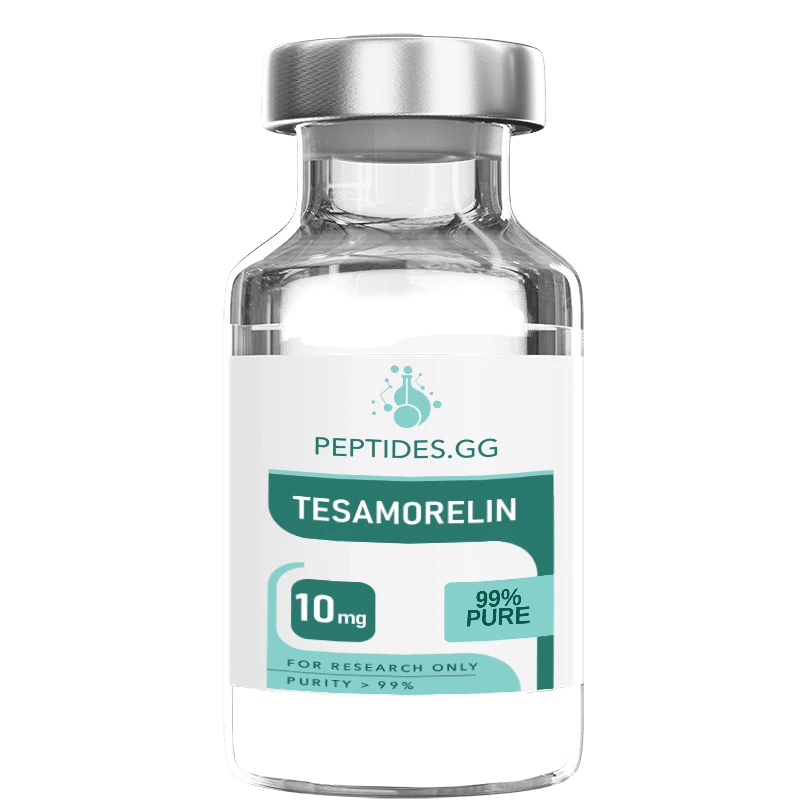
The Tesamorelin peptide serves as a valuable research tool for investigating growth hormone releasing hormone receptor signaling and lipodystrophy-related metabolic pathways in laboratory settings.
Research Disclaimer: Peptides.GG sells this and all other peptides for Research Only and not for human consumption.
Tesamorelin Peptide
$68.00 – $130.00
- Free Delivery on all orders over $200
- Earn 5% Store Credit with Every Order
- Same Day Shipping Before 1 PM PST
- 10% Discount for Cryptocurrency Payments
14-day money-back guarantee
If you are not satisfied with the product, simply return it and we will refund your money

The Tesamorelin peptide serves as a valuable research tool for investigating growth hormone releasing hormone receptor signaling and lipodystrophy-related metabolic pathways in laboratory settings.
Research Disclaimer: Peptides.GG sells this and all other peptides for Research Only and not for human consumption.
Frequently Asked Questions About Tesamorelin
What is Tesamorelin?
Tesamorelin is a synthetic, stabilized analog of growth hormone-releasing hormone (GHRH) that retains the complete 44-amino acid sequence of native human GHRH(1-44) with an N-terminal trans-3-hexenoyl modification added for metabolic stability. It is classified as an N-acylated synthetic GHRH analog and is studied as a research tool for GHRH-receptor signaling and related metabolic pathways. It is supplied strictly as a research compound for laboratory use and is not for human consumption.
What is the amino acid sequence of Tesamorelin?
Tesamorelin comprises the full 44 amino acids of human GHRH(1-44) with a trans-3-hexenoyl group attached to the N-terminal tyrosine residue. Its molecular formula is C₂₂₁H₃₆₆N₇₂O₆₇S, its molecular weight is 5,135.89 Da, and its CAS registry number is 218949-48-5. The N-terminal acylation protects the Ala-Asp dipeptide at positions 2-3 from dipeptidyl peptidase-IV (DPP-IV) cleavage, the primary degradation pathway of native GHRH.
What is Tesamorelin studied for in research?
In preclinical and in vitro research, Tesamorelin is used to investigate GHRH-receptor signaling and pituitary GH release, lipid metabolism and adipose-tissue biology (including visceral-fat mobilization mechanisms), body-composition remodeling, and the GH/IGF-1 anabolic axis. Its extended stability supports once-daily administration models examining sustained GH-axis stimulation. Supplied for laboratory research use only; not for human consumption.
What makes Tesamorelin more stable than native GHRH?
Native GHRH has an extremely short plasma half-life of about 7-10 minutes because DPP-IV rapidly cleaves its N-terminus. Tesamorelin's trans-3-hexenoyl group on the N-terminal tyrosine shields the critical Ala-Asp dipeptide from that cleavage, extending the reported plasma half-life to roughly 26-38 minutes while preserving full GHRH-receptor binding. Unlike CJC-1295, which modifies internal amino acids, Tesamorelin keeps the complete native GHRH sequence intact and adds only the protective N-terminal group.
What size is Tesamorelin available in?
Tesamorelin is supplied as a lyophilized (freeze-dried) powder in 10 mg and 20 mg sizes. The lyophilized format limits solution-phase degradation during storage and allows precise gravimetric preparation of research concentrations at the point of use.
How is Tesamorelin stored and handled in the laboratory?
Tesamorelin is a white to off-white lyophilized powder soluble in water, bacteriostatic water, and phosphate-buffered saline. The lyophilized powder is kept sealed, desiccated, and cold (-20°C to -80°C) until use; its N-terminal acylation gives it good stability in lyophilized form. Each batch is third-party tested with a Certificate of Analysis.
Related products
-

Ipamorelin CJC-1295 Blend
$75.00 – $150.00 Select options This product has multiple variants. The options may be chosen on the product pageSize: CJC-1295 5mg / Ipamorelin 5mg, CJC-1295 10mg / Ipamorelin 10mg
-
Hexarelin
$40.00 Select options This product has multiple variants. The options may be chosen on the product pageSize: 5mg
-
GHRP-6
$20.00 – $37.00 Select options This product has multiple variants. The options may be chosen on the product pageSize: 5mg, 10mg
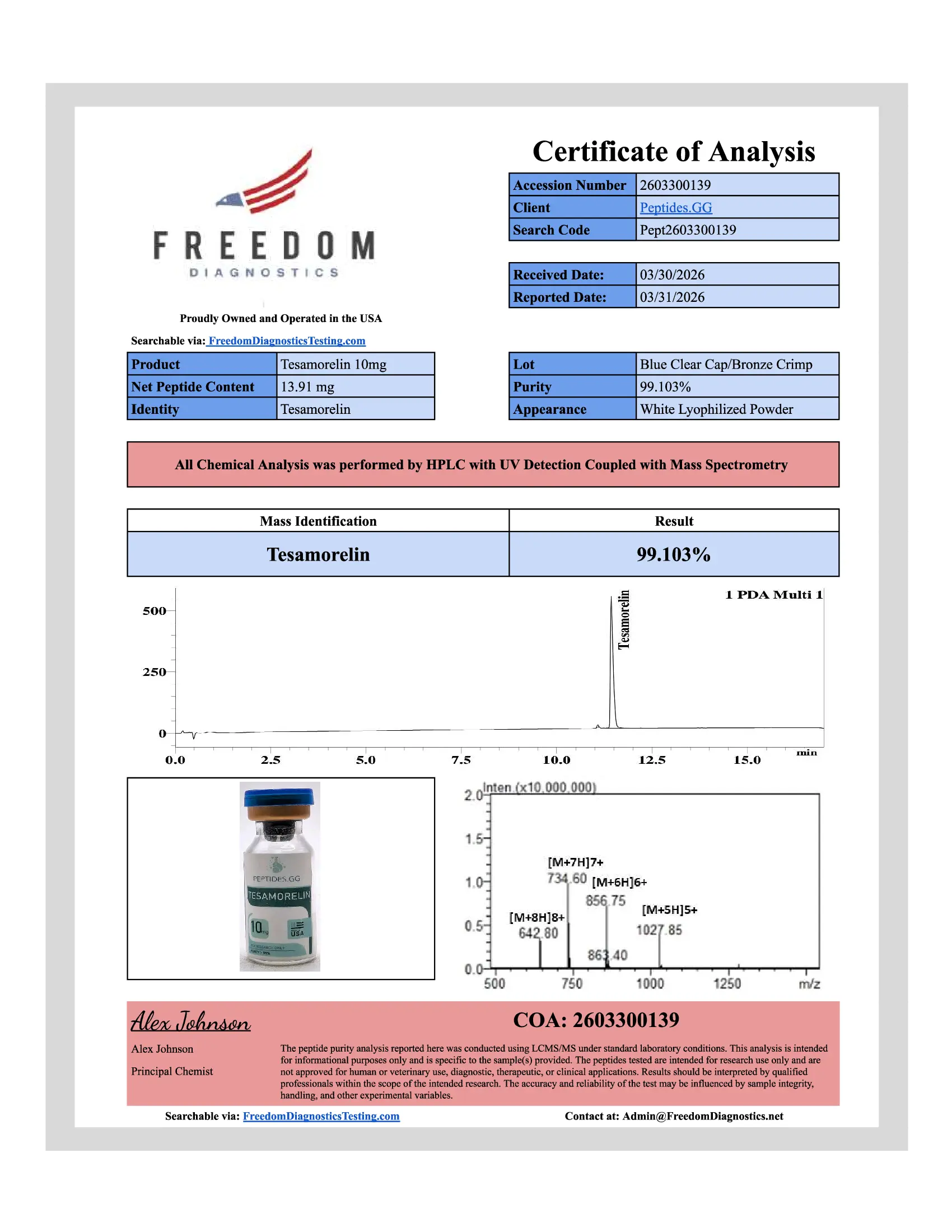
Certificate of Analysis
Third-party tested · Independent analytical lab
| Tested | Measured | Purity |
|---|---|---|
| Jul 2026 | 23.57mg | 99.36% |
| Jun 2026 | 20.99mg | 99.20% |
| Jun 2026 | 22.01mg | 98.55% |
| May 2026 | 22.21mg | 99.01% |
| May 2026 | 22.53mg | 99.48% |
| Apr 2026 | 21.81mg | 99.51% |
| Apr 2026 | 23.30mg | 99.85% |
| Apr 2026 | 22.40mg | 99.65% |
| Feb 2026 | 23.57mg | 99.33% |
| Jan 2026 | 21.84mg | 99.71% |
Latest safety testing
- Sterility
- TAMC/TYMC Jul 2026
| Tested | Measured | Purity |
|---|---|---|
| Jul 2026 | 11.12mg | 98.76% |
| Jul 2026 | 11.56mg | 99.17% |
| Jul 2026 | 11.62mg | 98.88% |
| Jun 2026 | 11.32mg | 98.08% |
| Jun 2026 | 11.65mg | 99.01% |
| May 2026 | 12.06mg | 98.72% |
| May 2026 | 11.80mg | 99.02% |
| May 2026 | 11.89mg | 99.00% |
| May 2026 | 11.72mg | 99.35% |
| Apr 2026 | 11.60mg | 99.68% |
Endotoxin, sterility, and heavy-metals reports are run on individual lots on a rotating basis, separate from the identity/purity assay above — not on every lot.
Research Overview
The Tesamorelin peptide serves as a valuable research tool for investigating growth hormone releasing hormone receptor signaling and lipodystrophy-related metabolic pathways in laboratory settings. This stabilized GHRH analog maintains the complete 44-amino acid sequence of native human GHRH while incorporating an N-terminal trans-3-hexenoic acid modification that dramatically enhances metabolic stability. Downstream growth factor research utilizes IGF-1 LR3, which bypasses GH-mediated signaling to directly activate IGF-I receptors in target tissues. Research applications have expanded to encompass investigations of visceral adipose tissue regulation, lipid metabolism, body composition remodeling, and long-term GH/IGF-1 axis modulation. GH axis research employs multiple stimulation approaches including GHSR agonists like Ipamorelin and the native GHRH sequence analog Sermorelin, enabling comparative pharmacological studies of pituitary GH release mechanisms.
The peptide’s development addressed the extremely short half-life of native GHRH (7-10 minutes) which limits research applications. The strategic N-terminal acylation protects against dipeptidyl peptidase-IV (DPP-IV) cleavage, the primary enzymatic pathway for GHRH degradation. Unlike CJC-1295 which modifies internal amino acids, Tesamorelin’s approach preserves the complete native GHRH sequence while adding a protective group. Laboratory studies investigate Tesamorelin’s effects on sustained GH pulsatility, regional fat distribution, metabolic parameters, and IGF-1 production dynamics.
Tesamorelin research benefits from its established medical use, providing extensive safety data and clinically validated biological activity that informs research protocol design. The peptide demonstrates sustained GH elevation effects on visceral adipose tissue reduction and metabolic improvement in various experimental contexts. Studies examine these effects in cell culture systems, tissue explants, and preclinical animal models with particular focus on lipid metabolism and body composition outcomes.
Molecular Characteristics
Complete Specifications:
- CAS Registry Number: 218949-48-5
- Molecular Weight: 5,135.89 Da
- Molecular Formula: C₂₂₁H₃₆₆N₇₂O₆₇S
- Sequence Length: 44 amino acids (full GHRH sequence) + trans-3-hexenoyl modification
- Peptide Classification: Synthetic GHRH analog, N-acylated
- Appearance: White to off-white lyophilized powder
- Solubility: Water, bacteriostatic water, phosphate buffered saline
The peptide’s 44-amino acid structure represents the complete human GHRH(1-44) sequence with trans-3-hexenoic acid attached to the N-terminal tyrosine residue. This acylation protects the critical Ala-Asp dipeptide at positions 2-3 from DPP-IV cleavage, the primary degradation pathway for native GHRH. The modification extends half-life while maintaining full biological activity through preserved GHRH receptor binding. Unlike shorter GHRH analogs (1-29), Tesamorelin includes the full sequence though residues 30-44 are not required for receptor activation, potentially influencing stability or tissue distribution.
Pharmacokinetic Profile in Research Models
Tesamorelin pharmacokinetic characterization in preclinical and clinical research reveals important properties for experimental design:
Absorption and Half-Life:
- Plasma half-life: 26-38 minutes (significantly extended versus native GHRH’s 7-10 minutes)
- Subcutaneous bioavailability established in multiple studies
- Sufficient duration for sustained physiological GH pulsatility
- Daily administration enables investigation of chronic GH axis stimulation effects
GH Stimulation Dynamics:
- Sustained GH pulsatility enhancement rather than pharmacological elevation
- Preservation of physiological GH secretion patterns
- Peak GH levels occur within 60-120 minutes post-administration
- Effects on GH persist several hours enabling once-daily research protocols
- Minimal receptor desensitization with consistent daily administration
IGF-1 and Metabolic Effects:
- Cumulative IGF-1 elevation with repeated administration (steady-state achieved over weeks)
- Visceral adipose tissue preferential reduction observed
- Metabolic improvements in lipid parameters
- Long-term effects require weeks to months for full manifestation
These pharmacokinetic characteristics inform research protocol design for studies examining sustained GH axis modulation effects, particularly in metabolic and body composition investigations requiring extended treatment periods.
Research Applications
Lipid Metabolism and Adipose Tissue Research
Tesamorelin serves as a research tool for investigating GH effects on lipid metabolism. Laboratory studies examine the peptide’s effects on:
- Visceral Fat Reduction Studies: Investigation of GH-mediated visceral adipose tissue mobilization and reduction mechanisms
- Lipolysis Pathway Research: Studies on hormone-sensitive lipase activation and adipose tissue lipolysis signaling
- Regional Fat Distribution: Research on differential effects between visceral and subcutaneous adipose depots
- Adipocyte Biology Studies: Investigation of adipocyte size, function, and metabolic characteristics
- Lipid Profile Research: Studies on triglyceride, cholesterol, and lipoprotein metabolism
Research protocols typically employ body composition imaging (MRI, CT), adipose tissue biopsies, and metabolic assessment in models of lipodystrophy or metabolic dysfunction.
Body Composition Remodeling Research
Substantial research focuses on comprehensive body composition investigation:
- Visceral to Subcutaneous Fat Ratio: Studies examining preferential visceral fat reduction
- Lean Mass Preservation: Research on maintaining or increasing muscle mass during fat reduction
- Trunk Fat Distribution: Investigation of abdominal and thoracic adipose tissue changes
- Metabolic Health Correlations: Studies relating body composition changes to metabolic improvements
- Long-Term Remodeling: Research on sustained body composition alterations with chronic treatment
Laboratory protocols investigate body composition changes using advanced imaging techniques and serial measurements over extended research periods (weeks to months).
IGF-1 Axis and Anabolic Pathway Investigation
Laboratory studies investigate Tesamorelin in IGF-1 research:
- Hepatic IGF-1 Production: Research on GH-stimulated IGF-1 synthesis and secretion dynamics
- IGF-1 Bioavailability Studies: Investigation of free versus bound IGF-1 and binding protein regulation
- Anabolic Signaling Pathways: Studies on IGF-1 receptor activation and downstream signaling cascades
- Tissue-Specific IGF-1 Effects: Research on IGF-1 actions in muscle, adipose, and other tissues
- GH/IGF-1 Feedback Regulation: Investigation of feedback mechanisms during sustained GH elevation
Experimental models include hepatocyte cultures for IGF-1 production studies and various tissues for IGF-1 receptor signaling investigation.
Metabolic Syndrome Research Applications
Research applications extend to metabolic dysfunction investigation:
- Insulin Sensitivity Studies: Examination of GH effects on glucose metabolism and insulin action
- Glucose Tolerance Research: Investigation of glucose handling and pancreatic beta cell function
- Lipid Metabolism Studies: Research on lipid oxidation, synthesis, and storage pathways
- Inflammatory Marker Investigation: Studies on adipose tissue inflammation and cytokine production
- Metabolic Flexibility Research: Investigation of substrate utilization and metabolic adaptation
Laboratory protocols investigate metabolic effects using glucose tolerance tests, euglycemic clamps, and metabolic tracer studies in animal models.
Aging and Metabolic Aging Research
Emerging research areas include age-related metabolic decline investigation:
- Age-Related Fat Accumulation: Research on mechanisms of visceral fat increase with aging
- GH Decline and Metabolic Health: Studies examining relationships between GH status and metabolic function
- Sarcopenic Obesity Research: Investigation of simultaneous muscle loss and fat gain in aging
- Metabolic Health Restoration: Studies on reversing age-related metabolic changes
- Long-Term Safety Research: Investigation of chronic GH axis stimulation in aging models
Research in this area examines Tesamorelin’s effects in aged animal models and contexts of metabolic aging.
Laboratory Handling and Storage Protocols
Lyophilized Powder Storage:
- Store at -20°C to -80°C in original sealed vial
- Protect from light exposure and moisture
- Desiccated storage environment recommended
- Stability data available for 24+ months at -20°C
Stability Considerations:
Tesamorelin demonstrates good stability as a lyophilized powder. The N-terminal acylation confers enhanced stability compared to native GHRH.
Quality Assurance and Analytical Testing
The analytical methods below are those commonly used to characterize and verify the identity, purity, and quality of research compounds in this class:
Purity Analysis:
- High-Performance Liquid Chromatography (HPLC): ≥99% purity
- Analytical method: Reversed-phase HPLC with UV detection at 214nm
- Multiple peak integration to ensure accurate purity determination
Structural Verification:
- Electrospray Ionization Mass Spectrometry (ESI-MS): Confirms molecular weight 5,135.89 Da
- Amino acid analysis: Verifies sequence composition
- N-terminal modification verification
- Peptide content determination: Quantifies actual peptide content by weight
Contaminant Testing:
- Bacterial endotoxin — Limulus amebocyte lysate (LAL) method
- Residual solvents: TFA and acetonitrile within acceptable limits
- Water content: Karl Fischer titration (<8%)
Documentation:
- Certificate of Analysis (COA) provided with each batch
- Third-party analytical verification available upon request
- Stability data documented for recommended storage conditions
- Batch-specific QC results traceable by lot number
Research Considerations
Experimental Design Factors:
Researchers should consider several factors when designing Tesamorelin experiments:
1. Treatment Duration: Visceral fat reduction and metabolic effects require extended treatment (weeks to months). Plan experimental timelines accordingly.
2. Body Composition Assessment: Advanced imaging (MRI, CT) needed to distinguish visceral from subcutaneous fat changes.
3. Clinical Translation: Tesamorelin’s FDA approval provides clinically relevant administration and safety information useful for research protocol design.
4. Combination Studies: Often investigated with lipid-lowering agents, insulin sensitizers, or other metabolic interventions.
5. Metabolic Context: Effects most pronounced in contexts of visceral adiposity or metabolic dysfunction.
Mechanism Investigation:
Tesamorelin’s mechanisms are well-characterized:
- GHRH receptor activation via preserved native sequence
- Enhanced stability via N-terminal acylation protecting against DPP-IV
- Sustained physiological GH pulsatility rather than pharmacological elevation
- GH-mediated lipolysis particularly in visceral adipose tissue
- IGF-1 production with anabolic and metabolic effects
- Potential direct effects on adipose tissue metabolism
The peptide’s mechanisms are identical to native GHRH regarding receptor activation, with modifications solely affecting pharmacokinetics.
Compliance and Safety Information
Regulatory Status:
Tesamorelin is provided as a research chemical for in-vitro laboratory studies and preclinical research only. This product has not been approved by the FDA for human therapeutic use, dietary supplementation, or medical applications.
Intended Use:
- In-vitro cell culture studies
- In-vivo preclinical research in approved animal models
- Laboratory investigation of biological mechanisms
- Academic and institutional research applications
NOT Intended For:
- Human consumption or administration
- Therapeutic treatment or diagnosis
- Dietary supplementation
- Veterinary therapeutic applications without appropriate oversight
Safety Protocols:
Researchers should follow standard laboratory safety practices when handling Tesamorelin:
- Use appropriate personal protective equipment (lab coat, gloves, safety glasses)
- Handle in well-ventilated areas or fume hood
- Follow institutional biosafety guidelines
- Dispose of waste according to local regulations for biological/chemical waste
- Consult material safety data sheet (MSDS) for additional safety information
—