

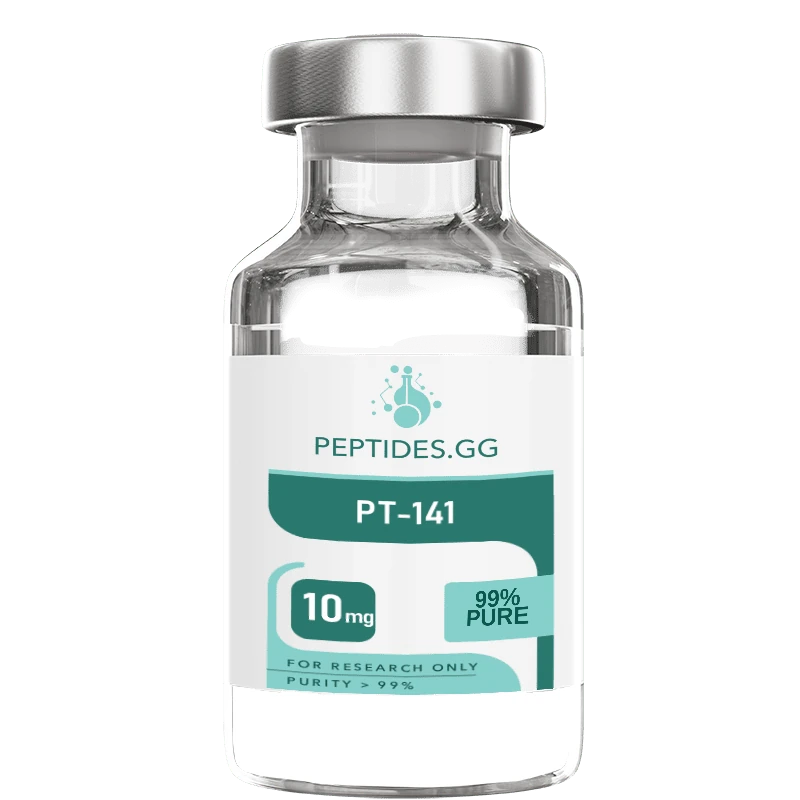
The PT-141 peptide (Bremelanotide) serves as a valuable research tool for investigating melanocortin receptor-mediated sexual function and reproductive pathways. This synthetic peptide represents a des-acetyl metabolite of Melanotan II, arising through enzymatic deacetylation.
Research Disclaimer: Peptides.GG sells this and all other peptides for Research Only and not for human consumption.
PT-141 Peptide (Bremelanotide)
$30.00
- Free Delivery on all orders over $200
- Earn 5% Store Credit with Every Order
- Same Day Shipping Before 1 PM PST
14-day money-back guarantee
Not satisfied? Return any unopened product within 14 days of delivery for a full refund — we send the return label.

The PT-141 peptide (Bremelanotide) serves as a valuable research tool for investigating melanocortin receptor-mediated sexual function and reproductive pathways. This synthetic peptide represents a des-acetyl metabolite of Melanotan II, arising through enzymatic deacetylation.
Research Disclaimer: Peptides.GG sells this and all other peptides for Research Only and not for human consumption.
Frequently Asked Questions About PT-141
What is PT-141?
PT-141 is a synthetic cyclic heptapeptide that acts as a melanocortin-receptor agonist, studied as a research tool for melanocortin-system pharmacology. It is the des-acetyl form of Melanotan II and is also known by the generic name bremelanotide (originally Palatin Technologies compound 141). It preferentially activates the MC3R and MC4R melanocortin-receptor subtypes. It is supplied strictly as a research compound for laboratory use and is not for human consumption.
What is the molecular profile of PT-141?
PT-141 is a cyclic heptapeptide with molecular formula C₅₀H₆₈N₁₄O₁₀, a molecular weight of 1,025.18 Da, and CAS registry number 189691-06-3. Its ring is formed by a lactam bridge between an aspartic-acid side chain and a lysine ε-amino group — the same constrained ring found in Melanotan II, from which PT-141 differs by lacking the N-terminal acetyl group. It is supplied as a white to off-white lyophilized powder soluble in water, bacteriostatic water, and phosphate-buffered saline, with purity verified by HPLC at ≥98%.
Is PT-141 the same as bremelanotide?
Yes. PT-141 is the research designation for the compound that later received the generic name bremelanotide; the two names refer to the same cyclic heptapeptide. The material supplied here is provided strictly as a research chemical for laboratory investigation — it is not the approved pharmaceutical product, not for human use, and not for self-administration.
How does PT-141 differ from Melanotan-2 (MT-2)?
PT-141 is the des-acetyl metabolite of Melanotan II (MT-2): it lacks MT-2's N-terminal acetyl group, which shifts its receptor profile toward preferential MC3R and MC4R activation with reduced MC1R activity, whereas MT-2 activates the melanocortin-receptor subtypes more broadly. This makes PT-141 a useful tool for studying MC3R/MC4R-specific pharmacology with less MC1R (pigmentation-pathway) involvement. Both are supplied strictly for laboratory research use and are not for human consumption.
What is PT-141 studied for in laboratory research?
In preclinical and in vitro research, PT-141 is used as a tool to investigate melanocortin-receptor pharmacology — receptor binding and selectivity, MC3R versus MC4R signaling, cAMP and MAPK transduction, and central melanocortin circuits in the hypothalamus (such as the paraventricular nucleus). Typical protocols include receptor-binding and functional-selectivity assays and comparative studies against MT-2 and selective melanocortin agonists. Supplied for laboratory research use only; not for human consumption.
What purity is PT-141, and how is it stored?
Each batch of PT-141 is verified at ≥99% purity by reversed-phase HPLC, with identity confirmed by electrospray-ionization mass spectrometry (against its 1,025.18 Da molecular weight) and verification of correct lactam-bridge cyclization; contaminant testing covers endotoxin (<5 EU/mg), heavy metals, residual solvents, and water content. Because the peptide is photosensitive, it is stored in amber or light-protected vials at -20°C to -80°C, sealed and desiccated, with stability data available for 12+ months at -20°C. A Certificate of Analysis is provided with each batch.
Research References
Peer-reviewed studies and database records underpinning the research described on this page. Links open on PubMed, PubMed Central, or the publisher in a new tab.
- Molinoff PB, et al. PT-141: a melanocortin agonist for the treatment of sexual dysfunction. Ann N Y Acad Sci. 2003. PMID: 12851303 →
- Haskell-Luevano C, et al. Discovery of prototype peptidomimetic agonists at the human melanocortin receptors MC1R and MC4R. J Med Chem. 1997. PMID: 9216831 →
- Van der Ploeg LH, et al. A role for the melanocortin 4 receptor in sexual function. Proc Natl Acad Sci U S A. 2002. PMID: 12172010 →
- Pfaus JG, et al. Selective facilitation of sexual solicitation in the female rat by a melanocortin receptor agonist. Proc Natl Acad Sci U S A. 2004. PMID: 15226502 →
- Trivedi P, et al. Exploring the site of anorectic action of peripherally administered synthetic melanocortin peptide MT-II in rats. Brain Res. 2003. PMID: 12834882 →
- Hadley ME, Dorr RT. Melanocortin peptide therapeutics: historical milestones, clinical studies and commercialization. Peptides. 2006. PMID: 16412534 →
Related products
-

Kisspeptin-10
$40.00 – $75.00 Select options This product has multiple variants. The options may be chosen on the product pageSize: 5mg, 10mg
-
Oxytocin
$50.00 Select options This product has multiple variants. The options may be chosen on the product pageSize: 10mg
-
Gonadorelin Acetate
$40.00 Select options This product has multiple variants. The options may be chosen on the product pageSize: 2mg
Certificate of Analysis
Third-party tested · Independent analytical lab
| Tested | Measured | Purity |
|---|---|---|
| Jun 2026 | 11.21mg | 99.02% |
| Jun 2026 | 11.58mg | 99.77% |
| May 2026 | 11.73mg | 99.71% |
| Mar 2026 | 13.62mg | 99.70% |
| Feb 2026 | 11.86mg | 99.86% |
| Jan 2026 | 10.03mg | 99.71% |
| Dec 2025 | 10.66mg | 99.73% |
| Nov 2025 | 10.71mg | 99.81% |
Research Overview
The PT-141 peptide (Bremelanotide) serves as a valuable research tool for investigating melanocortin receptor-mediated sexual function and reproductive pathways. This synthetic peptide represents a des-acetyl metabolite of Melanotan II, arising through enzymatic deacetylation. Research applications focus on understanding MC3R/MC4R receptor roles in sexual arousal, erectile function, reproductive behavior, and central melanocortin signaling with reduced pigmentation effects compared to broader-spectrum melanocortin agonists.
The peptide’s designation as PT-141 originates from its development as Palatin Technologies compound 141, later receiving the generic name bremelanotide. PT-141 demonstrates preferential activation of MC3R and MC4R over MC1R, distinguishing it from parent compound MT-2 which activates all melanocortin receptor subtypes. This selective receptor profile enables research into MC3R/MC4R-specific effects without confounding MC1R-mediated pigmentation.
PT-141 research has contributed significantly to understanding melanocortin system roles in sexual function, particularly central nervous system pathways involved in arousal, desire, and erectile function. The peptide’s ability to induce sexual arousal effects through central mechanisms rather than peripheral vascular mechanisms distinguishes it from other research approaches to sexual function investigation.
Molecular Characteristics
Complete Specifications:
- CAS Registry Number: 189691-06-3
- Molecular Weight: 1,025.18 Da
- Molecular Formula: C₅₀H₆₈N₁₄O₁₀
- Amino Acid Sequence: Ac-Nle-cyclo[Asp-His-D-Phe-Arg-Trp-Lys]-NH₂ (des-acetyl MT-2)
- PubChem CID: 9941957 (related to MT-2)
- Peptide Classification: Synthetic cyclic heptapeptide, selective MC3R/MC4R agonist
- Appearance: White to off-white lyophilized powder
- Solubility: Water, bacteriostatic water, phosphate buffered saline
The peptide’s cyclic structure forms through lactam bridge formation between the aspartic acid side chain and lysine epsilon-amino group, creating the same seven-membered ring as MT-2. PT-141 differs from MT-2 by lacking the N-terminal acetyl group, resulting from enzymatic deacetylation. This structural modification alters receptor selectivity profile, reducing MC1R activation while maintaining MC3R/MC4R agonist activity.
Pharmacokinetic Profile in Research Models
PT-141 pharmacokinetic characterization in preclinical research reveals important properties for experimental design:
Absorption and Bioavailability:
- Subcutaneous and intranasal administration routes investigated
- Enhanced stability against peptidase degradation due to cyclic structure
- Intranasal route shows rapid absorption with CNS penetration
- Subcutaneous route provides sustained absorption profile
Distribution and Elimination:
- Plasma half-life: Approximately 2-3 hours in research models
- Blood-brain barrier penetration demonstrated
- Central nervous system distribution crucial for sexual function effects
- Distribution to hypothalamic and limbic regions observed
Pharmacodynamic Characteristics:
- Onset of sexual arousal effects: 30-90 minutes post-administration in research models
- Duration of effects: 6-12 hours
- MC3R/MC4R activation in central melanocortin circuits
- Reduced melanotropic effects compared to MT-2
These pharmacokinetic properties inform research protocol design, particularly regarding route selection, timing of behavioral assessments, and measurement of central vs. peripheral effects.
Research Applications
Sexual Arousal and Reproductive Function Research
PT-141 serves as a primary research tool for investigating melanocortin-mediated sexual function:
- Central Arousal Pathway Studies: Investigation of hypothalamic and limbic system melanocortin circuits involved in sexual arousal and desire
- MC4R Sexual Function Research: Examination of MC4R receptor roles in sexual behavior, erectile function, and arousal pathways
- Neural Circuit Mapping: Studies identifying specific brain regions and neural pathways mediating PT-141’s sexual function effects
- Behavioral Assessment: Research on mating behavior, sexual motivation, copulatory behavior in animal models
- Gender-Specific Effects: Investigation of male vs. female sexual function pathways and differential melanocortin receptor roles
Research protocols employ sexual behavior assays, copulation testing, genital arousal measurements, and neural activation mapping to characterize PT-141’s effects on sexual function mechanisms.
Erectile Function Mechanism Studies
PT-141 enables investigation of central erectile function pathways:
- Central vs. Peripheral Mechanisms: Research distinguishing central arousal-mediated erection from peripheral vascular mechanisms
- Spinal Cord Pathway Research: Investigation of spinothalamic pathways and spinal reflexes involved in erectile function
- Autonomic Nervous System Studies: Examination of parasympathetic activation and neural control of penile erection
- Nitric Oxide Pathway Investigation: Research on NO-mediated vasodilation downstream of central melanocortin activation
- Erectile Dysfunction Models: Studies in various experimental models of erectile dysfunction
Laboratory investigations include penile erection monitoring, intracavernosal pressure measurements, neural pathway tracing, and neurotransmitter system studies.
Melanocortin Receptor Selectivity Research
PT-141’s altered receptor profile enables selectivity studies:
- MC3R vs. MC4R Pharmacology: Investigation of differential receptor contributions to sexual function effects
- MC1R Selectivity Research: Comparative studies with MT-2 to understand pigmentation vs. sexual function pathway separation
- Receptor Distribution Studies: Mapping of MC3R and MC4R expression in brain regions relevant to sexual function
- Signal Transduction Pathways: Analysis of cAMP signaling, MAPK activation, and downstream effects specific to MC3R/MC4R
- Structure-Activity Relationships: Research examining how structural modifications alter receptor selectivity
Research protocols include receptor binding assays, functional selectivity measurements, and comparative studies with receptor-selective compounds.
Central Melanocortin System Research
PT-141 enables broader melanocortin pathway investigation:
- Hypothalamic Circuit Research: Studies on paraventricular nucleus (PVN) and other hypothalamic regions expressing MC3R/MC4R
- Neurotransmitter Interactions: Investigation of melanocortin interactions with dopamine, Oxytocin, serotonin, and other neurotransmitter systems
- Energy Homeostasis Pathways: Research examining MC4R roles in feeding behavior and energy regulation (with reduced effects compared to more selective MC4R agonists)
- Stress Response Studies: Investigation of melanocortin system involvement in stress, anxiety, and behavioral responses
- Neuropeptide Interactions: Research on melanocortin system interactions with Kisspeptin-10, GnRH, and other reproductive neuropeptides
Studies employ neural circuit mapping, neurotransmitter measurements, electrophysiology, and behavioral pharmacology techniques.
Female Sexual Function Research
PT-141 research extends to female reproductive function:
- Female Arousal Mechanisms: Investigation of central arousal pathways in female research models
- Genital Blood Flow Research: Studies on clitoral and vaginal blood flow regulation through central pathways
- Ovarian Function Studies: Research on melanocortin receptor roles in ovarian physiology
- Reproductive Behavior: Investigation of receptivity, lordosis behavior, and mating behavior in female models
- Hormonal Interactions: Studies examining interactions with estrogen, progesterone, and other reproductive hormones
Research protocols include female sexual behavior assessments, genital blood flow measurements, and neural pathway investigations.
Laboratory Handling and Storage Protocols
Lyophilized Powder Storage:
- Store at -20°C to -80°C in original sealed vial
- Protect from light exposure (peptide is photosensitive)
- Desiccated storage environment required
- Stability data available for 12+ months at -20°C
Photosensitivity Considerations:
PT-141 demonstrates light sensitivity. Store in amber vials or protect from light exposure. During experimental procedures, minimize light exposure and use light-protected containers.
Quality Assurance and Analytical Testing
The analytical methods below are those commonly used to characterize and verify the identity, purity, and quality of research compounds in this class:
Purity Analysis:
- High-Performance Liquid Chromatography (HPLC): ≥99% purity
- Analytical method: Reversed-phase HPLC with UV detection at 280nm
- Multiple peak integration to ensure accurate purity determination
Structural Verification:
- Electrospray Ionization Mass Spectrometry (ESI-MS): Confirms molecular weight 1,025.18 Da
- Amino acid analysis: Verifies sequence composition
- Peptide content determination: Quantifies actual peptide content by weight
- Cyclization verification: Confirms proper lactam bridge formation
Contaminant Testing:
- Bacterial endotoxin — Limulus amebocyte lysate (LAL) method
- Residual solvents: TFA and acetonitrile within acceptable limits
- Water content: Karl Fischer titration (<8%)
Documentation:
- Certificate of Analysis (COA) provided with each batch
- Third-party analytical verification available upon request
- Stability data documented for recommended storage conditions
- Batch-specific QC results traceable by lot number
Research Considerations
Experimental Design Factors:
Researchers should consider several factors when designing PT-141 experiments:
1. Central vs. Peripheral Effects: PT-141’s primary mechanism involves central nervous system melanocortin activation. Experimental designs should account for CNS-mediated effects.
2. Administration Route: Route selection affects onset, duration, and intensity of effects. Intranasal administration may provide more rapid CNS penetration, while subcutaneous provides sustained effects.
3. Behavioral Timing: Sexual behavior assessments require appropriate timing relative to administration based on pharmacokinetic profile.
4. Receptor Selectivity Context: While PT-141 shows MC3R/MC4R preference, it retains some MT-2 characteristics. Consider using highly selective MC4R agonists for definitive receptor attribution studies.
5. Control Groups: Include appropriate vehicle controls, positive controls (where applicable), and comparative compounds (MT-2, selective MC4R agonists).
Mechanism Investigation:
PT-141’s mechanisms involve multiple pathways:
- MC3R/MC4R activation in hypothalamus (particularly PVN)
- Central melanocortin circuit activation
- Downstream neurotransmitter release (dopamine, oxytocin)
- Autonomic nervous system activation
- Spinal erectile centers activation
- Peripheral genital blood flow through central pathways
Secondary considerations include:
- Minimal MC1R activation (reduced pigmentation)
- Potential MC5R effects (less characterized)
- Interactions with other neuropeptide systems
Compliance and Safety Information
Regulatory Status:
PT-141 (Bremelanotide) is provided as a research chemical for in-vitro laboratory studies and preclinical research only. This product has not been approved by the FDA for over-the-counter therapeutic use, cosmetic applications, or self-administration.
Intended Use:
- In-vitro cell culture studies
- In-vivo preclinical research in approved animal models
- Laboratory investigation of melanocortin receptor pharmacology and sexual function mechanisms
- Academic and institutional research applications
NOT Intended For:
- Human consumption or self-administration
- Therapeutic treatment of sexual dysfunction
- Diagnostic purposes
- Dietary supplementation
- Veterinary therapeutic applications without appropriate oversight
- Any medical applications
Safety Protocols:
Researchers should follow standard laboratory safety practices when handling PT-141:
- Use appropriate personal protective equipment (lab coat, gloves, safety glasses)
- Handle in well-ventilated areas or fume hood
- Protect from light exposure during handling
- Follow institutional biosafety guidelines
- Dispose of waste according to local regulations for biological/chemical waste
- Consult material safety data sheet (MSDS) for additional safety information
—