

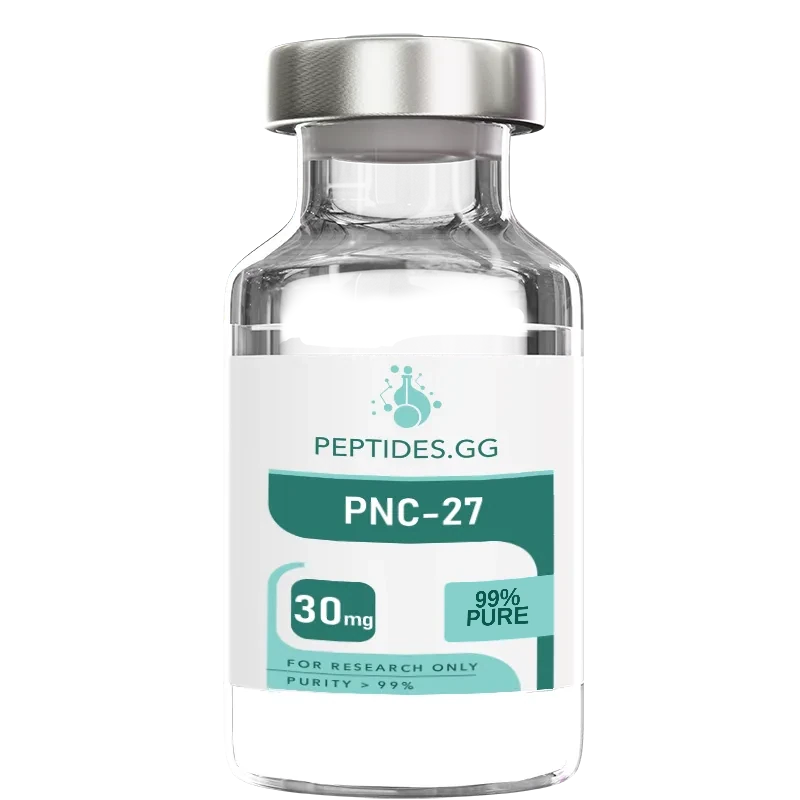
The PNC-27 peptide serves as a valuable research tool for investigating selective cancer cell membrane disruption through HDM-2 binding domain interaction. This synthetic anticancer peptide enables research into p53-MDM2 pathway-targeted membrane lysis mechanisms.
Research Disclaimer: Peptides.GG sells this and all other peptides for Research Only and not for human consumption.
PNC-27 Peptide
$100.00
- Free Delivery on all orders over $200
- Earn 5% Store Credit with Every Order
- Same Day Shipping Before 1 PM PST
- 10% Discount for Cryptocurrency Payments
14-day money-back guarantee
Not satisfied? Return any unopened product within 14 days of delivery for a full refund — we send the return label.

The PNC-27 peptide serves as a valuable research tool for investigating selective cancer cell membrane disruption through HDM-2 binding domain interaction. This synthetic anticancer peptide enables research into p53-MDM2 pathway-targeted membrane lysis mechanisms.
Research Disclaimer: Peptides.GG sells this and all other peptides for Research Only and not for human consumption.
Frequently Asked Questions About PNC-27
What is PNC-27?
PNC-27 is a synthetic chimeric, membrane-active peptide derived from the p53 tumor-suppressor protein, studied for its proposed mechanism of selective membrane disruption in transformed cells. It is supplied strictly as a research compound for laboratory use in oncology-focused cell biology, and is not for human consumption.
What is the molecular profile of PNC-27?
PNC-27 is a 32-amino-acid chimeric peptide with an approximate molecular weight of ~3,900 Da. It fuses residues 12-26 of human p53 - which contain the MDM2/HDM2-binding domain, including the key residues Phe19, Trp23, and Leu26 - to a C-terminal transmembrane-penetrating sequence that gives the peptide its amphipathic, membrane-active character.
What is PNC-27 studied for in research?
In preclinical and in vitro research, PNC-27 is used to investigate the p53-HDM2 protein-protein interaction, membrane biology and pore formation, apoptosis pathways, and selective cytotoxicity in transformed versus non-transformed cell models. Supplied for laboratory research use only; not for human consumption.
What is the dual-domain design of PNC-27?
PNC-27 combines two functional domains in one peptide: an N-terminal p53 (residues 12-26) segment that engages HDM2, and a C-terminal transmembrane-penetrating sequence that confers membrane activity. The guiding research hypothesis is that the p53 domain directs binding to HDM2 aberrantly expressed on the surface of cancer-derived cells while the penetrating sequence facilitates membrane pore formation - a selectivity mechanism that remains actively investigated.
What size is PNC-27 available in?
PNC-27 is supplied as a 30 mg lyophilized (freeze-dried) powder. The lyophilized format limits solution-phase degradation during storage and allows precise gravimetric preparation of research concentrations at the point of use.
How is PNC-27 stored and handled in the laboratory?
PNC-27 is a white to off-white lyophilized powder soluble in aqueous buffers (PBS, sterile water), with a small amount of DMSO as co-solvent if needed for its hydrophobic transmembrane segment. The lyophilized powder is kept sealed at -20°C in a desiccated, light-protected environment; freeze-thaw cycles are minimized. Each batch is third-party tested with a Certificate of Analysis.
Related products
-

NAD+
$65.00 – $125.00 Select options This product has multiple variants. The options may be chosen on the product pageSize: 500mg, 1000mg
-
Fox04-DRI
$149.00 Select options This product has multiple variants. The options may be chosen on the product pageSize: 10mg
-
Glutathione
$45.00 – $75.00 Select options This product has multiple variants. The options may be chosen on the product pageSize: 600mg, 1500mg
Certificate of Analysis
Third-party tested · Independent analytical lab
| Tested | Measured | Purity |
|---|---|---|
| Jan 2026 | 31.36mg | 99.59% |
| Sep 2025 | 28.32mg | 99.74% |
Research Overview
The PNC-27 peptide is a chimeric p53-derived construct that has attracted significant interest in oncology-focused preclinical research for its proposed mechanism of selective membrane disruption in transformed cells. Structurally, PNC-27 was engineered by fusing residues 12–26 of the human p53 tumor suppressor protein with a transmembrane-penetrating sequence, yielding a 32-amino-acid construct that retains the MDM2-binding domain of p53 while incorporating membrane-active properties. This dual-domain architecture is central to the hypothesis guiding research into the compound: that the p53 residues direct binding to HDM2 (the human ortholog of MDM2) expressed aberrantly on the surface of cancer-derived cell lines, while the penetrating sequence facilitates pore formation in the target membrane.
Laboratory investigations into p53-pathway modulation have expanded considerably over the past two decades, with researchers identifying numerous molecular targets and tool compounds that illuminate the mechanisms governing cell fate decisions in transformed versus non-transformed cell populations. PNC-27 serves as a valuable research tool within this landscape because it offers a distinct mechanistic angle compared to conventional small-molecule MDM2 inhibitors. Rather than operating through intracellular signaling cascades, the peptide is theorized to act directly at the plasma membrane — a feature that makes it particularly relevant to studies examining surface-expressed MDM2 as a vulnerability in specific tumor cell models. Researchers investigating apoptosis pathways, membrane biology, and p53–MDM2 protein–protein interactions have employed PNC-27 as part of mechanistic dissection strategies. For studies that also explore immunomodulatory or senolytic peptide research, complementary tools such as Foxo4-DRI and Thymosin Alpha-1 are frequently examined in parallel experimental designs.
The selectivity profile proposed for PNC-27 — preferential disruption of transformed cell membranes over normal cell membranes — represents one of the most actively debated and investigated aspects of this compound in current literature. Research models employing multiple cancer-derived cell lines alongside non-transformed controls have been used to interrogate whether differential HDM2 surface expression accounts for observed selectivity, or whether additional biophysical factors related to membrane composition in transformed cells contribute to the phenomenon. Understanding these distinctions has broader implications for the fields of peptide-based oncology research and membrane-active therapeutic peptide design.
Molecular Characteristics
Complete Specifications:
- CAS Number: Not universally assigned; research-grade material identified by sequence descriptor
- Molecular Weight: Approximately 3,900 Da
- Molecular Formula: Complex chimeric sequence; empirical formula consistent with 32-residue peptide
- Sequence: 32-amino acid chimeric construct: p53 residues 12–26 fused to a transmembrane-penetrating sequence
- Peptide Length / Classification: 32 amino acids; chimeric p53-derived membrane-active peptide
- Appearance: White to off-white lyophilized powder
- Solubility: Soluble in aqueous buffers (PBS, sterile water)
The molecular architecture of PNC-27 reflects a deliberate design strategy aimed at combining two distinct functional domains within a single peptide scaffold. The N-terminal region, derived from p53 residues 12–26, contains the alpha-helical segment known to engage the hydrophobic cleft of MDM2/HDM2. This region carries the critical residues Phe19, Trp23, and Leu26 (numbering relative to full-length p53), which form the primary contact interface in the native p53–MDM2 interaction. Structural studies of the native complex have shown that this interaction buries approximately 1,600 Ų of solvent-accessible surface area, a substantial interface that has informed the design of numerous peptide mimetics and small-molecule disruptors in the research literature.
The C-terminal transmembrane-penetrating sequence appended to the p53 domain imparts amphipathic character to PNC-27, contributing to its membrane-active behavior. The overall hydrophobic moment and charge distribution of the intact 32-mer influence its propensity to associate with lipid bilayers, and researchers have used circular dichroism spectroscopy to characterize the secondary structure adopted by the peptide in membrane-mimetic environments versus aqueous solution. The ~3,900 Da molecular weight places PNC-27 in the mid-range of research peptides where cell-free binding assays, surface plasmon resonance experiments, and fluorescence-based membrane disruption assays are all experimentally tractable.
Pharmacokinetic Profile in Research Models
Absorption and Cellular Uptake Dynamics
- In vitro uptake studies indicate that PNC-27 associates with cell membranes within minutes of exposure, consistent with direct membrane interaction rather than receptor-mediated endocytosis as the primary entry mechanism
- Fluorescence microscopy experiments using labeled analogs have tracked the spatial distribution of the peptide at the plasma membrane and in subcellular compartments across different cell line models
- Uptake efficiency in research models has been shown to vary with peptide concentration, incubation time, and the surface HDM2 expression level of the target cell population
- At concentrations used in mechanistic studies, cellular morphology changes consistent with membrane disruption have been documented by electron microscopy in susceptible cell lines
Bioactivity Dynamics in Preclinical Systems
- Concentration-response relationships for PNC-27 in transformed cell line models have been characterized using viability assays (MTT, trypan blue exclusion) across multiple research groups
- Temporal kinetics of membrane disruption, measured by propidium iodide exclusion assays, suggest rapid onset in sensitive cell models following peptide addition to culture medium
- Comparative studies across cell lines with varying p53 status and surface HDM2 expression have been used to build mechanistic arguments about the selectivity determinants of PNC-27 activity
Metabolic Considerations in Research Systems
- As an unmodified linear peptide, PNC-27 is susceptible to proteolytic degradation in serum-containing media; researchers typically use serum-free or reduced-serum conditions for short-term mechanistic experiments
- Half-life estimates in biological matrices remain an active area of characterization, with some laboratories employing protease inhibitor cocktails to extend peptide stability during extended incubation experiments
- In vivo preclinical models (rodent xenograft studies) have been used to assess systemic behavior, though the primary research utility of PNC-27 remains in cell-based and cell-free mechanistic systems
Research Applications
p53–HDM2 Protein–Protein Interaction Research
- PNC-27 serves as a peptide-based probe for characterizing the p53–MDM2/HDM2 binding interface in biochemical pull-down and co-immunoprecipitation experiments
- Surface plasmon resonance and isothermal titration calorimetry studies have used PNC-27 to measure binding kinetics and thermodynamic parameters of the p53 transactivation domain interaction with HDM2
- Competition assays employing PNC-27 alongside small-molecule MDM2 inhibitors (nutlin-class compounds) help define pharmacological space and potential mechanistic overlap
- Mutational analysis studies use PNC-27 variants (Ala-scanning analogs) to map the contribution of individual residues to binding affinity and membrane activity
Research into the p53–MDM2 axis has generated a rich toolkit of peptide and small-molecule probes, and PNC-27 occupies a unique niche within this toolkit by combining a recognized binding domain with membrane-active properties. This dual functionality enables experimental designs that simultaneously probe binding specificity and membrane biophysics within the same experimental system, a feature not available with purely intracellular inhibitors.
Membrane Biology and Pore Formation Studies
- Liposome leakage assays (using fluorescent dye encapsulation and release) have been employed to characterize the membrane-disrupting activity of PNC-27 in defined lipid bilayer systems
- Electron microscopy of treated cell membranes has provided ultrastructural evidence for pore-like lesions in susceptible cell models following PNC-27 exposure
- Electrophysiology patch-clamp experiments using model membranes have been used to characterize ion conductance changes induced by the peptide
- Comparative studies with other membrane-active peptides such as LL-37 provide mechanistic context for interpreting the membrane-interaction data generated with PNC-27
The membrane biology research applications of PNC-27 extend beyond cancer cell biology into the broader field of antimicrobial and membrane-active peptide science. Understanding how the chimeric architecture of PNC-27 translates into specific membrane disruption mechanisms — relative to purely amphipathic peptides or purely receptor-targeting constructs — informs the design of next-generation research probes in this space.
Apoptosis Pathway Investigation
- Caspase activation assays (caspase-3/7, caspase-8, caspase-9) following PNC-27 treatment of susceptible cell lines have been used to characterize whether the observed cell death involves canonical apoptotic executioner cascades
- Annexin V / propidium iodide flow cytometry provides temporal resolution of membrane integrity loss versus phosphatidylserine externalization following PNC-27 exposure in research models
- Mitochondrial membrane potential measurements (JC-1 assay) have been incorporated into research protocols to assess whether the intrinsic apoptosis pathway is engaged downstream of membrane disruption
- Bcl-2 family protein expression studies (Western blot, proteomics) in PNC-27-treated cells contribute to understanding the relationship between membrane events and downstream signaling cascades
Selective Cytotoxicity Research and Cell Biology Models
- Side-by-side treatment of transformed and non-transformed isogenic cell pairs with PNC-27 enables differential response analysis, providing data relevant to understanding selectivity mechanisms
- HDM2 knockdown (siRNA) and overexpression experiments in isogenic backgrounds are used to establish the causal relationship between surface HDM2 levels and PNC-27 activity in cell models
- 3D tumor spheroid and organoid research models provide more physiologically complex environments for investigating PNC-27 penetration and activity beyond 2D monolayer cultures
- Complementary immunomodulatory research tools such as KPV are sometimes investigated alongside PNC-27 in studies examining the tumor microenvironment and inflammatory signaling in cancer biology models
Laboratory Handling and Storage Protocols
Lyophilized Storage
- Store lyophilized PNC-27 at −20°C in a desiccated environment, protected from light and moisture
- Aliquoting into single-use quantities prior to first use is recommended to avoid repeated freeze-thaw cycles that can accelerate degradation
- Allow the sealed vial to equilibrate to room temperature before opening to prevent condensation on the powder
Quality Assurance and Analytical Testing
The analytical methods below are those commonly used to characterize and verify the identity, purity, and quality of research compounds in this class:
- Purity Analysis (HPLC): PNC-27 is analyzed by reverse-phase high-performance liquid chromatography (RP-HPLC); purity is confirmed at ≥99% by peak area integration, with the chromatogram provided in the certificate of analysis
- Structural Verification (ESI-MS): Electrospray ionization mass spectrometry confirms the molecular mass for this compound, verifying the correct sequence assembly and detecting any truncated or oxidized species that would compromise research validity
- Contaminant Testing: Testing for residual solvents, acetate counterion content, and endotoxin (LAL assay) is conducted to ensure that research results reflect PNC-27 activity rather than contaminant interference
- Documentation: A certificate of analysis (CoA) including lot number, synthesis date, purity result, mass spec data, and storage recommendations accompanies each shipment for laboratory records
Research Considerations
Investigators designing experiments with PNC-27 should account for the following experimental design factors:
- Characterize surface HDM2 expression in all cell lines used as test or control populations prior to PNC-27 treatment, as this variable is central to the proposed selectivity mechanism
- Include appropriate negative controls (scrambled sequence peptide of similar length and charge) to distinguish sequence-specific effects from non-specific membrane perturbation
- Account for peptide adsorption to plasticware and serum protein binding when calculating effective free peptide concentrations in cell culture experiments
- Employ orthogonal viability and cell death assays to distinguish membrane disruption (rapid, necrosis-like) from apoptotic cascades requiring protein synthesis and multi-hour time courses
- Document the p53 mutational status and MDM2 amplification status of all cell lines used, as these factors may influence experimental outcomes and interpretation
Key mechanistic questions actively investigated in the research literature include:
- Whether surface-expressed HDM2 is required for PNC-27 membrane association or is instead coincidental to an HDM2-independent membrane-active mechanism
- The structural basis of pore formation — whether PNC-27 forms defined oligomeric channels or induces detergent-like membrane solubilization at higher concentrations
- The relationship between p53 pathway status (wild-type vs. mutant vs. null) and cell sensitivity to PNC-27 in isogenic model systems
- Whether the observed effects can be recapitulated or blocked by pre-incubation with excess recombinant HDM2 protein
Compliance and Safety Information
- Regulatory Status: PNC-27 is supplied exclusively as a research reagent for laboratory use. It is not approved by the FDA or any other regulatory authority as a drug, medical device, or diagnostic product.
- Intended Use: This compound is intended solely for in vitro cell biology research, biochemical assays, and preclinical studies conducted by qualified researchers in appropriately equipped laboratory settings.
- NOT Intended For: Human or veterinary administration, consumption, or any use outside of a controlled research laboratory environment. This product is not a dietary supplement, pharmaceutical, or clinical reagent.
- Safety Protocols: Handle in accordance with standard laboratory safety guidelines for research peptides. Use appropriate personal protective equipment (gloves, eye protection, lab coat). Consult the Safety Data Sheet (SDS) for hazard classification and disposal requirements applicable to your jurisdiction.