

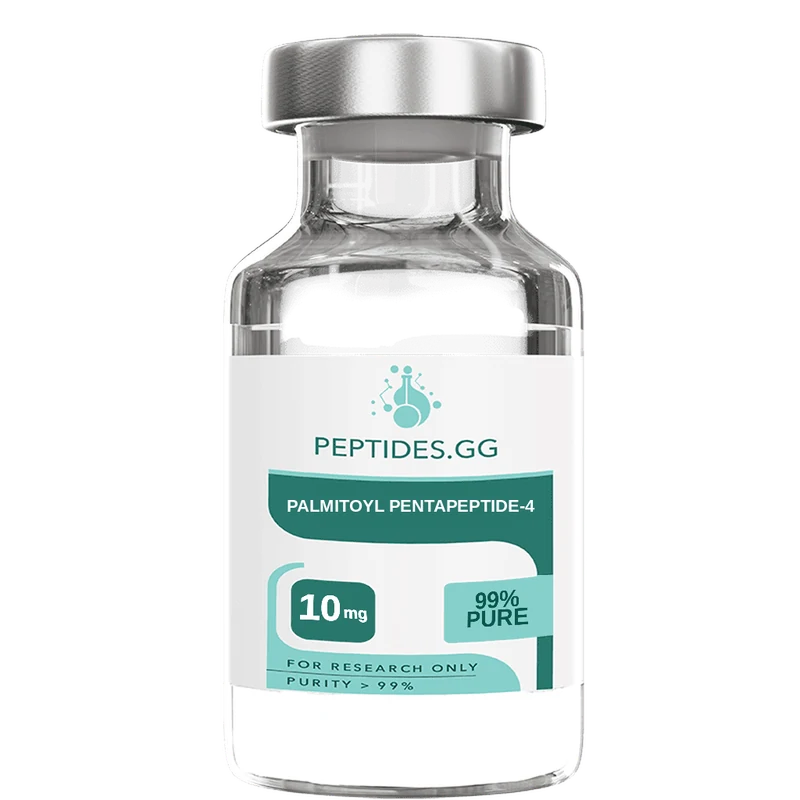
Palmitoyl Pentapeptide-4 (Pal-KTTKS), also known as Matrixyl®, is a synthetic lipopeptide built on a sequence from type I procollagen, supplied as a lyophilized research chemical for in vitro laboratory investigation. Third-party lab tested for purity.
Peptides.GG is a chemical supplier and is not a compounding pharmacy under 503A or 503B. Statements have not been evaluated by the US FDA. Products are not intended to diagnose, treat, cure, or prevent any disease. For research use only — not for human consumption.
Palmitoyl Pentapeptide-4
$49.00
- Free Delivery on all orders over $200
- Earn 5% Store Credit with Every Order
- Same Day Shipping Before 1 PM PST
14-day money-back guarantee
Not satisfied? Return any unopened product within 14 days of delivery for a full refund — we send the return label.

Palmitoyl Pentapeptide-4 (Pal-KTTKS), also known as Matrixyl®, is a synthetic lipopeptide built on a sequence from type I procollagen, supplied as a lyophilized research chemical for in vitro laboratory investigation. Third-party lab tested for purity.
Peptides.GG is a chemical supplier and is not a compounding pharmacy under 503A or 503B. Statements have not been evaluated by the US FDA. Products are not intended to diagnose, treat, cure, or prevent any disease. For research use only — not for human consumption.
Frequently Asked Questions About Palmitoyl Pentapeptide-4
What is Palmitoyl Pentapeptide-4?
Palmitoyl Pentapeptide-4 (Pal-KTTKS) is a synthetic lipopeptide: the pentapeptide Lys-Thr-Thr-Lys-Ser, a sequence from the carboxyl-terminal propeptide of type I procollagen, carrying a palmitoyl (C16) chain on its N-terminal amine. It is supplied strictly as a research compound for laboratory use and is not for human consumption.
Is Palmitoyl Pentapeptide-4 the same as Matrixyl®?
Palmitoyl pentapeptide-4 is the INCI name of the peptide also known as Matrixyl®, a registered trademark of Sederma. Peptides.GG is not affiliated with Sederma and does not sell Sederma's branded ingredient. This product is the palmitoyl pentapeptide-4 peptide itself, supplied as a lyophilized research chemical.
Is Palmitoyl Pentapeptide-4 the same as Matrixyl® 3000?
No. Matrixyl® 3000 is a different ingredient: a blend of two other lipopeptides, palmitoyl tripeptide-1 (Pal-GHK) and palmitoyl tetrapeptide-7. Palmitoyl Pentapeptide-4 is a single peptide, Pal-KTTKS, and is not a component of that blend.
What is the CAS number and molecular weight of Palmitoyl Pentapeptide-4?
CAS 214047-00-4, molecular formula C₃₉H₇₅N₇O₁₀, molecular weight 802.1 g/mol (monoisotopic mass 801.558 Da), sequence Pal-Lys-Thr-Thr-Lys-Ser-OH, PubChem CID 9897237. PubChem also lists the compound as palmitoyl pentapeptide-3. Synthetic peptides may be supplied as a salt, so net peptide content can differ from the gross mass of the powder.
What is Palmitoyl Pentapeptide-4 studied for in laboratory research?
In vitro and ex vivo research uses Pal-KTTKS to study extracellular-matrix protein production (type I and III collagen, fibronectin) in fibroblast cultures, the self-assembly of peptide amphiphiles into β-sheet tapes and fibrils, and the stability and skin-layer distribution of lipidated peptides in dermal models. Supplied for laboratory research use only; not for human consumption.
What size is Palmitoyl Pentapeptide-4 available in, and how is it stored?
Palmitoyl Pentapeptide-4 is supplied as a lyophilized powder in a 10 mg size. The sealed powder is stored at -20°C or below, desiccated and protected from light and moisture.
Research References
Peer-reviewed studies and database records underpinning the research described on this page. Links open on PubMed, PubMed Central, or the publisher in a new tab.
- Katayama K, et al. A pentapeptide from type I procollagen promotes extracellular matrix production. J Biol Chem. 1993. PMID: 8486721 →
- Lintner K, Peschard O. Biologically active peptides: from a laboratory bench curiosity to a functional skin care product. Int J Cosmet Sci. 2000. PMID: 18503476 →
- Abu Samah NH, Heard CM. Topically applied KTTKS: a review. Int J Cosmet Sci. 2011. PMID: 21535443 →
- Jones RR, et al. Collagen stimulating effect of peptide amphiphile C16-KTTKS on human fibroblasts. Mol Pharm. 2013. PMID: 23320752 →
- Castelletto V, et al. Self-assembly of palmitoyl lipopeptides used in skin care products. Langmuir. 2013. PMID: 23822110 →
- Choi YL, et al. Dermal Stability and In Vitro Skin Permeation of Collagen Pentapeptides (KTTKS and palmitoyl-KTTKS). Biomol Ther (Seoul). 2014. PMID: 25143811 →
- Mortazavi SM, et al. Effect of Palmitic Acid Conjugation on Physicochemical Properties of Peptide KTTKS: A Preformulation Study. J Cosmet Sci. 2019. PMID: 31829923 →
Related products
-

Vesugen (Bioregulator)
$60.00 Select options This product has multiple variants. The options may be chosen on the product pageSize: 20mg
-
AOD9604
$30.00 – $80.00 Select options This product has multiple variants. The options may be chosen on the product pageSize: 2mg, 5mg, 10mg
Research Overview
Palmitoyl Pentapeptide-4 (Pal-KTTKS), also known as Matrixyl®, is a synthetic lipopeptide: the five-residue sequence Lys-Thr-Thr-Lys-Ser (KTTKS) carrying a palmitoyl (C16) chain on its N-terminal amine. In the research literature it is studied for its effect on extracellular-matrix protein production in fibroblast cultures and as a self-assembling peptide amphiphile.
The peptide sequence comes from collagen biology. Katayama and colleagues (1993) dissected a fragment of the carboxyl-terminal propeptide of type I procollagen and identified Lys-Thr-Thr-Lys-Ser, residues 212 to 216, as the minimum sequence necessary for potent stimulation of collagen and fibronectin production in a variety of mesenchymal cells. The palmitoyl conjugate follows a design rationale described by Lintner and Peschard (2000): short peptides are highly soluble and fragile, and the authors reported that long-chain fatty-acid conjugates improve their skin penetration and specific activity.
Names and Related Ingredients
Palmitoyl pentapeptide-4 is the INCI name for Pal-KTTKS, and PubChem also lists it under the name palmitoyl pentapeptide-3. It is the peptide marketed as Matrixyl® by Sederma. This page uses the INCI name because the product is the peptide itself, supplied as a lyophilized research chemical, and not Sederma’s branded ingredient.
Matrixyl® 3000 is a different ingredient. It is a blend of two other lipopeptides, palmitoyl tripeptide-1 (Pal-GHK, the palmitoylated form of the GHK sequence also found in GHK-Cu) and palmitoyl tetrapeptide-7, and it is not the material sold on this page.
Molecular Characteristics
- Sequence: Pal-Lys-Thr-Thr-Lys-Ser-OH (Pal-KTTKS)
- Systematic name: N2-(1-oxohexadecyl)-L-lysyl-L-threonyl-L-threonyl-L-lysyl-L-serine
- Molecular formula: C₃₉H₇₅N₇O₁₀
- Molecular weight: 802.1 g/mol (monoisotopic mass 801.558 Da)
- CAS number: 214047-00-4
- PubChem CID: 9897237
The palmitoyl group is attached as an amide to the α-amino group of the N-terminal lysine, leaving the C-terminal serine as a free acid and both lysine side-chain amines free. All five residues are L-amino acids.
In a preformulation study, Mortazavi and colleagues (2019) compared Pal-KTTKS with the unmodified KTTKS peptide. Palmitoylation turned a freely water-soluble, hydrophilic peptide (logP about −1.6) into a lipophilic one (calculated logP about 3.7) with surface activity and a critical micelle concentration of about 0.024 mM. Both peptides were hygroscopic, decomposed at about 150 to 154°C without melting, and showed maximum UV absorbance below 200 nm.
Research Applications
Extracellular-matrix protein production in fibroblast cultures
Abu Samah and Heard (2011) reviewed the KTTKS literature and described a sound in vitro basis for an effect on fibroblasts, with the stimulatory effect specific to collagen types I and III and fibronectin expression. For the palmitoylated form, Jones and colleagues (2013) reported that Pal-KTTKS stimulated collagen production by cultured dermal and corneal fibroblasts in a concentration-dependent manner, with the effect appearing close to the critical aggregation concentration of the peptide. The authors suggested that self-assembly and collagen stimulation are inter-related.
Self-assembly as a peptide amphiphile
Castelletto and colleagues (2013) compared three palmitoyl lipopeptides, C16-KTTKS, C16-KT, and C16-GHK, using spectroscopy, microscopy, and X-ray scattering. Pal-KTTKS formed flat tapes and extended fibrillar structures with high β-sheet content, was stained by Congo red, and gave a highly aligned cross-β X-ray diffraction pattern, whereas the other two formed crystal-like aggregates. All three had similar critical aggregation concentrations, governed by the length of the lipid chain.
Dermal stability and skin permeation models
Choi and colleagues (2014) developed a liquid chromatography–tandem mass spectrometry method for Pal-KTTKS and used it to compare the palmitoylated and unmodified peptides in hairless mouse skin. In skin extracts and homogenates both were rapidly degraded, Pal-KTTKS less so, and protease inhibitors improved the stability of both. Neither peptide was detected in the receptor solution, indicating that neither crossed full-thickness skin under the study conditions; Pal-KTTKS was detected in the stratum corneum, epidermis, and dermis, while KTTKS was not detected in any skin layer.
The catalog also carries the copper tripeptides GHK-Cu and AHK-Cu, which are studied in the same extracellular-matrix research literature.
Product Format and Storage
Palmitoyl Pentapeptide-4 is supplied as a lyophilized (freeze-dried) powder in a 10 mg size. The sealed powder is stored at -20°C or below, desiccated and protected from light and moisture.
Quality Assurance and Analytical Testing
The analytical methods below are those commonly used to characterize and verify the identity, purity, and quality of a synthetic lipopeptide of this class:
- Reversed-phase HPLC — purity determination, with material of this grade characterized at ≥99% purity.
- Mass spectrometry — identity confirmation against the monoisotopic mass of 801.558 Da. Liquid chromatography–tandem mass spectrometry methods specific to Pal-KTTKS have been published.
- Amino-acid analysis — composition verification against the Lys₂Thr₂Ser content of the KTTKS sequence.
- Counter-ion determination — synthetic peptides of this class can be isolated as acetate or trifluoroacetate salts, so net peptide content is distinguished from the gross mass of the powder.
- Karl Fischer titration — residual moisture in the lyophilized powder.
Compliance and Safety Information
Palmitoyl Pentapeptide-4 is offered strictly as a research chemical for in vitro laboratory investigation. It is not a drug, dietary supplement, cosmetic, or food, and it is not intended for human or veterinary use. Purchasers are responsible for ensuring that handling, storage, and disposal comply with the regulations applicable to their jurisdiction and institution.
Matrixyl® is a registered trademark of Sederma, named on this page only to identify the peptide. Peptides.GG is not affiliated with or endorsed by Sederma.
Peptides.GG is a chemical supplier and is not a compounding pharmacy under 503A or 503B. Statements have not been evaluated by the US FDA. Products are not intended to diagnose, treat, cure, or prevent any disease. For research use only — not for human consumption.