

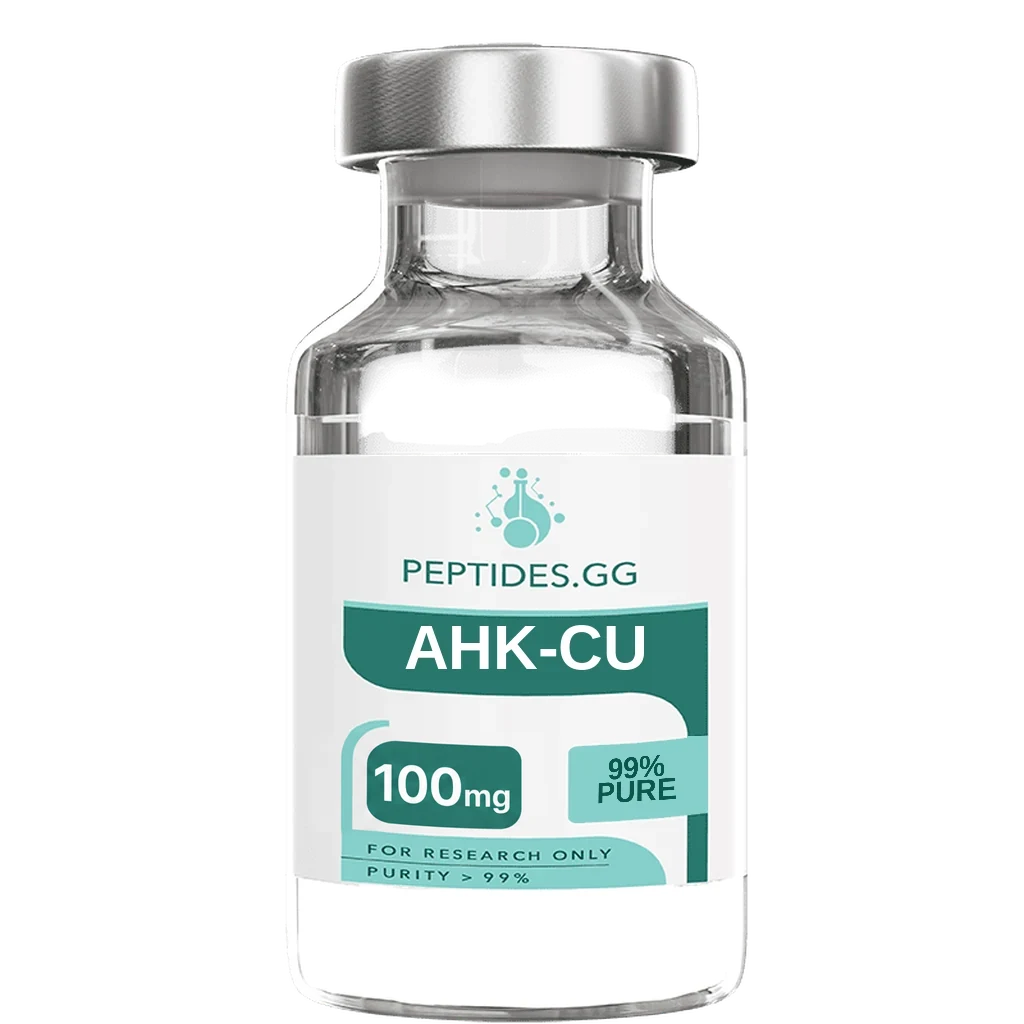
AHK-Cu is the copper(II) complex of the synthetic tripeptide alanyl-histidyl-lysine, supplied as a lyophilized research chemical for in vitro laboratory investigation. Third-party lab tested for purity.
Peptides.GG is a chemical supplier and is not a compounding pharmacy under 503A or 503B. Statements have not been evaluated by the US FDA. Products are not intended to diagnose, treat, cure, or prevent any disease. For research use only — not for human consumption.
AHK-Cu Peptide
$70.00
- Free Delivery on all orders over $200
- Earn 5% Store Credit with Every Order
- Same Day Shipping Before 1 PM PST
- 10% Discount for Cryptocurrency Payments
14-day money-back guarantee
Not satisfied? Return any unopened product within 14 days of delivery for a full refund — we send the return label.
AHK-Cu is the copper(II) complex of the synthetic tripeptide alanyl-histidyl-lysine, supplied as a lyophilized research chemical for in vitro laboratory investigation. Third-party lab tested for purity.
Peptides.GG is a chemical supplier and is not a compounding pharmacy under 503A or 503B. Statements have not been evaluated by the US FDA. Products are not intended to diagnose, treat, cure, or prevent any disease. For research use only — not for human consumption.
Frequently Asked Questions About AHK-Cu
What is AHK-Cu?
AHK-Cu is the copper(II) complex of the synthetic tripeptide alanyl-histidyl-lysine (Ala-His-Lys). It belongs to the family of copper-binding tripeptides studied as research tools in matrix biology and cell-proliferation research, of which GHK-Cu is the best-characterized member. It is supplied strictly as a research compound for laboratory use and is not for human consumption.
How does AHK-Cu differ from GHK-Cu?
The two differ by a single amino-acid residue: AHK begins with alanine, GHK with glycine, and the remaining His-Lys sequence and the copper-binding motif are identical. That one methyl group is the entire structural distinction, which is why the pair is used as a matched comparison in structure-activity research. The research base for GHK-Cu is far larger, and findings for GHK-Cu do not automatically transfer to AHK-Cu.
What is the molecular profile of AHK-Cu?
The free tripeptide AHK has the sequence Ala-His-Lys, molecular formula C₁₅H₂₆N₆O₄, average molecular weight 354.41 Da, and CAS 126828-32-8 (PubChem CID 7408502). For the copper complex, the only public PubChem record (CID 168431292) describes the monohydrochloride form, CAS 682809-81-0, formula C₁₅H₂₄ClCuN₆O₄, formula weight 451.39. The neutral 1:1 complex corresponds to approximately 415.9 Da by calculation from the free-peptide mass. Because supplied material may be a salt, hydrate, or neutral complex, the batch Certificate of Analysis governs actual peptide content and copper stoichiometry.
How does the peptide bind copper?
The Xaa-His motif in a short peptide forms a well-characterized copper(II) site. Coordination involves the N-terminal amine, the deprotonated backbone amide nitrogen, and the histidine imidazole nitrogen, giving a square-planar geometry around the metal. Complex formation can be observed directly by the d-d absorption band in UV-visible spectroscopy.
What is AHK-Cu studied for in laboratory research?
The principal published study specific to AHK-Cu is Pyo and colleagues (2007), which examined the compound in cultured human dermal papilla cells and in human hair follicles ex vivo, reporting follicle elongation and dermal papilla cell proliferation at picomolar to nanomolar concentrations along with changes in apoptosis markers. Beyond that, AHK-Cu appears mainly as a comparator to GHK-Cu in copper-tripeptide structure-activity work. Supplied for laboratory research use only; not for human consumption.
What size is AHK-Cu available in, and how is it stored?
AHK-Cu is supplied as a lyophilized powder in a 100 mg size, which is the standard size for this compound. Copper-peptide complexes of this class characteristically carry a blue to blue-green color. It is stored sealed, cold, desiccated, and protected from light and moisture; because copper(II) complexes are redox-active, contact with strong reducing agents is minimized. A Certificate of Analysis accompanies the product.
Research References
Peer-reviewed studies and database records underpinning the research described on this page. Links open on PubMed, PubMed Central, or the publisher in a new tab.
- Pyo HK, et al. The effect of tripeptide-copper complex on human hair growth in vitro. Arch Pharm Res. 2007. PMID: 17703734 →
- Pickart L. The human tri-peptide GHK and tissue remodeling (GHK — sibling copper tripeptide, for comparison). J Biomater Sci Polym Ed. 2008. PMID: 18644225 →
- Gonzalez P, et al. Cu(II) Binding to the Peptide Ala-His-His, a Chimera of the Canonical Cu(II)-Binding Motifs Xxx-His and Xxx-Zzz-His (Xaa-His coordination chemistry). Inorg Chem. 2017. PMID: 29190078 →
- Hureau C, et al. X-ray and solution structures of Cu(II) GHK and Cu(II) DAHK complexes: influence on their redox properties (GHK/DAHK structural comparison). Chemistry. 2011. PMID: 21780203 →
Related products
-

Vesugen (Bioregulator)
$60.00 Select options This product has multiple variants. The options may be chosen on the product pageSize: 20mg
-
AOD9604
$30.00 – $80.00 Select options This product has multiple variants. The options may be chosen on the product pageSize: 2mg, 5mg, 10mg
Research Overview
AHK-Cu is the copper(II) complex of the synthetic tripeptide alanyl-histidyl-lysine (Ala-His-Lys). It belongs to the small family of copper-binding tripeptides studied as research tools in matrix biology and cell-proliferation research, of which the best-characterized member is GHK-Cu. Both molecules share the same organizing principle: a short peptide carrying an N-terminal amino group and a histidine imidazole nitrogen, which together chelate a copper(II) ion with high affinity.
AHK-Cu is considerably less studied than its GHK counterpart. The published literature specific to this molecule is narrow, and researchers working with it are generally doing comparative work — placing AHK-Cu alongside GHK-Cu to isolate what changes when the glycine of the GHK sequence is substituted for alanine. That single-residue difference is the entire structural distinction between the two compounds, which is what makes the pair useful as a matched comparison.
Molecular Characteristics
The free peptide (AHK)
The uncomplexed tripeptide is well characterized. Sequence Ala-His-Lys (AHK), molecular formula C₁₅H₂₆N₆O₄, average molecular weight 354.41 Da (monoisotopic 354.202 Da), CAS 126828-32-8, PubChem CID 7408502. These values describe the free peptide with no metal bound.
The copper complex — read this before quoting a number
Registry data for the copper complex is less clean than for the free peptide, and it is worth being precise rather than tidy. The only public PubChem record for "AHK-Cu" (CID 168431292) describes the monohydrochloride form — [L-alanyl-N-L-histidyl-N,N3-L-lysinato(2−)]copper monohydrochloride, CAS 682809-81-0, formula C₁₅H₂₄ClCuN₆O₄, formula weight 451.39. That is a specific salt form, not the neutral 1:1 complex, and the two are not interchangeable when calculating concentrations.
The neutral 1:1 peptide-copper complex itself corresponds to approximately 415.9 Da — the free peptide (354.41) less the two protons displaced on chelation, plus copper (63.55). That figure is arithmetic from the established free-peptide mass rather than a value read from a registry entry, and it is presented here as such.
Because supplied material may be a salt, a hydrate, or the neutral complex depending on the manufacturing route, the batch Certificate of Analysis governs the actual peptide content and copper stoichiometry. Researchers preparing gravimetric standards should work from batch documentation rather than from a generic catalog molecular weight.
Copper Coordination
The Xaa-His motif at positions 2 and 3 of a short peptide forms a well-known copper(II) binding site. Coordination involves the N-terminal amine, the deprotonated backbone amide nitrogen, and the histidine imidazole nitrogen, producing a square-planar geometry around the metal. In AHK the N-terminal residue is alanine; in GHK it is glycine. The additional methyl group of alanine is the only difference between them, and comparative coordination chemistry on this class of peptide is an active area of inorganic-chemistry research.
The catalog also supplies the metal-free tripeptide GHK Basic, which allows a laboratory to control copper stoichiometry itself rather than receiving a pre-formed complex. AHK-Cu, by contrast, is supplied as the pre-formed copper complex.
Research Applications
Dermal papilla cell research
The principal published study specific to AHK-Cu is Pyo and colleagues (2007), which examined L-alanyl-L-histidyl-L-lysine-Cu²⁺ in cultured human dermal papilla cells and in human hair follicles ex vivo. The authors reported elongation of follicles ex vivo and proliferation of dermal papilla cells in vitro at picomolar to nanomolar concentrations, together with an elevated Bcl-2/Bax ratio and reduced levels of cleaved caspase-3 and PARP. Dermal papilla cells are specialized fibroblasts, and this remains the reference study for the compound.
Comparative copper-tripeptide work
Beyond that study, AHK-Cu appears in the literature chiefly as a comparator to GHK-Cu, whose research base in extracellular-matrix remodeling and tissue biology is far larger. Laboratories examining structure-activity relationships across the copper-tripeptide class use the pair together, and frequently alongside other repair-associated research peptides in the catalog such as BPC-157 and TB-500.
A note on the evidence base: the volume of peer-reviewed work naming AHK-Cu specifically is small — a single-figure number of directly relevant papers. This is stated plainly because the surrounding literature on GHK-Cu is extensive and it would be easy to mistake one for the other. Findings established for GHK-Cu do not automatically transfer to AHK-Cu.
Product Format and Storage
AHK-Cu is supplied as a lyophilized (freeze-dried) powder in a 100 mg size. Copper-peptide complexes of this class characteristically carry a blue to blue-green color, the intensity of which varies with the copper loading and the salt form.
The sealed lyophilized powder is stored cold, desiccated, and protected from light and moisture. Copper(II) complexes are redox-active, so contact with strong reducing agents and prolonged exposure to light and elevated temperature are minimized during handling. A Certificate of Analysis accompanies the product.
Quality Assurance and Analytical Testing
The analytical methods below are those commonly used to characterize and verify the identity, purity, and quality of a copper-peptide complex of this class:
- Reversed-phase HPLC — purity determination, with material of this grade characterized at ≥99% purity.
- Mass spectrometry — identity confirmation of the peptide component and of the copper adduct, which shows the characteristic isotope signature of copper.
- Amino-acid analysis — composition verification against the Ala-His-Lys sequence.
- Copper content determination — typically by atomic absorption spectroscopy or ICP, establishing the peptide-to-copper ratio in the supplied material.
- UV-visible spectroscopy — the d-d absorption band of the square-planar copper(II) center is a direct indicator of complex formation.
- Karl Fischer titration — residual moisture in the lyophilized powder.
Compliance and Safety Information
AHK-Cu is offered strictly as a research chemical for in vitro laboratory investigation. It is not a drug, dietary supplement, cosmetic, or food, and it is not intended for human or veterinary use. Purchasers are responsible for ensuring that handling, storage, and disposal comply with the regulations applicable to their jurisdiction and institution, including those governing copper-containing waste.
Peptides.GG is a chemical supplier and is not a compounding pharmacy under 503A or 503B. Statements have not been evaluated by the US FDA. Products are not intended to diagnose, treat, cure, or prevent any disease. For research use only — not for human consumption.