
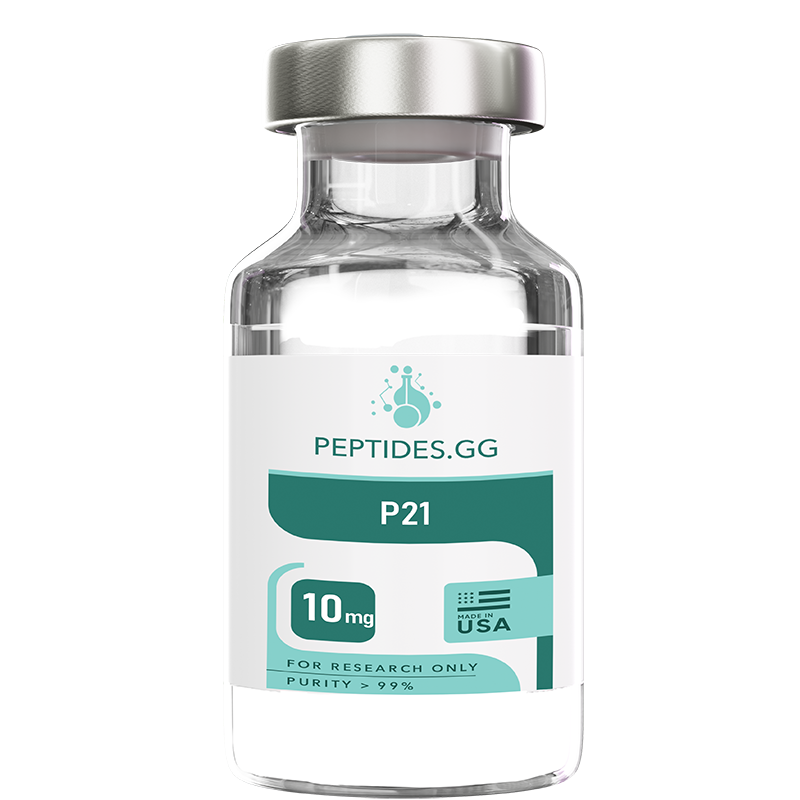
P21 serves as a valuable research tool for investigating cognitive enhancement mechanisms, neuroplasticity pathways, and neurotrophin signaling in laboratory settings.
Research Disclaimer: Peptides.GG sells this and all other peptides for Research Only and not for human consumption.
P21
$110.00
- Free Delivery on all orders over $200
- Earn 5% Store Credit with Every Order
- Same Day Shipping Before 1 PM PST
- 10% Discount for Cryptocurrency Payments
14-day money-back guarantee
If you are not satisfied with the product, simply return it and we will refund your money

P21 serves as a valuable research tool for investigating cognitive enhancement mechanisms, neuroplasticity pathways, and neurotrophin signaling in laboratory settings.
Research Disclaimer: Peptides.GG sells this and all other peptides for Research Only and not for human consumption.
Frequently Asked Questions About P21
What is P21?
P21 is a synthetic peptide derived from ciliary neurotrophic factor (CNTF), a member of the IL-6 cytokine family, designed to retain CNTF’s cognitive-enhancement and neurotrophic activity in a smaller, more research-tractable fragment. It is supplied strictly as a research compound for laboratory use and is not for human consumption.
What is the molecular profile of P21?
P21 has an approximate molecular weight of ~578.7 Da and a molecular formula of C₂₇H₄₂N₆O₈, with the exact sequence proprietary to the research formulation. It is engineered as an optimized fragment of CNTF that retains the receptor-binding domain and signal-transduction motifs needed for neurotrophin-receptor interaction while eliminating non-essential sequence.
What is P21 studied for in research?
In preclinical and in vitro research, P21 is used to investigate adult hippocampal neurogenesis, CREB-pathway activation, cognitive-enhancement mechanisms, synaptic plasticity, and neurotrophic-factor signaling (including BDNF and CNTF-receptor pathways). Supplied for laboratory research use only; not for human consumption.
What is P21 derived from?
P21 is a rationally designed fragment of ciliary neurotrophic factor (CNTF). Full-length CNTF is large (>20 kDa) with complex multi-receptor signaling; P21 was developed to preserve the essential receptor-binding domain and CNTF’s cognitive-enhancement activity within an optimized peptide framework, giving researchers improved metabolic stability and specificity.
What size is P21 available in?
P21 is supplied as a 10 mg lyophilized (freeze-dried) powder. The lyophilized format limits solution-phase degradation during storage and allows precise gravimetric preparation of research concentrations at the point of use.
How is P21 stored and handled in the laboratory?
P21 is a white to off-white lyophilized powder soluble in water, bacteriostatic water, and phosphate-buffered saline. The lyophilized powder is kept sealed, cold (-20°C to -80°C), and protected from light and moisture until use. Each batch is third-party tested with a Certificate of Analysis.
Related products
-

Methylene Blue
$24.99 – $30.99 Select options This product has multiple variants. The options may be chosen on the product pageSize: 10mg/ML 50ml, 12mg x 60 Capsules
-
VIP
$55.00 – $99.00 Select options This product has multiple variants. The options may be chosen on the product pageChoose Option: 5mg, 10mg
-
Adamax
$65.00 Select options This product has multiple variants. The options may be chosen on the product pageSize: 10mg

Research Overview
P21 serves as a valuable research tool for investigating cognitive enhancement mechanisms, neuroplasticity pathways, and neurotrophin signaling in laboratory settings. This synthetic peptide represents a rationally designed fragment of ciliary neurotrophic factor (CNTF), a member of the IL-6 cytokine family known for potent neurotrophic and neuroprotective properties. Neuroprotection research also utilizes Pinealon, a bioregulatory tripeptide targeting gene expression in neural tissue through mechanistically distinct pathways. Through structure-activity relationship studies, P21 was developed to maintain CNTF’s cognitive enhancement effects while offering improved research utility and specificity. Neurotrophin-focused cognitive research complements P21 studies with Noopept for glutamatergic receptor modulation and N-Acetyl Semax Amidate for BDNF-mediated neuroplasticity investigations.
The peptide’s development focused on identifying the minimal active sequence responsible for CNTF’s cognitive benefits. Full-length CNTF, while demonstrating remarkable neurotrophic properties, presents challenges for research applications due to its large size (molecular weight >20 kDa), complex multi-receptor signaling, and potential for pleiotropic effects. P21 addresses these limitations by preserving essential neurobiological activities within an optimized peptide framework.
P21 research demonstrates robust effects on hippocampal neurogenesis, a process closely linked to learning and memory formation. Laboratory studies investigate the peptide’s effects on neural progenitor proliferation, neuronal differentiation, synaptic integration, and functional contribution of adult-born neurons to cognitive processes. The peptide’s mechanism involves CREB pathway activation, neurotrophic factor expression modulation, and enhancement of synaptic plasticity markers.
Molecular Characteristics
Complete Specifications:
- Molecular Weight: ~578.7 Da (exact sequence proprietary to research formulation)
- CAS Registry Number: 1246751-68-7
- Molecular Formula: C₂₇H₄₂N₆O₈
- Peptide Classification: CNTF-derived synthetic cognitive enhancement peptide
- Design Rationale: Optimized fragment maintaining neurotrophin receptor interaction
- Appearance: White to off-white lyophilized powder
- Solubility: Water, bacteriostatic water, phosphate buffered saline
- Structural Features: Retained CNTF receptor binding domain
The peptide’s molecular architecture incorporates the essential structural elements required for CNTF receptor complex interaction while eliminating non-essential sequences. P21 maintains critical amino acid residues necessary for receptor binding and downstream signaling pathway activation. The optimized length provides improved metabolic stability compared to full-length CNTF while preserving biological activity essential for cognitive enhancement research.
Key Structural Features:
- Receptor Binding Domain: Maintained CNTF receptor (CNTFR) interaction capability
- Signal Transduction Motifs: Preserved sequences for JAK-STAT pathway activation
- Reduced Molecular Size: Enhanced tissue penetration and research utility
- Improved Specificity: Focused cognitive enhancement activity profile
Pharmacokinetic Profile in Research Models
P21 pharmacokinetic characterization in preclinical research demonstrates favorable properties for cognitive research applications:
Stability and Distribution:
- Improved metabolic stability vs. full-length CNTF
- Tissue distribution: CNS penetration documented in research models
- Brain regional targeting: Hippocampus, cortex (high CNTF receptor expression regions)
- Duration of biological effects: Extended cognitive enhancement observed for days post-administration
Absorption Considerations:
- Multiple administration routes investigated in research models
- Intranasal administration shows promise for direct CNS delivery
- Peripheral administration with documented CNS effects
- administration optimization based on experimental paradigm and research objectives
Biological Activity Profile:
- Rapid CREB phosphorylation observed within hours
- Neurogenesis effects detected 24-72 hours post-administration
- Sustained cognitive improvements lasting days to weeks
- Cumulative neuroplastic effects with repeated administration
These pharmacokinetic and pharmacodynamic characteristics enable diverse research protocols investigating acute cognitive enhancement, sustained neuroplasticity effects, and long-term neurogenesis modulation.
Research Applications
Neurogenesis and Adult Hippocampal Research
P21 serves as a research tool for investigating adult neurogenesis mechanisms:
- Neural Progenitor Proliferation: Investigation of progenitor cell division and expansion
- Neuronal Differentiation: Studies on progenitor commitment to neuronal lineage
- Neuronal Migration: Research on new neuron migration to target brain regions
- Synaptic Integration: Investigation of functional incorporation into neural circuits
- Survival and Maturation: Studies on long-term survival of adult-born neurons
Research protocols employ BrdU labeling, DCX immunostaining, retroviral labeling, and electrophysiological recording to characterize P21’s neurogenesis effects. Experimental timelines span days to weeks to capture proliferation, differentiation, and integration phases.
CREB Pathway Investigation
Laboratory studies investigate P21’s CREB activation mechanisms:
- CREB Phosphorylation: Analysis of rapid pCREB induction following P21 administration
- Gene Expression Profiling: Investigation of CREB-responsive gene transcription
- Downstream Effectors: Research on IEG (immediate early gene) expression patterns
- Transcriptional Regulation: Studies on learning-related gene expression programs
- Pathway Crosstalk: Investigation of CREB interactions with other signaling cascades
CREB signaling is central to memory consolidation and synaptic plasticity. P21’s robust CREB activation makes it valuable for dissecting CREB-dependent cognitive mechanisms.
Cognitive Enhancement Mechanism Studies
P21 facilitates investigation of cognitive enhancement at multiple levels:
- Memory Formation Research: Investigation of encoding, consolidation, and retrieval enhancement
- Learning Facilitation: Studies on acquisition rate improvement across learning paradigms
- Spatial Cognition: Research using Morris water maze, radial arm maze, Barnes maze
- Recognition Memory: Investigation using novel object recognition, object location tasks
- Fear Memory: Studies on contextual and cued fear conditioning enhancement
Experimental protocols correlate P21’s neurobiological effects (neurogenesis, CREB activation, synaptic markers) with cognitive performance outcomes to establish mechanism-function relationships.
Synaptic Plasticity Research
Research applications extend to synaptic mechanism investigation:
- Long-Term Potentiation: Investigation of LTP magnitude and duration enhancement
- Synaptic Density: Studies on synaptophysin, PSD-95, and other synaptic protein expression
- Dendritic Spine Analysis: Research on spine density, morphology, and dynamics
- Structural Plasticity: Investigation of dendritic arborization and synaptic remodeling
- Functional Connectivity: Studies using electrophysiology and imaging to assess network effects
Laboratory protocols combine electrophysiological recordings, molecular analysis (Western blot, immunohistochemistry), and structural imaging (confocal microscopy, electron microscopy) to characterize P21’s synaptic plasticity effects.
Neurotrophic Factor Pathway Research
P21 provides a research tool for investigating neurotrophic signaling:
- BDNF Expression: Analysis of brain-derived neurotrophic factor upregulation
- NGF Modulation: Investigation of nerve growth factor pathway interactions
- Neurotrophin Receptor Signaling: Studies on TrkB, TrkA receptor activation
- CNTF Receptor Complex: Research on CNTFR/gp130/LIFR signaling mechanisms
- JAK-STAT Pathway: Investigation of cytokine-like signaling in neurons
Research examines P21’s effects on neurotrophic factor expression, receptor phosphorylation, and downstream signaling cascade activation to understand mechanisms of cognitive enhancement.
Neuroprotection Research Applications
P21’s neurotrophic properties enable neuroprotection mechanism investigation:
- Oxidative Stress Models: Research on protection against ROS and oxidative damage
- Excitotoxicity Studies: Investigation of glutamate-induced neurotoxicity protection
- Ischemic Injury Models: Studies on stroke and hypoxia-ischemia protection mechanisms
- Neurodegenerative Paradigms: Research in chronic neurodegeneration models
- Cognitive Aging Research: Investigation of age-related cognitive decline prevention
Experimental models include cell culture stress models, hippocampal slice preparations under stress conditions, and in vivo injury models assessing P21’s neuroprotective efficacy.
Laboratory Handling and Storage Protocols
Lyophilized Powder Storage:
- Store at -20°C to -80°C in original sealed vial
- Protect from light exposure and moisture
- Desiccated storage environment required
- Stability data: 12+ months at -20°C under proper storage conditions
Special Handling Considerations: Each P21 batch undergoes comprehensive analytical characterization appropriate for complex synthetic peptides: Purity Analysis: Structural Verification: Bioactivity Verification: Contaminant Testing: Documentation: Experimental Design Factors: Researchers should consider several factors when designing P21 experiments: 1. Temporal Dynamics: P21’s effects manifest over different timescales. CREB activation occurs within hours, neurogenesis effects require days, and cognitive improvements may accumulate with repeated administration. 2. administration Paradigms: single-administration vs. repeat-administration protocols produce different outcomes. Acute administration for immediate plasticity studies vs. chronic administration for cumulative neurogenesis effects. 3. Administration Route: Consider intranasal for direct CNS delivery or systemic routes with documented brain penetration. Route selection impacts onset, duration, and magnitude of effects. 4. Cognitive Assessment Timing: Align behavioral testing with expected peak effects. Neurogenesis-dependent cognitive benefits may require 1-3 weeks post-treatment. 5. Neurogenesis-Independent Effects: P21 produces cognitive enhancement through multiple mechanisms. Design experiments to dissect neurogenesis-dependent vs. neurogenesis-independent effects. Mechanism Investigation: P21’s mechanisms of action involve multiple converging pathways: Multi-level experimental approaches combining molecular, cellular, and behavioral assays provide comprehensive mechanistic insights. Regulatory Status: Intended Use: NOT Intended For: Safety Protocols: —
Research Considerations
Compliance and Safety Information
P21 is provided as a research chemical for in-vitro laboratory studies and preclinical research only. This product has not been approved by the FDA for human therapeutic use, dietary supplementation, or medical applications.
Researchers should follow standard laboratory safety practices when handling P21: