

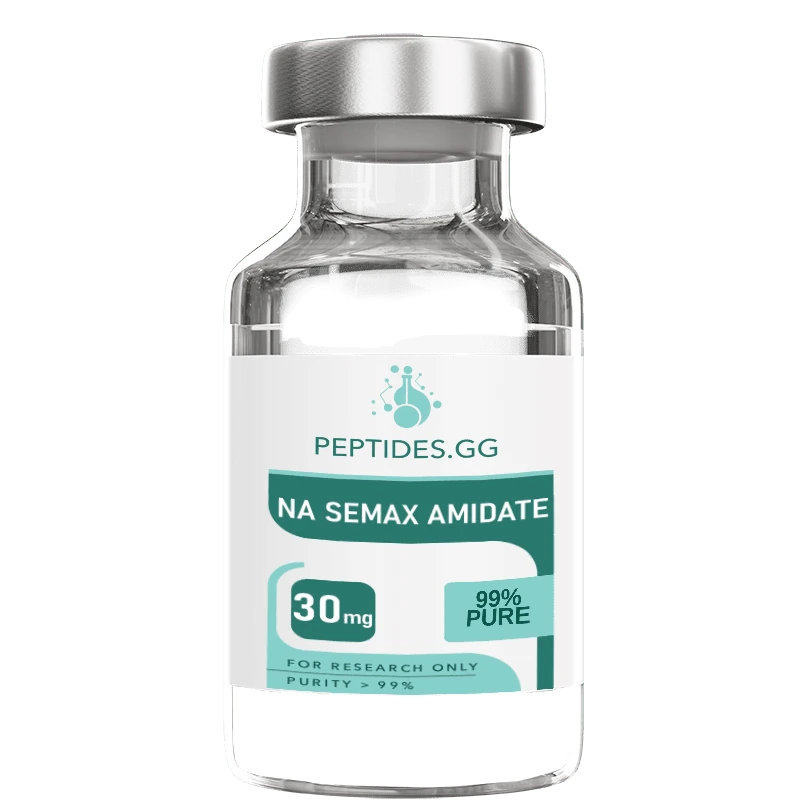
The N-Acetyl Semax Amidate peptide serves as a valuable research tool for investigating enhanced melanocortin receptor-mediated neuroprotection, cognitive modulation, and neuroplasticity mechanisms. This modified analog of Semax demonstrates improved stability and bioavailability for research applications.
Research Disclaimer: Peptides.GG sells this and all other peptides for Research Only and not for human consumption.
N-Acetyl Semax Amidate Peptide
$69.00
- Free Delivery on all orders over $200
- Earn 5% Store Credit with Every Order
- Same Day Shipping Before 1 PM PST
14-day money-back guarantee
Not satisfied? Return any unopened product within 14 days of delivery for a full refund — we send the return label.

The N-Acetyl Semax Amidate peptide serves as a valuable research tool for investigating enhanced melanocortin receptor-mediated neuroprotection, cognitive modulation, and neuroplasticity mechanisms. This modified analog of Semax demonstrates improved stability and bioavailability for research applications.
Research Disclaimer: Peptides.GG sells this and all other peptides for Research Only and not for human consumption.
Frequently Asked Questions About N-Acetyl Semax Amidate
What is N-Acetyl Semax Amidate?
N-Acetyl Semax Amidate is a doubly modified analog of Semax, the synthetic heptapeptide based on the ACTH(4-10) fragment. It carries two stabilizing modifications — an N-terminal acetyl group and a C-terminal amide — on the Semax sequence, and is studied as a research tool for neurotrophic and neuroprotective mechanisms. It is supplied strictly as a research compound for laboratory use and is not for human consumption.
What is the molecular profile of N-Acetyl Semax Amidate?
N-Acetyl Semax Amidate has the sequence Ac-Met-Glu-His-Phe-Pro-Gly-Pro-NH₂ — the ACTH(4-10)-based Semax heptapeptide with the N-terminus acetylated and the C-terminus amidated. Its molecular formula is C₃₉H₅₄N₁₀O₁₀S and its molecular weight is approximately ~855 Da. A formal CAS registry number is not assigned to this specific modified form. It is supplied as a white to off-white lyophilized powder, soluble in water and bacteriostatic water, and verified at ≥99% purity by reversed-phase HPLC.
How do the acetylation and amidation modifications affect the peptide?
The N-terminal acetyl group and C-terminal amide cap both ends of the heptapeptide, which in research is associated with greater resistance to aminopeptidase and carboxypeptidase breakdown compared with unmodified Semax. This double-capping is the defining structural feature distinguishing N-Acetyl Semax Amidate from Semax and from the N-acetyl-only variant. The modifications are a stability strategy studied in peptide-pharmacology research.
How is N-Acetyl Semax Amidate studied in research models?
In laboratory research, the Semax family is studied for effects on neurotrophic-factor systems — including brain-derived neurotrophic factor (BDNF) and nerve growth factor (NGF) — and for neuroprotective activity in rodent models of cerebral ischemia, alongside interactions with cholinergic and monoaminergic systems. These mechanisms are investigated in cell-culture and animal models, not in humans.
What is N-Acetyl Semax Amidate studied for in laboratory research?
In preclinical and in vitro research, N-Acetyl Semax Amidate is used as a tool to investigate neurotrophic-factor expression, neuroprotection in ischemia models, and the pharmacology and stability of modified ACTH(4-10) analogs. Typical protocols include gene- and protein-expression assays and neuroprotection models in animals. Supplied for laboratory research use only; not for human consumption.
What purity is N-Acetyl Semax Amidate, and is it third-party tested?
Each batch of N-Acetyl Semax Amidate is verified at ≥99% purity by reversed-phase HPLC, with identity confirmed by electrospray-ionization mass spectrometry against its approximately ~855 Da molecular weight and amino-acid analysis. The lyophilized powder is kept sealed and desiccated at -20°C to -80°C, protected from light and moisture, with stability data available for 24+ months at -20°C. A Certificate of Analysis accompanies each batch, with third-party analytical verification available on request.
Research References
Peer-reviewed studies and database records underpinning the research described on this page. Links open on PubMed, PubMed Central, or the publisher in a new tab.
- Dolotov OV, et al. Semax, an analog of ACTH(4-10) with cognitive effects, regulates BDNF and trkB expression in the rat hippocampus. Brain Res. 2006. PMID: 16996037 →
- Dolotov OV, et al. Semax, an analogue of adrenocorticotropin (4-10), binds specifically and increases levels of brain-derived neurotrophic factor protein in rat basal forebrain. J Neurochem. 2006. PMID: 16635254 →
- Shadrina M, et al. Comparison of the temporary dynamics of NGF and BDNF gene expression in rat hippocampus, frontal cortex, and retina under Semax action. J Mol Neurosci. 2010. PMID: 19662538 →
- Dmitrieva VG, et al. Semax and Pro-Gly-Pro activate the transcription of neurotrophins and their receptor genes after cerebral ischemia. Cell Mol Neurobiol. 2010. PMID: 19633950 →
- Sudarkina OY, et al. Brain Protein Expression Profile Confirms the Protective Effect of the ACTH(4-7)PGP Peptide (Semax) in a Rat Model of Cerebral Ischemia-Reperfusion. Int J Mol Sci. 2021. PMID: 34201112 →
- Eremin KO, et al. Semax, an ACTH(4-10) analogue with nootropic properties, activates dopaminergic and serotoninergic brain systems in rodents. Neurochem Res. 2005. PMID: 16362768 →
- Medvedeva EV, et al. The peptide semax affects the expression of genes related to the immune and vascular systems in rat brain focal ischemia: genome-wide transcriptional analysis. BMC Genomics. 2014. PMID: 24661604 →
- Potaman VN, et al. Degradation of ACTH/MSH(4-10) and its synthetic analog semax by rat serum enzymes: an inhibitor study. Peptides. 1993. PMID: 8392718 →
Related products
-

Selank
$33.00 Select options This product has multiple variants. The options may be chosen on the product pageSize: 10mg
-
NA Selank Amidate
$40.00 – $65.00 Select options This product has multiple variants. The options may be chosen on the product pageSize: 10mg, 30mg
Research Overview
The N-Acetyl Semax Amidate peptide is a structurally optimized synthetic analog of the adrenocorticotropic hormone fragment ACTH(4-10), engineered with dual terminal modifications — N-terminal acetylation and C-terminal amidation — that substantially alter its stability and receptor interaction profile relative to the parent Semax molecule. The base Semax sequence (Met-Glu-His-Phe-Pro-Gly-Pro) was itself derived from the ACTH(4-7) core pharmacophore extended with a Pro-Gly-Pro tripeptide to enhance penetration of the blood-brain barrier in research models. N-Acetyl Semax Amidate represents the most chemically refined iteration of this lineage, and it has become a preferred research tool in neuroscience laboratories examining the molecular underpinnings of brain-derived neurotrophic factor (BDNF) regulation, neuroprotective signaling, and melanocortin receptor pharmacology.
The peptide has attracted sustained research interest because the ACTH(4-10) fragment it is derived from does not exhibit the adrenocortical activity of full-length ACTH, making it a selective probe for the behavioral and neurotrophin-related actions of the melanocortin system. Research groups focused on cognitive function, neuroplasticity, and neuroprotection have used N-Acetyl Semax Amidate to investigate the downstream consequences of melanocortin receptor engagement in central nervous system tissue, particularly with respect to BDNF and nerve growth factor (NGF) expression in rodent models. For investigators building a broader picture of neuroprotective peptide pharmacology, related research tools such as Selank and PE-22-28 are frequently examined alongside N-Acetyl Semax Amidate in comparative preclinical studies.
The specific combination of N-acetylation and C-amidation distinguishes N-Acetyl Semax Amidate from both unmodified Semax and the singly modified N-Acetyl Semax variant. These terminal modifications collectively reduce susceptibility to exopeptidase degradation — aminopeptidases at the N-terminus and carboxypeptidases at the C-terminus — resulting in a construct with extended half-life in biological matrices compared to the parent peptide. This enhanced metabolic stability, combined with the Pro-Gly-Pro extension’s reported capacity to facilitate central nervous system access, has made N-Acetyl Semax Amidate a widely cited compound in the preclinical neurotrophin and neuroprotection literature. Researchers studying nootropic peptide biology often examine it in the context of other neuroactive research tools, including Noopept and Cortagen, to build comparative mechanistic frameworks.
Molecular Characteristics
Complete Specifications:
- CAS Number: Not formally assigned for the N-acetyl amidate form
- Molecular Weight: ~855 Da
- Molecular Formula: C₃₉H₅₄N₁₀O₁₀S
- Sequence: Ac-Met-Glu-His-Phe-Pro-Gly-Pro-NH₂ (N-acetylated, C-amidated)
- Peptide Length / Classification: 7 amino acids; synthetic melanocortin/ACTH fragment analog, enhanced stability nootropic peptide
- Appearance: White to off-white lyophilized powder
- Solubility: Readily soluble in sterile water and physiological saline; PBS solubility confirmed at research-relevant concentrations
At approximately 855 Da, N-Acetyl Semax Amidate occupies the low-molecular-weight end of the research peptide spectrum, a size regime associated with favorable passive diffusion characteristics and tractable analytical quantification. The heptapeptide backbone retains the His-Phe-Pro pharmacophore that is understood to be critical for melanocortin receptor engagement, while the flanking Met-Glu and Pro-Gly-Pro segments contribute to the overall conformational landscape and metabolic profile of the molecule. Circular dichroism studies of Semax-family peptides in aqueous and membrane-mimetic environments have shown that the Pro residues impose conformational constraints that restrict backbone flexibility, potentially pre-organizing the central pharmacophore for receptor interaction.
The acetyl group at the N-terminus not only confers exopeptidase resistance but also alters the electrostatic character of the peptide’s N-terminal region, reducing the positive charge that would otherwise be present on a free amine at physiological pH. This modification affects the peptide’s interaction with anionic components of biological surfaces and may contribute to differences in receptor selectivity observed between N-Acetyl Semax Amidate and the free-amine parent compound. The C-terminal amide similarly mimics the charge-neutral environment found in the native post-translational processing of many neuropeptides, providing a bioisosteric replacement for the carboxylate that reduces susceptibility to carboxypeptidase cleavage.
Pharmacokinetic Profile in Research Models
Absorption and Central Nervous System Access
- Intranasal administration routes have been studied in rodent models to assess CNS delivery efficiency, leveraging the olfactory and trigeminal pathways that bypass the blood-brain barrier for small peptides with appropriate physicochemical properties
- The Pro-Gly-Pro extension incorporated into the Semax scaffold is hypothesized to facilitate active or passive transcellular transport mechanisms relevant to blood-brain barrier penetration, and this hypothesis has informed the design of intranasal delivery studies in rodent preclinical models
- Comparative bioavailability studies between N-Acetyl Semax Amidate and parent Semax in rodent models demonstrate that the terminal modifications extend plasma half-life, providing a longer window for CNS engagement per administration in preclinical experimental designs
- Radiolabeled tracer studies in rodent models have been used to track the regional CNS distribution of Semax-family peptides following intranasal or systemic administration
Bioactivity Dynamics and Receptor Engagement
- BDNF and NGF mRNA upregulation in rodent brain tissue has been documented within hours of N-Acetyl Semax Amidate administration in preclinical models, with the magnitude and regional specificity of induction characterized by quantitative PCR and in situ hybridization
- Melanocortin receptor binding studies (MC1R, MC4R, MC5R radioligand binding assays) have been used to characterize the receptor selectivity profile of N-Acetyl Semax Amidate relative to full-length ACTH and other ACTH fragment analogs
- cAMP second messenger assays in melanocortin receptor-expressing cell lines provide functional correlates of receptor engagement that complement binding studies in research characterization of this compound
Metabolic Considerations
- The dual terminal modifications of N-Acetyl Semax Amidate confer significantly improved resistance to exopeptidase degradation compared to unprotected Semax, with LC-MS/MS methods used to quantify intact peptide in plasma and brain homogenate samples over time
- Endopeptidase cleavage within the peptide backbone remains a degradation pathway under investigation; the Pro residues at positions 5 and 7 provide structural resistance to many endopeptidases that require flexible backbone access
- Metabolite profiling studies in rodent models have characterized the degradation products of N-Acetyl Semax Amidate, providing information relevant to the interpretation of behavioral and molecular endpoints in preclinical experiments
Research Applications
BDNF and Neurotrophin Expression Research
- Studies examining regional BDNF mRNA and protein upregulation following N-Acetyl Semax Amidate administration in rodent models, with particular focus on the hippocampus and prefrontal cortex
- TrkB receptor phosphorylation assays (Western blot, ELISA) used to confirm that BDNF protein increases produced by N-Acetyl Semax Amidate are biologically active and capable of engaging downstream signaling cascades
- CREB phosphorylation and downstream transcriptional regulation studies examining how melanocortin-driven BDNF increases translate into lasting changes in gene expression profiles in neuronal populations
- Comparative neurotrophin induction studies using N-Acetyl Semax Amidate and N-Acetyl Semax to isolate the contribution of C-amidation to the neurotrophin induction profile
The BDNF-upregulating activity of N-Acetyl Semax Amidate in preclinical models has made it a prominent research tool in the neurotrophin field. BDNF is a critical regulator of synaptic plasticity, neuronal survival, and adult neurogenesis, and compounds capable of modulating its expression in defined brain regions are valuable probes for interrogating these processes in mechanistic research.
Neuroprotection Studies in Preclinical Injury Models
- Rodent models of ischemic brain injury (transient and permanent middle cerebral artery occlusion) have been used to examine the effects of N-Acetyl Semax Amidate on infarct volume, neurological deficit scoring, and molecular markers of excitotoxicity
- Oxidative stress marker quantification (malondialdehyde, superoxide dismutase activity, glutathione levels) in brain tissue following peptide treatment in injury models provides mechanistic data on antioxidant-related neuroprotective pathways
- Neuroinflammation studies measuring cytokine profiles (TNF-α, IL-6, IL-1β) and microglial activation markers (Iba-1, CD68) in treated versus control animals elucidate the inflammatory modulation component of neuroprotective effects
- Neuronal apoptosis quantification (TUNEL staining, cleaved caspase-3 immunohistochemistry) in injury models treated with N-Acetyl Semax Amidate addresses whether neuroprotection involves direct anti-apoptotic signaling
Neuroprotection research using N-Acetyl Semax Amidate spans multiple injury paradigms and mechanistic hypotheses, reflecting the compound’s documented ability to engage multiple protective pathways simultaneously. This multi-target profile, while making mechanistic attribution more complex, also makes N-Acetyl Semax Amidate a versatile research tool for studying neuroprotection as a systems-level biological phenomenon.
Cognitive Function and Neuroplasticity Research
- Morris water maze, radial arm maze, and novel object recognition behavioral paradigms in rodent models have been used to characterize the effects of N-Acetyl Semax Amidate on spatial memory, working memory, and recognition memory endpoints
- Long-term potentiation (LTP) recordings in hippocampal slice preparations provide electrophysiological measures of synaptic plasticity relevant to the proposed cognitive research applications of the compound
- Dendritic spine density and morphology analyses (Golgi staining, confocal microscopy) in brain regions associated with learning and memory provide structural correlates of plasticity effects
- Comparative studies pairing N-Acetyl Semax Amidate with dipeptide research tools such as Adamax allow mechanistic comparison across distinct neurochemical targets in the same behavioral paradigms
Melanocortin Receptor Pharmacology
- Radioligand displacement assays at cloned human melanocortin receptors (MC1R through MC5R) characterize the binding affinity and selectivity profile of N-Acetyl Semax Amidate across the receptor family
- Functional cAMP assays in HEK-293 or CHO cells expressing individual MC receptor subtypes define agonist potency (EC50) and efficacy (Emax) parameters for each receptor subtype
- Structure-activity relationship studies comparing N-Acetyl Semax Amidate to Semax, N-Acetyl Semax, and truncated analogs provide data on the molecular determinants of receptor selectivity within this peptide series
- In vivo receptor occupancy studies using PET-compatible radiolabeled analogs represent an emerging methodology for characterizing CNS receptor engagement of Semax-family peptides in preclinical models
Laboratory Handling and Storage Protocols
Lyophilized Storage
- Store lyophilized N-Acetyl Semax Amidate at −20°C in a sealed, desiccated container protected from light; under these conditions, the lyophilized material is stable for 24 months from the manufacture date
- Pre-aliquoting into single-experiment quantities before use is strongly recommended to prevent repeated freeze-thaw degradation of the entire stock
- Allow vials to reach room temperature before opening to prevent moisture condensation on the hygroscopic powder
Quality Assurance and Analytical Testing
The analytical methods below are those commonly used to characterize and verify the identity, purity, and quality of research compounds in this class:
- Purity Analysis (HPLC): N-Acetyl Semax Amidate is characterized by reverse-phase HPLC using a C18 column with UV detection; purity is confirmed at ≥99% by peak area integration, and the chromatogram is included in the certificate of analysis
- Structural Verification (ESI-MS): Electrospray ionization mass spectrometry confirms the molecular mass of the intact peptide and verifies the presence of both the N-acetyl group and C-terminal amide, distinguishing N-Acetyl Semax Amidate from partially modified variants
- Contaminant Testing: Residual solvent analysis, endotoxin testing (LAL method), and counterion quantification (acetate or TFA content) help ensure research-grade quality and to prevent confounding of experimental results by contaminant bioactivity
- Documentation: A certificate of analysis specifying lot number, synthesis date, purity percentage, mass spectrometric data, and recommended storage conditions is provided with each shipment
Research Considerations
Investigators designing preclinical experiments with N-Acetyl Semax Amidate should consider the following experimental design factors:
- Include a Semax parent compound and, where feasible, N-Acetyl Semax control groups to isolate the specific contributions of each terminal modification to observed experimental outcomes
- Verify receptor expression profiles (MC4R in particular) in brain regions under investigation, as regional receptor density will influence the magnitude and anatomical specificity of responses in preclinical models
- Account for the methionine residue as a potential site of oxidative modification during storage and in oxidatively stressed biological environments; analytical verification of peptide integrity at the start and end of extended experiments is advisable
- Use vehicle-matched controls (same vehicle buffer, same administration route) to distinguish peptide-specific effects from administration procedure effects in behavioral and molecular endpoint studies
- Consider the acute versus chronic administration context; BDNF induction kinetics and neuroplasticity endpoint measurements require appropriately timed sacrifice or sampling protocols relative to the last administration
Mechanistic questions of active interest in the current literature include:
- The specific MC receptor subtype(s) most responsible for BDNF induction by N-Acetyl Semax Amidate in distinct brain regions, addressable by receptor-selective antagonist co-administration experiments
- Whether the neuroprotective effects observed in injury models are primarily mediated through BDNF upregulation or via direct receptor-mediated anti-inflammatory and anti-apoptotic signaling pathways independent of BDNF
- The extent to which improved metabolic stability of N-Acetyl Semax Amidate versus unmodified Semax accounts for quantitative differences in efficacy at equivalent administered amounts in preclinical models
Compliance and Safety Information
- Regulatory Status: N-Acetyl Semax Amidate is supplied solely as a research reagent. It is not approved by the FDA or any equivalent regulatory authority as a pharmaceutical, dietary supplement, or medical device.
- Intended Use: This compound is intended exclusively for in vitro biochemical research, cell-based assays, and properly authorized preclinical animal studies conducted by trained researchers in compliant laboratory environments.
- NOT Intended For: Human or veterinary administration, self-experimentation, consumption in any form, or use outside of a controlled, registered research laboratory setting.
- Safety Protocols: Handle with appropriate personal protective equipment (nitrile gloves, safety glasses, lab coat). Refer to the Safety Data Sheet for hazard classification, first aid measures, and disposal requirements applicable in your jurisdiction.