

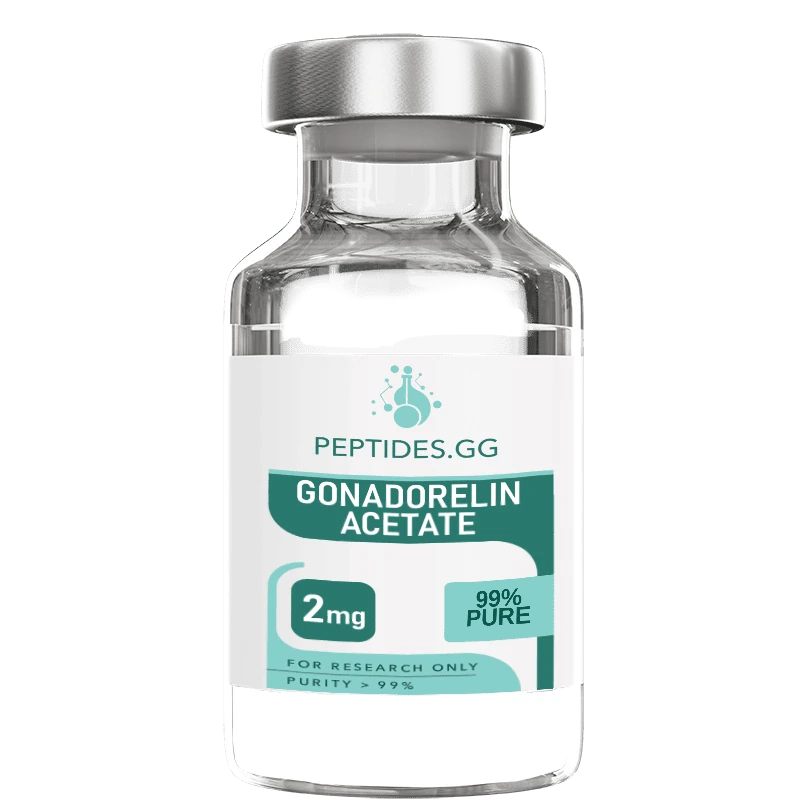
The Gonadorelin peptide (Acetate) serves as an essential research tool for investigating reproductive neuroendocrinology and hypothalamic-pituitary axis regulation in laboratory settings.
Research Disclaimer: Peptides.GG sells this and all other peptides for Research Only and not for human consumption.
Gonadorelin Peptide (Acetate)
$40.00
- Free Delivery on all orders over $200
- Earn 5% Store Credit with Every Order
- Same Day Shipping Before 1 PM PST
14-day money-back guarantee
Not satisfied? Return any unopened product within 14 days of delivery for a full refund — we send the return label.

The Gonadorelin peptide (Acetate) serves as an essential research tool for investigating reproductive neuroendocrinology and hypothalamic-pituitary axis regulation in laboratory settings.
Research Disclaimer: Peptides.GG sells this and all other peptides for Research Only and not for human consumption.
Frequently Asked Questions About Gonadorelin Acetate
What is Gonadorelin Acetate?
Gonadorelin Acetate is a synthetic decapeptide identical in structure to naturally occurring gonadotropin-releasing hormone (GnRH), the hypothalamic neuropeptide that regulates the reproductive endocrine system. It is supplied strictly as a research compound for laboratory use in reproductive neuroendocrinology, and is not for human consumption.
What is the amino acid sequence of Gonadorelin Acetate?
Gonadorelin has the sequence pGlu-His-Trp-Ser-Tyr-Gly-Leu-Arg-Pro-Gly-NH₂. Its molecular formula is C₅₅H₇₅N₁₇O₁₃, its molecular weight is 1,182.3 Da, and its CAS registry number is 34973-08-5. The N-terminal pyroglutamic acid and C-terminal glycine amide protect it from exopeptidase degradation.
What is Gonadorelin Acetate studied for in research?
In preclinical and in vitro research, Gonadorelin is used to investigate GnRH-receptor pharmacology and signaling, LH and FSH secretion dynamics, hypothalamic-pituitary-gonadal axis regulation, GnRH-neuron biology, fertility and reproductive function, and the upstream kisspeptin-GnRH axis. Supplied for laboratory research use only; not for human consumption.
Why must Gonadorelin be administered in pulses in research models?
GnRH physiologically acts in pulses, and pulse frequency determines whether LH or FSH secretion predominates. Pulsatile administration maintains GnRH-receptor responsiveness, whereas continuous exposure paradoxically suppresses gonadotropin release through receptor desensitization. This distinctive pharmacodynamic property - combined with a very short (2-4 minute) half-life - makes Gonadorelin a tool for studying the temporal control of hormone signaling.
What size is Gonadorelin Acetate available in?
Gonadorelin Acetate is supplied as a 2 mg lyophilized (freeze-dried) powder. The lyophilized format limits solution-phase degradation during storage and allows precise gravimetric preparation of research concentrations at the point of use.
How is Gonadorelin Acetate stored and handled in the laboratory?
Gonadorelin is a white to off-white lyophilized powder soluble in water, bacteriostatic water, and phosphate-buffered saline. The lyophilized powder is kept sealed, cold (-20°C to -80°C), and protected from light and moisture until use; slightly acidic pH improves solution stability and polypropylene tubes limit adsorption. Each batch is third-party tested with a Certificate of Analysis.
Related products
-

Melanotan 2
$36.00 Select options This product has multiple variants. The options may be chosen on the product pageSize: 10mg
-
Kisspeptin-10
$40.00 – $75.00 Select options This product has multiple variants. The options may be chosen on the product pageSize: 5mg, 10mg
-
Oxytocin
$50.00 Select options This product has multiple variants. The options may be chosen on the product pageSize: 10mg
Research Overview
The Gonadorelin peptide (Acetate) serves as an essential research tool for investigating reproductive neuroendocrinology and hypothalamic-pituitary axis regulation in laboratory settings. This synthetic decapeptide is identical in structure to the naturally occurring gonadotropin-releasing hormone (GnRH), the hypothalamic neuropeptide that represents the apex regulator of the reproductive endocrine system. Research applications have expanded significantly to encompass neuroendocrine signaling studies, receptor pharmacology investigations, pulsatile hormone secretion analysis, and fertility research across multiple experimental systems. Reproductive neuroendocrine research intersects with Kisspeptin-10, which acts upstream of GnRH neurons as the primary activator of the reproductive axis, and Oxytocin for studying hypothalamic neuropeptide interactions in reproductive function.
The peptide was first identified in the early 1970s through pioneering work that isolated and characterized the hypothalamic factor responsible for stimulating gonadotropin release from the anterior pituitary. This discovery earned Andrew Schally and Roger Guillemin the Nobel Prize in Physiology or Medicine in 1977, underscoring the fundamental importance of GnRH in reproductive biology. Laboratory studies investigate Gonadorelin’s effects on gonadotroph cell function, LH and FSH secretion dynamics, GnRH receptor signaling pathways, and reproductive hormone cascade regulation.
Gonadorelin Acetate research demonstrates the peptide’s unique pulsatile secretion requirement for proper reproductive function. Continuous exposure paradoxically suppresses gonadotropin release through receptor desensitization, while pulsatile administration maintains physiological responsiveness. This distinctive pharmacodynamic property makes Gonadorelin invaluable for investigating temporal aspects of hormone signaling, receptor regulation, and neuroendocrine communication.
Molecular Characteristics
Complete Specifications:
- CAS Registry Number: 34973-08-5
- Molecular Weight: 1,182.3 Da
- Molecular Formula: C₅₅H₇₅N₁₇O₁₃
- Amino Acid Sequence: pGlu-His-Trp-Ser-Tyr-Gly-Leu-Arg-Pro-Gly-NH₂
- Alternative Names: GnRH, LHRH, Luteinizing Hormone-Releasing Hormone, LH-RH
- Number of Amino Acids: 10
- N-terminal Modification: Pyroglutamic acid (cyclized glutamine)
- C-terminal Modification: Amidated glycine
- Peptide Classification: Hypothalamic releasing hormone
- Appearance: White to off-white lyophilized powder
- Solubility: Water, bacteriostatic water, phosphate buffered saline
The peptide’s 10-amino acid structure contains critical modifications at both termini that are essential for biological activity. The N-terminal pyroglutamic acid (cyclized glutamine) provides resistance to aminopeptidase degradation, while the C-terminal glycine amide protects against carboxypeptidase activity. These modifications significantly enhance metabolic stability compared to unmodified sequences. The peptide contains three aromatic residues (His², Trp³, Tyr⁵) that contribute to receptor binding affinity and specificity. Position 6 (glycine) serves as a critical flexibility point in the peptide backbone, allowing the molecule to adopt the proper conformation for GnRH receptor interaction.
Pharmacokinetic Profile in Research Models
Gonadorelin Acetate pharmacokinetic characterization in preclinical research reveals important properties for experimental design:
Absorption and Distribution:
- Intravenous bioavailability: 100% by definition
- Subcutaneous and intramuscular routes show variable absorption (20-40% bioavailability)
- Rapid distribution with small volume of distribution (0.2-0.5 L/kg)
- Minimal protein binding in circulation
- Does not cross blood-brain barrier significantly when administered peripherally
Metabolism and Elimination:
- Plasma half-life: 2-4 minutes following IV administration in rodent models
- Extremely rapid clearance through enzymatic degradation
- Primary metabolism sites: Positions 5-6, 6-7, and 9-10 bonds
- Degradation by endopeptidases and exopeptidases
- Renal clearance of metabolites
Pulsatile Secretion Dynamics:
- Endogenous GnRH released in pulses every 60-120 minutes
- Pulse frequency determines LH vs. FSH predominance
- Rapid pulse frequency favors LH release
- Slower pulse frequency favors FSH release
- Continuous exposure causes receptor desensitization
These pharmacokinetic characteristics inform research protocol design, particularly regarding pulsatile administration requirements, administration frequency, and timing of gonadotropin measurements. The extremely short half-life necessitates frequent administration or continuous infusion systems in experimental models investigating physiological pulsatile patterns.
Research Applications
Neuroendocrine Signaling and GnRH Receptor Research
Gonadorelin Acetate serves as a primary research tool for investigating hypothalamic-pituitary communication. Laboratory studies examine the peptide’s effects on:
- GnRH Receptor Pharmacology: Investigation of GnRH receptor (GnRHR) binding kinetics, affinity determination, and structure-activity relationships
- Receptor Signaling Pathways: Analysis of Gq/11 protein coupling, phospholipase C activation, inositol phosphate generation, and calcium mobilization
- Second Messenger Systems: Examination of intracellular calcium dynamics, protein kinase C activation, and downstream signaling cascades
- Receptor Desensitization Research: Studies on receptor internalization, downregulation, and resensitization following agonist exposure
- Receptor Expression Studies: Investigation of GnRH receptor gene expression, protein levels, and membrane localization
Research protocols typically employ primary pituitary cell cultures, immortalized gonadotroph cell lines (LβT2, αT3-1), receptor binding assays, calcium imaging, and reporter gene systems to characterize Gonadorelin’s receptor-mediated effects.
Gonadotropin Secretion Studies
Laboratory studies investigate Gonadorelin’s fundamental role in regulating gonadotropin release:
- LH Secretion Research: Examination of luteinizing hormone synthesis, storage, and regulated secretion from gonadotroph cells
- FSH Secretion Studies: Investigation of follicle-stimulating hormone production, differential regulation, and secretion kinetics
- Pulsatile Secretion Investigation: Analysis of pulse generator mechanisms, frequency modulation, and amplitude regulation
- Gonadotroph Cell Function: Studies on gonadotroph cell differentiation, gene expression, and secretory capacity
- concentration-response Characterization: Determination of concentration-effect relationships and maximal response parameters
These research areas utilize primary pituitary cell cultures, pituitary explants, radioimmunoassay or ELISA for hormone quantification, and perifusion systems for temporal secretion analysis.
Reproductive Endocrinology Research
Gonadorelin research extensively investigates reproductive hormone regulation:
- HPG Axis Regulation: Examination of hypothalamic-pituitary-gonadal axis feedback loops, hormone interactions, and regulatory mechanisms
- Sex Steroid Feedback: Investigation of estrogen and testosterone feedback effects on GnRH responsiveness and gonadotropin secretion
- Puberty Initiation Research: Studies on pubertal GnRH secretion patterns, gonadotropin surge generation, and reproductive maturation
- Ovulatory Cycle Studies: Analysis of GnRH pulse patterns during follicular and luteal phases, preovulatory LH surge mechanisms
- Seasonal Reproduction Research: Investigation of photoperiod effects on GnRH neurons and reproductive seasonality in appropriate animal models
Laboratory protocols employ intact animal models, gonadectomized models with hormone replacement, in vivo microdialysis, and serial hormone sampling to characterize reproductive endocrine regulation.
GnRH Neuron Biology Research
Research applications extend to GnRH neuron investigation:
- GnRH Neuron Development: Examination of embryonic GnRH neuron migration from olfactory placode to hypothalamus
- Neuron Electrophysiology: Investigation of GnRH neuron firing patterns, burst activity, and electrical properties
- Neurotransmitter Regulation: Studies on kisspeptin, GABA, glutamate, and other neurotransmitter inputs to GnRH neurons
- Neuron Network Properties: Research on GnRH neuron synchronization, pulse generator mechanisms, and network coordination
- Metabolic Regulation: Investigation of leptin, ghrelin, and metabolic signals affecting GnRH neuron activity
Experimental approaches include GnRH-GFP transgenic models, electrophysiological recordings, immunohistochemistry, neuronal tracing, and optogenetic manipulation techniques.
Fertility and Reproductive Function Research
Gonadorelin serves as a research tool for investigating fertility mechanisms:
- Ovarian Function Studies: Examination of follicular development, ovulation induction, and corpus luteum formation
- Testicular Function Research: Investigation of spermatogenesis regulation, Leydig cell function, and testosterone production
- Fertility Restoration Studies: Research on reproductive recovery following various challenges or interventions
- Reproductive Aging Research: Studies on reproductive senescence, ovarian reserve decline, and age-related GnRH changes
- Hypogonadotropic Hypogonadism Models: Investigation of GnRH deficiency states and reproductive insufficiency
Research protocols utilize ovarian histology, follicle counting, sperm analysis, testosterone measurements, fertility assessments, and reproductive outcome studies.
GnRH Analog and Antagonist Research
Laboratory studies investigate GnRH analogs and receptor modulation:
- GnRH Agonist Studies: Examination of superagonist properties, receptor downregulation mechanisms, and desensitization kinetics
- GnRH Antagonist Research: Investigation of competitive receptor antagonism, immediate suppression effects, and structure-activity relationships
- Structure-Activity Relationships: Analysis of amino acid substitutions, conformational changes, and biological activity modifications
- Long-Acting Analog Development: Studies on depot formulations, sustained release systems, and extended pharmacokinetic profiles
- Receptor Selectivity Research: Investigation of GnRH receptor subtype selectivity (GnRH-I vs. GnRH-II receptors)
These research applications employ competitive binding assays, functional antagonism studies, in vivo suppression models, and comparative pharmacology approaches.
Kisspeptin-GnRH Axis Research
Emerging research areas investigate upstream GnRH regulation:
- Kisspeptin Regulation: Examination of kisspeptin/GPR54 system effects on GnRH neuron activity and secretion
- RFRP-3 (GnIH) Studies: Investigation of gonadotropin-inhibitory hormone effects on GnRH release
- Neurokinin B Research: Analysis of neurokinin B/TAC3 signaling in GnRH pulse generation
- Metabolic Input Integration: Studies on leptin, insulin, and metabolic hormones affecting GnRH secretion
- Stress Effects Research: Investigation of stress hormone impacts on reproductive axis function
Laboratory protocols utilize dual-labeling immunohistochemistry, GnRH secretion measurements with upstream regulator manipulation, and knockout/knockdown models.
Laboratory Handling and Storage Protocols
Lyophilized Powder Storage:
- Store at -20°C to -80°C in original sealed vial
- Protect from light exposure and moisture
- Desiccated storage environment required
- Stability data available for 12+ months at -20°C
- Long-term storage at -80°C recommended for extended periods (>12 months)
Stability Considerations:
Gonadorelin Acetate demonstrates moderate stability when properly stored. The N-terminal pyroglutamic acid and C-terminal amide provide significant protection against exopeptidase degradation. However, the peptide remains susceptible to endopeptidase cleavage at specific sites, particularly under physiological conditions. Acidic pH (4-5) enhances stability, while neutral to basic pH accelerates degradation. Maintain sterile technique during preparation to prevent bacterial contamination. For pulsatile administration experiments, consider using programmable infusion pumps with appropriate storage conditions.
Quality Assurance and Analytical Testing
The analytical methods below are those commonly used to characterize and verify the identity, purity, and quality of research compounds in this class:
Purity Analysis:
- High-Performance Liquid Chromatography (HPLC): ≥99% purity
- Analytical method: Reversed-phase HPLC with UV detection at 214nm and 280nm
- Gradient elution with acetonitrile/water/TFA system
- Multiple peak integration to ensure accurate purity determination
- Related substances and degradation products quantified below acceptable limits
Structural Verification:
- Electrospray Ionization Mass Spectrometry (ESI-MS): Confirms molecular weight 1,182.3 Da
- MALDI-TOF mass spectrometry: Additional structural confirmation
- Amino acid analysis: Verifies sequence composition
- Peptide content determination: Quantifies actual peptide content by weight (typically ≥80%)
- N-terminal pyroglutamic acid confirmed
- C-terminal amide confirmed
Contaminant Testing:
- Bacterial endotoxin — Limulus amebocyte lysate (LAL) method
- Residual solvents: TFA and acetonitrile within ICH Q3C acceptable limits
- Water content: Karl Fischer titration (<8%)
- Acetate counter-ion confirmed by ion chromatography
Documentation:
- Certificate of Analysis (COA) provided with each batch
- Third-party analytical verification available upon request
- Stability data documented for recommended storage conditions
- Batch-specific QC results traceable by unique lot number
- Full chain of custody documentation available
- Compliance with research-grade specifications confirmed
Research Considerations
Experimental Design Factors:
Researchers should consider several factors when designing Gonadorelin Acetate experiments:
1. Pulsatile vs. Continuous Administration: Pulsatile delivery (every 1-2 hours) mimics physiological patterns and maintains receptor sensitivity. Continuous exposure causes rapid desensitization (within 2-4 hours) and paradoxical suppression of gonadotropin secretion.
2. Concentration Selection: In vitro studies typically use 0.1-100 nM concentrations. In vivo studies employ 0.01-10 μg/kg amounts depending on species and route. EC₅₀ values for LH release are typically 0.1-1 nM in pituitary cell cultures.
3. Temporal Considerations: LH response peaks at 15-30 minutes post-administration. FSH response may be delayed. Multiple sampling timepoints necessary to characterize full secretory response.
4. Species Differences: GnRH sequence is highly conserved across mammals but exhibits species variations in non-mammalian vertebrates. Receptor binding affinity and signaling efficiency may vary between species.
5. Sex and Hormonal Status: Gonadotropin responsiveness varies with sex, estrous cycle stage, castration status, and prior hormone exposure. Experimental design must account for these variables.
6. Control Groups: Include vehicle controls, time controls, and concentration-response series. Consider positive controls (potassium chloride for depolarization) in cell-based studies.
Mechanism Investigation:
Gonadorelin’s mechanisms of action involve well-characterized pathways:
- GnRH receptor (GnRHR) binding and activation (Class A GPCR)
- Gq/11 protein coupling and GTPase activation
- Phospholipase C-β activation and PIP₂ hydrolysis
- Inositol-1,4,5-trisphosphate (IP₃) generation and calcium release from intracellular stores
- Diacylglycerol (DAG) production and protein kinase C activation
- Calcium influx through voltage-gated calcium channels
- MAPK pathway activation (ERK1/2, JNK, p38)
- Transcription factor activation (AP-1, Egr-1) for gonadotropin gene expression
- Regulated exocytosis of LH and FSH from secretory granules
The peptide’s multiple downstream effects require careful experimental design to isolate specific signaling components. Use of pathway-specific inhibitors (U73122 for PLC, specific PKC inhibitors, MEK inhibitors) helps dissect individual pathway contributions.
Pulsatile Delivery Systems:
Investigating physiological GnRH function requires specialized delivery approaches:
- Programmable peristaltic pumps for in vivo studies
- Perifusion systems for in vitro pituitary cell studies
- Microfluidic devices for precise temporal control
- Push-pull perfusion for hypothalamic GnRH sampling
- Osmotic minipumps (note: provide continuous delivery, useful for desensitization studies)
Compliance and Safety Information
Regulatory Status:
Gonadorelin Acetate is provided as a research chemical for in-vitro laboratory studies and preclinical research only. This product has not been approved by the FDA for human therapeutic use, dietary supplementation, or medical applications. While gonadorelin formulations exist as approved medications in some contexts, this research-grade material is not intended for therapeutic purposes.
Intended Use:
- In-vitro pituitary cell culture studies
- In-vivo preclinical reproductive endocrinology research in approved animal models
- Laboratory investigation of neuroendocrine mechanisms
- Academic and institutional research applications
- Receptor pharmacology and signaling studies
- Drug development research
NOT Intended For:
- Human consumption or administration
- Therapeutic treatment or diagnosis
- Fertility treatment applications
- Veterinary therapeutic applications without appropriate oversight
- Any clinical or medical applications
- Dietary supplementation or bodybuilding purposes
Safety Protocols:
Researchers should follow standard laboratory safety practices when handling Gonadorelin Acetate:
- Use appropriate personal protective equipment (lab coat, nitrile gloves, safety glasses)
- Handle in well-ventilated areas or biosafety cabinet when working with cell cultures
- Follow institutional biosafety guidelines and endocrinology research protocols
- Dispose of waste according to local regulations for biological/chemical waste
- Consult material safety data sheet (MSDS) for additional safety information
- Follow IACUC-approved protocols for all animal studies
- Use appropriate radiation safety procedures if conducting radioimmunoassay
Animal Research Considerations:
- IACUC approval required for all in vivo studies
- Appropriate anesthesia and analgesia protocols
- Humane endpoints clearly defined
- Minimize animal numbers through proper statistical design
- Consider alternatives to animal models where feasible
—