

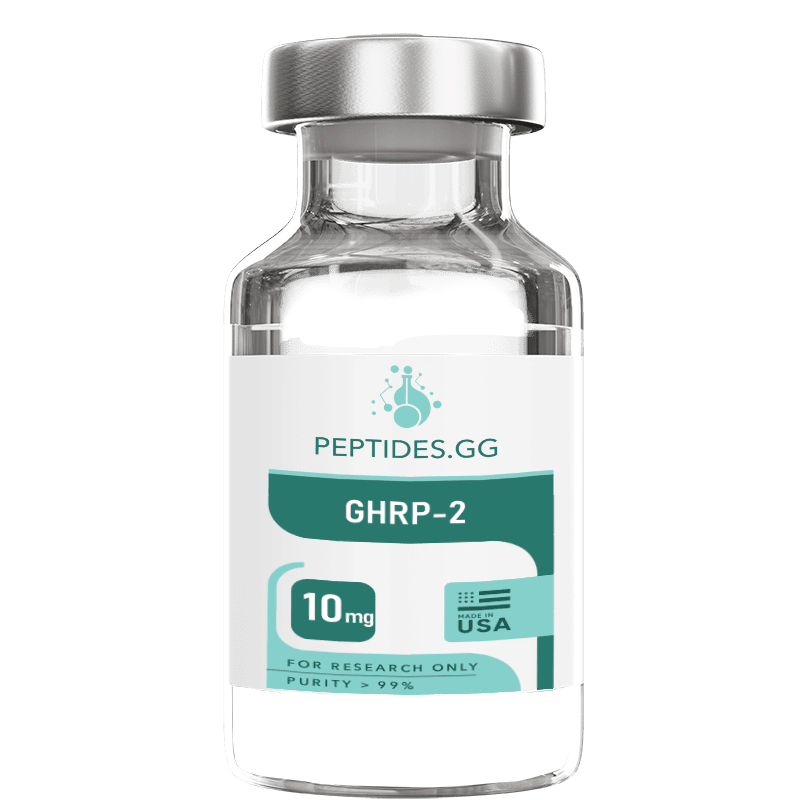
The GHRP-2 peptide (Growth Hormone Releasing Peptide-2) serves as a valuable research tool for investigating ghrelin receptor activation, growth hormone secretion dynamics, and hypothalamic-pituitary axis regulation in laboratory settings.
Research Disclaimer: Peptides.GG sells this and all other peptides for Research Only and not for human consumption.
GHRP-2 Peptide
$36.99
- Free Delivery on all orders over $200
- Earn 5% Store Credit with Every Order
- Same Day Shipping Before 1 PM PST
14-day money-back guarantee
Not satisfied? Return any unopened product within 14 days of delivery for a full refund — we send the return label.

The GHRP-2 peptide (Growth Hormone Releasing Peptide-2) serves as a valuable research tool for investigating ghrelin receptor activation, growth hormone secretion dynamics, and hypothalamic-pituitary axis regulation in laboratory settings.
Research Disclaimer: Peptides.GG sells this and all other peptides for Research Only and not for human consumption.
Related products
-

Vesugen (Bioregulator)
$60.00 Select options This product has multiple variants. The options may be chosen on the product pageSize: 20mg
-
AOD9604
$30.00 – $80.00 Select options This product has multiple variants. The options may be chosen on the product pageSize: 2mg, 5mg, 10mg
Certificate of Analysis
Third-party tested · Independent analytical lab
| Tested | Measured | Purity |
|---|---|---|
| Apr 2026 | 11.16mg | 99.22% |
| Mar 2026 | 11.30mg | 99.66% |
Research Overview
The GHRP-2 peptide, or Growth Hormone Releasing Peptide-2, serves as a valuable research tool for investigating growth hormone secretagogue receptor (GHSR/ghrelin receptor) biology and somatotropic axis regulation in laboratory settings. This synthetic hexapeptide represents one of the most potent first-generation growth hormone secretagogues, binding the GHSR-1a receptor to stimulate pulsatile growth hormone release from the anterior pituitary independently of growth hormone-releasing hormone (GHRH) pathways.
GHRP-2 research complements studies using GHRH analogs such as Sermorelin and CJC-1295, which stimulate GH release through the GHRH receptor. While GHRH agonists amplify existing GH pulses, GHRP-2 can initiate new secretory episodes, providing researchers with distinct tools for investigating somatotropic axis regulation. The related peptide GHRP-6 offers similar GHSR agonism with differences in receptor selectivity and secondary effects on appetite signaling.
Molecular Characteristics
Complete Specifications:
- CAS Registry Number: 158861-67-7
- Molecular Weight: 817.9 Da
- Molecular Formula: C₄₅H₅₅N₉O₆
- Amino Acid Sequence: D-Ala-D-2-Nal-Ala-Trp-D-Phe-Lys-NH₂
- Receptor Target: GHSR-1a (Ki ~1.0 nM)
- Appearance: White to off-white lyophilized powder
- Solubility: Water, bacteriostatic water
The hexapeptide contains three D-amino acids (D-Ala, D-2-Nal, D-Phe) conferring resistance to enzymatic degradation. The D-2-naphthylalanine at position 2 is critical for receptor binding affinity and selectivity. The C-terminal amidation enhances stability and receptor interaction.
Research Applications
Growth Hormone Axis Research
- GH Pulsatility Studies: Investigation of GHSR-mediated GH secretion patterns, pulse amplitude, and frequency
- IGF-1 Axis: Downstream effects on IGF-1 production, IGFBP regulation, and tissue-specific signaling
- Hypothalamic-Pituitary Function: Somatotroph responsiveness, feedback regulation, and axis integrity assessment
- Synergy Studies: Combined GHRP-2 and GHRH analog protocols to characterize secretagogue interactions
Musculoskeletal Research
Research examines GHRP-2’s effects on protein synthesis, nitrogen balance, and muscle tissue anabolism mediated through GH and IGF-1 pathways. Studies in this area complement research using IGF-1 LR3 which investigates direct IGF-1 receptor-mediated effects on muscle and connective tissue growth.
Appetite and Metabolic Research
GHRP-2’s GHSR agonism parallels ghrelin’s orexigenic signaling. Research investigates appetite stimulation mechanisms, gastric motility effects, and metabolic rate modulation. The peptide’s ability to increase food intake has research applications in cachexia and wasting condition models.
Cardioprotection and Immune Research
Laboratory studies examine GHRP-2’s effects on cardiac tissue protection, anti-apoptotic mechanisms in cardiomyocytes, and thymic function modulation. Research suggests GHSR-mediated signaling may influence T-cell maturation and immune system function.
Laboratory Handling and Storage
Storage Conditions:
- Lyophilized: -20°C to -80°C, protected from light
- Reconstituted: 2-8°C for up to 7 days; -20°C in aliquots for longer storage
- Avoid repeated freeze-thaw cycles
Reconstitution: Bacteriostatic water or sterile water. Add slowly, gentle swirling.
Compliance Information
GHRP-2 is provided as a research chemical for in-vitro and preclinical research only. Not approved for human therapeutic use, dietary supplementation, or medical applications.