

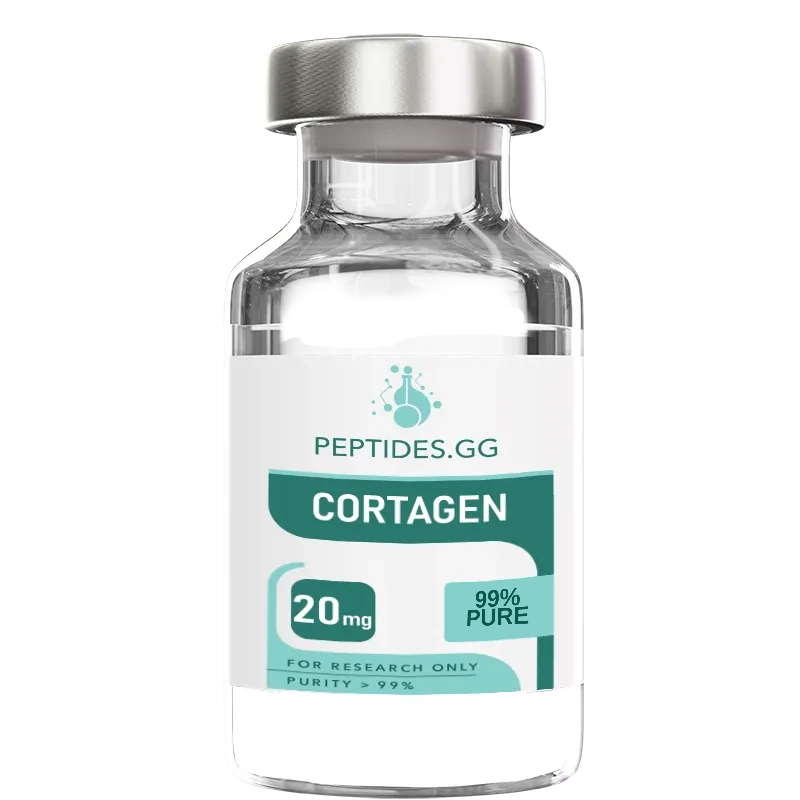
The Cortagen peptide serves as a research tool for investigating cerebral cortex-specific bioregulation and neuroprotective mechanisms. This short bioregulatory peptide enables research into tissue-specific gene expression modulation and neuronal function preservation.
Research Disclaimer: Peptides.GG sells this and all other peptides for Research Only and not for human consumption.
Cortagen Peptide
$45.00
- Free Delivery on all orders over $200
- Earn 5% Store Credit with Every Order
- Same Day Shipping Before 1 PM PST
14-day money-back guarantee
Not satisfied? Return any unopened product within 14 days of delivery for a full refund — we send the return label.
The Cortagen peptide serves as a research tool for investigating cerebral cortex-specific bioregulation and neuroprotective mechanisms. This short bioregulatory peptide enables research into tissue-specific gene expression modulation and neuronal function preservation.
Research Disclaimer: Peptides.GG sells this and all other peptides for Research Only and not for human consumption.
Frequently Asked Questions About Cortagen
What is Cortagen?
Cortagen is a synthetic tetrapeptide bioregulator composed of the amino acid sequence Alanine-Glutamic Acid-Aspartic Acid-Proline (AEDP), developed within the Khavinson peptide bioregulation research program at the St. Petersburg Institute of Bioregulation and Gerontology. Supplied for laboratory research use only; not for human consumption.
What is the molecular profile of Cortagen?
Cortagen is a single defined-sequence synthetic tetrapeptide with the amino acid sequence Ala-Glu-Asp-Pro (AEDP). Its molecular formula is C₁₇H₂₆N₄O₉ and its molecular weight is 430.41 Da. It is produced by solid-phase peptide synthesis and verified by HPLC (≥98% purity) and ESI-MS.
What is Cortagen studied for in research?
In preclinical and in vitro research, Cortagen is used as a neural bioregulator research tool to investigate cerebral cortex and neural tissue and related tissue-specific peptide-signaling pathways. Supplied for laboratory research use only; not for human consumption.
Why is Cortagen considered a neural bioregulator?
The Khavinson bioregulation hypothesis proposes that short, organ-specific peptides act as endogenous molecular messengers that influence tissue homeostasis through targeted gene-regulatory interactions. Cortagen is studied within this framework as a neural bioregulator — a research tool for investigating signaling in cerebral cortex and neural tissue.
What size is Cortagen available in?
Cortagen is supplied as a lyophilized (freeze-dried) powder in 20mg. The lyophilized format is preferred for research because it eliminates solution-phase degradation during storage and allows precise gravimetric preparation of research concentrations at the point of use.
How is Cortagen stored and handled in the laboratory?
Cortagen is supplied as white to off-white lyophilized powder. It is soluble in sterile water and aqueous buffers at neutral to slightly alkaline pH; limited solubility in non-polar organic solvents. For research handling, the lyophilized powder is kept sealed, cold, and protected from light until use. Each batch is third-party tested and supplied with a certificate of analysis.
Related products
-

Crystagen
$55.00 Select options This product has multiple variants. The options may be chosen on the product pageSize: 20mg
-
Thymosin Alpha-1
$55.00 – $95.00 Select options This product has multiple variants. The options may be chosen on the product pageSize: 5mg, 10mg
-
Vilon (Bioregulator)
$60.00 Select options This product has multiple variants. The options may be chosen on the product pageSize: 20mg
Certificate of Analysis
Third-party tested · Independent analytical lab
| Tested | Measured | Purity |
|---|---|---|
| Nov 2025 | 23.88mg | 99.49% |
Research Overview
The Cortagen peptide is a synthetic tetrapeptide bioregulator composed of the amino acid sequence Alanine-Glutamic Acid-Aspartic Acid-Proline (AEDP), developed within the Khavinson peptide bioregulation research program at the St. Petersburg Institute of Bioregulation and Gerontology. Classified as a neural bioregulator, Cortagen is designed as a research tool targeting cerebral cortex tissue, and laboratory investigations examine its interactions with cortical neurons, glial cells, and associated signaling networks. The AEDP sequence is hypothesized to exhibit tissue-specific affinity for neural cell populations, with research focusing on how this short peptide signal modulates gene expression programs relevant to cortical function, structural plasticity, and cellular resilience under stress conditions.
Scientific interest in Cortagen has grown alongside the broader field of peptide bioregulation research, which investigates whether organ-derived short peptides function as endogenous molecular regulators of tissue homeostasis. Within this framework, Cortagen serves as a valuable research tool for studying transcriptional regulation in cortical tissue at the cellular and molecular level. Researchers examining neuroprotection and cognitive biology frequently use Cortagen in experimental panels alongside peptides with documented neuroactive properties, such as Noopept and Selank, allowing comparative characterization of mechanism-specific versus bioregulatory-class peptide effects within the same neural model systems.
Preclinical research employing Cortagen spans multiple neuroscience subfields, including investigations into age-associated cortical decline, synaptic protein expression, and neuroinflammatory pathway modulation. The peptide’s compact tetrapeptide structure facilitates mechanistic dissection of its biological interactions, as each residue can be individually modified or substituted to map structure-activity relationships. Laboratory studies using aged rodent models, primary cortical neuron cultures, and cortical organoid systems have been employed to characterize Cortagen’s research profile. Its use is often contextualized alongside other neuroactive research compounds including Pinealon and Chonluten, enabling multi-tissue bioregulatory comparisons across neural and non-neural systems.
Molecular Characteristics
Complete Specifications:
- CAS Number: Not formally assigned (research compound)
- Molecular Weight: ~430 Da
- Molecular Formula: C₁₇H₂₆N₄O₉
- Sequence: Ala-Glu-Asp-Pro (AEDP)
- Peptide Length / Classification: Tetrapeptide; neural bioregulator
- Appearance: White to off-white lyophilized powder
- Solubility: Soluble in sterile water and aqueous buffers at neutral to slightly alkaline pH; limited solubility in non-polar organic solvents
The molecular architecture of Cortagen reflects the structural logic common to Khavinson-class bioregulatory tetrapeptides: a short, charged sequence with a rigid C-terminal proline residue. The proline at the fourth position introduces a cyclic constraint on the peptide backbone, restricting rotational freedom and imposing a defined secondary structure preference. This conformational rigidity is considered analytically significant because it limits the conformational ensemble available to the peptide in solution, potentially facilitating specific recognition by target macromolecules in cortical cell nuclei. The alanine residue at the N-terminus provides a hydrophobic methyl side chain, while the central glutamic acid and aspartic acid residues contribute negatively charged carboxylate groups that create a strongly anionic central region in the peptide at physiological pH.
At approximately 430 Da, Cortagen occupies a molecular weight range that is favorable for passive cellular uptake studies, though the proline-induced rigidity may influence membrane permeability relative to more flexible peptides of similar size. Researchers designing uptake studies often compare Cortagen with structurally related tripeptides and pentapeptides to determine how backbone rigidity affects cellular internalization efficiency in neuronal versus glial cell populations.
Pharmacokinetic Profile in Research Models
Absorption and Distribution
- Blood-brain barrier (BBB) penetration is a critical parameter in neural bioregulator research; in vitro BBB models using brain endothelial cell monolayers have been employed to characterize Cortagen’s permeability coefficient under physiological conditions
- Intranasal delivery route studies in rodent models investigate olfactory-mediated brain access as an alternative to systemic administration in preclinical neuroprotection research designs
- Autoradiographic studies in rat brain sections have been used to examine regional distribution patterns of radiolabeled Cortagen analogs following systemic administration in animal research protocols
- Cortical versus subcortical distribution ratios are monitored in animal studies to assess tissue-targeting selectivity consistent with the neural bioregulator hypothesis
Bioactivity Dynamics
- Primary cortical neuron cultures derived from rat or mouse embryos are the standard in vitro system for examining Cortagen-induced transcriptional changes using RNA sequencing and quantitative PCR methods
- Time-course experiments spanning 6, 24, 48, and 72 hours are used to distinguish rapid early-response gene activation from slower secondary transcriptional programs
- Concentration-dependent effects are profiled across a range of research concentrations using concentration-response experimental designs with multiple biological replicates
- Electrophysiological assays including multi-electrode array (MEA) recordings are employed to examine functional correlates of Cortagen exposure in neuronal network activity
Metabolic Considerations
- The C-terminal proline residue confers resistance to carboxypeptidase degradation, potentially extending the metabolic half-life of Cortagen relative to proline-free tetrapeptides in biological matrices
- Plasma stability assays using human and rodent plasma incubation followed by LC-MS/MS analysis are standard pre-validation steps before commencing in vivo research programs
- Cerebrospinal fluid (CSF) sampling in animal studies is used to confirm CNS exposure levels and assess the relationship between plasma and CNS concentrations over time
- Metabolite identification by high-resolution mass spectrometry supports interpretation of in vivo bioactivity data by distinguishing intact Cortagen effects from those of degradation products
Research Applications
Neuroprotection Research
- Oxidative stress challenge models using hydrogen peroxide or glutamate excitotoxicity in primary cortical neurons, with Cortagen applied as a pre-treatment, co-treatment, or post-treatment variable
- Hypoxia-reoxygenation injury models in cortical cell cultures to investigate Cortagen’s influence on cell viability markers including LDH release, MTT reduction, and caspase-3 activation
- Examination of anti-apoptotic protein expression (Bcl-2, Bcl-xL) and pro-apoptotic signaling (Bax, cytochrome c release) in stressed cortical neurons exposed to Cortagen
- Reactive oxygen species (ROS) quantification using fluorescent probes in Cortagen-treated neuronal cultures under oxidative challenge conditions
Neuroprotection is one of the most active areas of preclinical neuroscience research, encompassing investigations into neuronal survival mechanisms across models of acute injury and chronic neurodegeneration. Cortagen serves as a research tool in these systems by enabling researchers to probe how short peptide bioregulatory signals interact with cellular stress response pathways at the transcriptional and post-translational levels.
Cognitive Function and Synaptic Biology
- Synaptophysin, PSD-95, and BDNF expression analysis in cortical tissue from aged rodent models administered Cortagen in preclinical research protocols
- Long-term potentiation (LTP) investigations in hippocampal and cortical slice preparations following Cortagen pre-treatment to assess synaptic plasticity correlates
- Dendritic spine density and morphology analysis using confocal imaging and Golgi staining in cortical tissue from Cortagen-exposed research animals
- RNA sequencing panels examining synaptic gene expression networks, including glutamate receptor subunit expression (AMPA, NMDA) in cortical neuron cultures
Synaptic plasticity underlies the cellular mechanisms investigated in cognitive neuroscience research. Cortagen is examined in this context as a potential modulator of synaptic protein expression and network excitability, with researchers comparing its transcriptional profile against other neuroactive peptides such as PE-22-28 to identify pathway-specific versus shared mechanisms of action across structurally distinct neuroactive compounds.
Cortical Plasticity and Neurogenesis Models
- Neural progenitor cell (NPC) proliferation and differentiation assays examining how Cortagen influences cortical neurosphere expansion and directed neuronal fate specification
- BrdU and EdU incorporation assays to quantify proliferating cell populations in cortical tissue sections from Cortagen-treated aged rodent research cohorts
- Cortical organoid systems from induced pluripotent stem cells (iPSCs) as three-dimensional models to examine how bioregulatory peptide signals influence cortical layer formation and maturation
- Transcription factor expression analysis (Sox2, Pax6, Tbr2, Ctip2) to characterize cortical progenitor identity in Cortagen-exposed neural stem cell cultures
Neurodegeneration Models
- Amyloid-beta peptide toxicity models in primary cortical cultures to examine whether Cortagen modulates cellular responses to aggregation-prone protein accumulation
- Tau phosphorylation analysis at disease-relevant epitopes (Ser396, Thr231) in neuronal cultures exposed to kinase-activating stress conditions alongside Cortagen
- Alpha-synuclein aggregation assays in cortical neuron-based models examining the interaction between bioregulatory peptide signaling and protein quality control pathways
- Neuroinflammation marker profiling (TNF-α, IL-1β, IL-6, iNOS) in microglia-neuron co-culture systems to characterize Cortagen’s influence on glial activation states
Neurodegeneration research represents a major frontier in preclinical neuroscience. Cortagen is examined in disease-model systems alongside compounds such as Adamax to profile how peptides with distinct structural origins interact with shared pathological mechanisms, including proteostatic stress, mitochondrial dysfunction, and neuroinflammatory cascades in cortical tissue.
Epigenetic and Gene Regulatory Research
- Chromatin immunoprecipitation sequencing (ChIP-seq) to map histone modification patterns at neural gene loci in Cortagen-treated cortical cell populations
- DNA methylation profiling using bisulfite sequencing to identify CpG sites exhibiting altered methylation in Cortagen-exposed cortical tissue from aged versus young animal models
- ATAC-seq assays to profile chromatin accessibility changes in neuronal populations following Cortagen exposure, identifying regulatory elements that may be modulated by bioregulatory peptide signaling
- Transcriptomic atlas comparisons between Cortagen-treated and vehicle-control cortical tissue using spatial transcriptomics platforms to preserve anatomical context
Laboratory Handling and Storage Protocols
Lyophilized Storage
- Store lyophilized Cortagen at −20°C in a sealed, light-protected container with desiccant to maintain powder integrity during long-term archiving
- Do not expose to temperatures above 25°C for extended periods; brief room temperature exposure during handling is acceptable when the vial remains sealed
- Pre-aliquot lyophilized material into single-experiment quantities before use to avoid repeated temperature cycling of bulk stock
- Lyophilized Cortagen is stable for up to 24 months at −20°C when stored under recommended conditions with packaging integrity maintained
Quality Assurance and Analytical Testing
The analytical methods below are those commonly used to characterize and verify the identity, purity, and quality of research compounds in this class:
- Purity Analysis (HPLC): Cortagen is analyzed by reverse-phase HPLC with UV detection at 220 nm. Purity ≥99% is the research-grade specification, ensuring that minor synthesis byproducts or truncated sequences do not constitute a significant fraction of the research-grade material.
- Structural Verification (ESI-MS): Electrospray ionization mass spectrometry confirms the molecular weight consistent with the AEDP tetrapeptide sequence and verifies the absence of racemization artifacts or unintended modifications introduced during solid-phase synthesis.
- Contaminant Testing: Endotoxin can be screened by the Limulus amebocyte lysate (LAL) assay, a critical specification for neuronal cell culture applications where endotoxin contamination can activate Toll-like receptor 4 signaling and confound inflammatory endpoint measurements. Residual solvent and heavy metal screening is also available among these methods.
- Documentation: A batch-specific certificate of analysis (CoA) accompanies each research shipment, providing purity chromatograms, mass spectrometric data, and all contaminant test results required for institutional research compliance documentation.
Research Considerations
Researchers designing Cortagen-based experiments should account for the following experimental design factors:
- Confirm the developmental stage and cortical area origin of primary neuron preparations, as gene expression baselines differ substantially between embryonic, postnatal, and adult-derived cortical cell populations
- Include serum-free and reduced-serum culture conditions in experimental designs to minimize variability from growth factor and protein content in serum batches, which can mask or amplify peptide-induced transcriptional effects
- Validate antibody specificity and ensure appropriate loading controls when using Western blot to quantify synaptic or neuroprotective protein endpoints in Cortagen-treated samples
- Account for glial cell contamination in primary cortical cultures using neuronal enrichment steps or mixed-culture controls when interpreting neuron-specific endpoints
- Apply statistical power calculations during experimental design phase to ensure adequate sample sizes for detecting expected effect magnitudes based on pilot data
Mechanistic investigations into Cortagen’s neural biology interactions may examine:
- Interactions with neurotrophic factor signaling pathways, particularly BDNF/TrkB and NGF/TrkA receptor systems implicated in cortical neuron survival and synaptic maintenance
- Transcription factor binding analysis for CREB, NRF2, and REST/NRSF, which are master regulators of neuronal gene expression programs relevant to plasticity and stress resistance
- Mitochondrial function assays (oxygen consumption rate, mitochondrial membrane potential) in Cortagen-exposed neurons to characterize bioenergetic correlates of neural bioregulatory peptide activity
- Calcium imaging studies using genetically encoded calcium indicators (GCaMP) to examine neuronal network activity dynamics in Cortagen-treated cortical cultures
Compliance and Safety Information
- Regulatory Status: Cortagen is supplied exclusively as a research compound for laboratory use. It has not been evaluated or approved by the FDA, EMA, or any other regulatory authority for human or veterinary medical use.
- Intended Use: This material is intended solely for in vitro laboratory research and preclinical investigations conducted by qualified scientific personnel within institutionally approved research frameworks.
- NOT Intended For: Human consumption, in vivo administration to humans, veterinary use, food, drug, cosmetic, or household applications. Not for use outside of professional research laboratory settings.
- Safety Protocols: Handle according to institutional biosafety guidelines. Wear appropriate personal protective equipment (gloves, lab coat, eye protection) when handling lyophilized powders and solutions. Consult the material safety data sheet (MSDS) provided with each shipment. Dispose of all research materials in accordance with applicable institutional and governmental regulations governing peptide research compounds.