
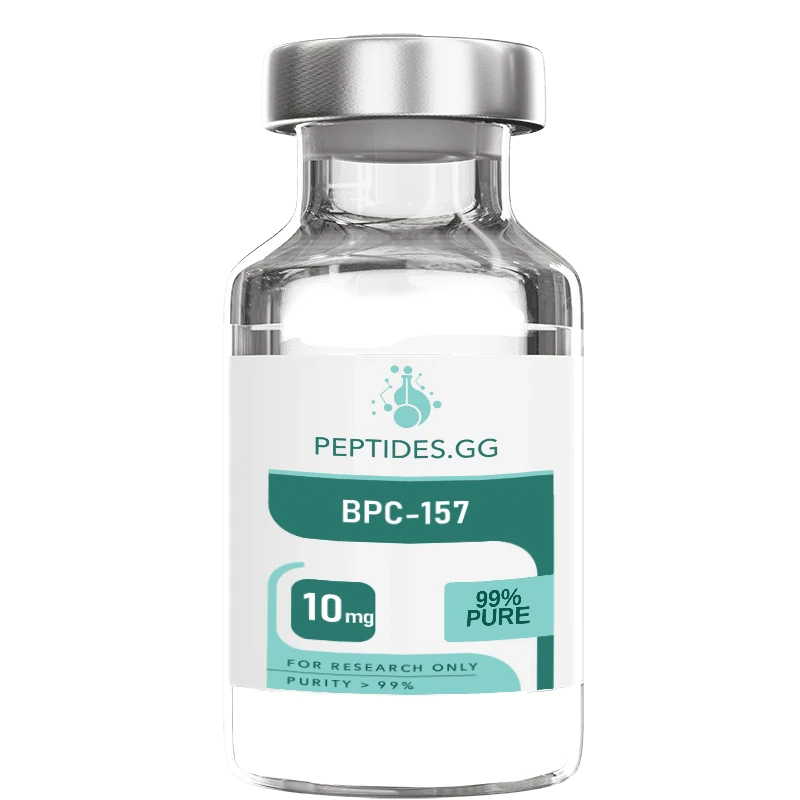
The BPC-157 peptide is a synthetic pentadecapeptide (15 amino acids) supplied as a lyophilized research chemical for in vitro laboratory investigation. Third-party lab tested for purity.
Peptides.GG is a chemical supplier and is not a compounding pharmacy under 503A or 503B. Statements have not been evaluated by the US FDA. Products are not intended to diagnose, treat, cure, or prevent any disease. For research use only — not for human consumption.
BPC-157 Peptide
$65.00 – $235.00
- Free Delivery on all orders over $200
- Earn 5% Store Credit with Every Order
- Same Day Shipping Before 1 PM PST
- 10% Discount for Cryptocurrency Payments
14-day money-back guarantee
If you are not satisfied with the product, simply return it and we will refund your money

The BPC-157 peptide is a synthetic pentadecapeptide (15 amino acids) supplied as a lyophilized research chemical for in vitro laboratory investigation. Third-party lab tested for purity.
Peptides.GG is a chemical supplier and is not a compounding pharmacy under 503A or 503B. Statements have not been evaluated by the US FDA. Products are not intended to diagnose, treat, cure, or prevent any disease. For research use only — not for human consumption.
Frequently Asked Questions About BPC-157
What is BPC-157?
BPC-157 is a synthetic pentadecapeptide (15 amino acids) corresponding to a partial sequence of body protection compound (BPC), a protective protein identified in gastric juice. It is studied as a broadly cytoprotective research tool for tissue repair, angiogenesis, and gastrointestinal-protection research, and is supplied strictly as a research compound for laboratory use, not for human consumption.
What is the amino acid sequence of BPC-157?
BPC-157 has the 15-residue sequence Gly-Glu-Pro-Pro-Pro-Gly-Lys-Pro-Ala-Asp-Asp-Ala-Gly-Leu-Val. Its molecular formula is C₆₂H₉₈N₁₆O₂₂, its molecular weight is 1,419.55 Da, and its CAS registry number is 137525-51-0 (PubChem CID 9941957). The sequence contains four proline residues (positions 3, 4, 5, and 8) that contribute to its conformational stability.
What is BPC-157 studied for in research?
In preclinical and in vitro research, BPC-157 is used to investigate angiogenesis and endothelial biology, tendon/ligament/muscle and bone repair, gastrointestinal mucosal integrity, the nitric oxide system, neuroprotection and the gut-brain axis, and broad cytoprotection across organ systems. Supplied for laboratory research use only; not for human consumption.
How does BPC-157 promote angiogenesis in research models?
Research indicates BPC-157 promotes blood-vessel formation primarily through activation of VEGFR2 and the downstream Akt-eNOS pathway, alongside interaction with the nitric oxide (NO) system. It is also studied for activation of the FAK-paxillin pathway, which governs cell migration and adhesion. These angiogenic and migratory mechanisms are considered central to its broader tissue-repair activity in research models.
What size is BPC-157 available in?
BPC-157 is supplied as a lyophilized (freeze-dried) powder in 10 mg and 20 mg sizes. The lyophilized format limits solution-phase degradation during storage and allows precise gravimetric preparation of research concentrations at the point of use.
How is BPC-157 stored and handled in the laboratory?
BPC-157 is a white to off-white lyophilized powder soluble in water, bacteriostatic water, and phosphate-buffered saline. It is kept sealed, cold (-20°C to -80°C), and protected from light and moisture until use. BPC-157 is noted for unusually robust stability for a research peptide, including documented stability in gastric juice (pH ~1.5) and across a broad pH range. Each batch is third-party tested for identity and purity.
Related products
-

GLOW(ghk-cu+bpc157+tb500) Blend
$110.00 Select options This product has multiple variants. The options may be chosen on the product pageSize: 70mg
-
LL-37
$80.00 – $150.00 Select options This product has multiple variants. The options may be chosen on the product pageSize: 5mg, 10mg
-
ARA-290
$50.00 – $70.00 Select options This product has multiple variants. The options may be chosen on the product pageSize: 10mg, 16mg
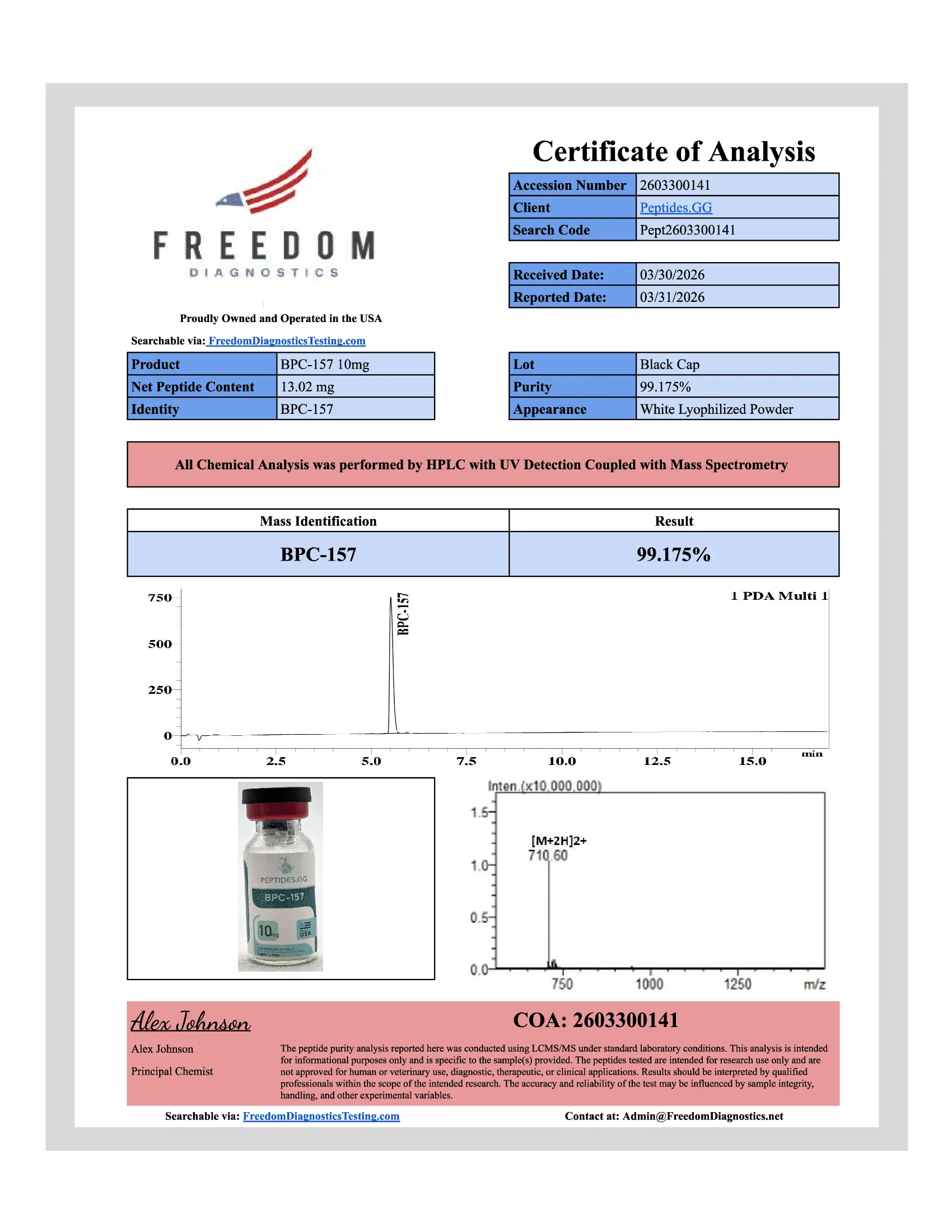
Certificate of Analysis
Third-party tested · Independent analytical lab
| Tested | Measured | Purity |
|---|---|---|
| Jun 2026 | 11.95mg | 99.89% |
| Jun 2026 | 11.23mg | 99.76% |
| Jun 2026 | 11.97mg | 99.70% |
| May 2026 | 11.32mg | 99.93% |
| May 2026 | 11.36mg | 99.42% |
| May 2026 | 11.19mg | 99.67% |
| May 2026 | 11.87mg | 99.36% |
| Apr 2026 | 12.02mg | 99.80% |
| Apr 2026 | 11.90mg | 99.77% |
| Mar 2026 | 11.42mg | 99.74% |
Latest safety testing
- Sterility
- TAMC/TYMC Jul 2026
- Heavy metals
- As/Cd/Pb not detected Feb 2026
- Endotoxin
- 8.159 EU/vial Feb 2026
| Tested | Measured | Purity |
|---|---|---|
| Jul 2026 | 22.24mg | 99.81% |
| Jun 2026 | 21.40mg | 99.56% |
| May 2026 | 23.01mg | 99.20% |
| Feb 2026 | 24.37mg | 99.60% |
| Jan 2026 | 21.49mg | 99.75% |
| Dec 2025 | 22.79mg | 99.64% |
| Nov 2025 | 27.34mg | 99.70% |
Endotoxin, sterility, and heavy-metals reports are run on individual lots on a rotating basis, separate from the identity/purity assay above — not on every lot.
Research Overview
The BPC-157 peptide serves as a valuable research tool for investigating tissue repair, angiogenesis, and cytoprotection mechanisms in laboratory settings. This synthetic pentadecapeptide corresponds to a partial sequence of body protection compound (BPC), a protective protein identified in gastric juice, and is studied for its broad regenerative and protective activity across multiple tissue types. Research applications span musculoskeletal repair, gastrointestinal mucosal integrity, vascular biology, and the nitric oxide system, making BPC-157 one of the most widely studied cytoprotective research peptides.
The peptide’s research interest stems from its remarkable stability and the breadth of tissue systems in which it has been investigated. Unlike many peptides that act through a single well-defined receptor, BPC-157 is studied as a pleiotropic cytoprotective agent whose effects in research models appear to converge on common pathways of angiogenesis, growth-factor signaling, and the nitric oxide (NO) system. Tissue repair research frequently positions BPC-157 alongside TB-500 (Thymosin Beta-4) and GHK-Cu, which promote healing through actin dynamics and extracellular-matrix remodeling respectively, providing complementary mechanisms for comparative regeneration studies.
Laboratory studies investigate BPC-157’s effects on endothelial cell function and blood-vessel formation, tendon and ligament fibroblast behavior, gastrointestinal epithelial integrity, and neural tissue protection in preclinical models. Across these systems, research examines how the peptide modulates growth-factor expression, the FAK-paxillin pathway, and VEGFR2 signaling, and how it interacts with the nitric oxide system to influence vascular tone and tissue protection. These broad, convergent activities make BPC-157 a valuable tool for investigating shared mechanisms of tissue maintenance and repair.
Molecular Characteristics
Complete Specifications:
- CAS Registry Number: 137525-51-0
- Molecular Weight: 1,419.55 Da
- Molecular Formula: C₆₂H₉₈N₁₆O₂₂
- Amino Acid Sequence: Gly-Glu-Pro-Pro-Pro-Gly-Lys-Pro-Ala-Asp-Asp-Ala-Gly-Leu-Val
- PubChem CID: 9941957
- Peptide Classification: Synthetic pentadecapeptide
- Appearance: White to off-white lyophilized powder
- Solubility: Water, bacteriostatic water, phosphate buffered saline
The peptide’s 15-amino acid structure contributes to its unique stability profile. Four proline residues within the sequence (positions 3, 4, 5, and 8) introduce conformational constraints that may contribute to enzymatic resistance. The sequence includes both acidic residues (glutamic acid, aspartic acid) and basic residues (lysine), creating an overall charge distribution that influences solubility and potential molecular interactions. As a partial sequence of the larger body protection compound found in gastric juice, BPC-157 is investigated as a stable, fully synthetic representative of that protein’s cytoprotective activity.
Pharmacokinetic and Stability Profile in Research Models
BPC-157 characterization in preclinical research highlights an unusually robust stability profile relevant to experimental design:
Stability Profile:
- Exceptional stability relative to many research peptides, attributed in part to its proline-rich sequence
- Documented stability in human gastric juice and resistance to acid-mediated degradation (stable at pH ~1.5)
- Maintained structural integrity and biological activity across a broad pH range in research models
- Resistance to enzymatic hydrolysis that limits the experimental window of less stable peptides
Distribution and Activity in Research Models:
- Investigated across multiple administration routes in preclinical models owing to its stability profile
- Biological effects studied in both local-tissue and systemic experimental paradigms
- Activity examined in vascular, musculoskeletal, gastrointestinal, and neural tissue compartments
- Effects in repair models often assessed over multi-day to multi-week experimental timecourses
This unusual stability profile is itself a frequent subject of BPC-157 research and allows for more flexible experimental protocols than many peptides permit, including paradigms in which the compound is introduced through the gastrointestinal environment.
Research Applications
Angiogenesis and Vascular Research
BPC-157 serves as a research tool for investigating blood-vessel formation and endothelial biology. Laboratory studies examine its effects on:
- Endothelial Tube Formation: Investigation of capillary-like network formation in endothelial cell culture systems
- VEGFR2 Signaling: Research on vascular endothelial growth factor receptor 2 activation and downstream Akt-eNOS pathway engagement
- Endothelial Migration and Survival: Studies on endothelial cell migration, proliferation, and survival under stress
- Wound Angiogenesis: Examination of new vessel formation in tissue-repair and ischemia models
- Vascular Integrity: Research on endothelial barrier function and microvascular response to injury
Research protocols typically employ endothelial cell cultures, aortic ring assays, and in vivo vascular models to characterize BPC-157’s angiogenic effects, which are considered central to its broader tissue-repair activity.
Tendon, Ligament, and Musculoskeletal Repair Research
Substantial research focuses on connective-tissue and musculoskeletal repair:
- Tendon Fibroblast Studies: Investigation of tenocyte outgrowth, migration, and survival in culture
- FAK-Paxillin Pathway: Research on focal adhesion kinase and paxillin signaling governing cell adhesion and migration
- Tendon-to-Bone Healing: Studies in transected and injured tendon models examining repair organization
- Ligament, Muscle, and Bone Models: Examination of ligament, skeletal-muscle, and bone repair paradigms
- Growth-Factor Modulation: Research on growth-factor expression accompanying connective-tissue repair
Laboratory protocols investigate musculoskeletal repair using tenocyte and fibroblast cultures, transected tendon and muscle injury models, and histological assessment of repair quality.
Gastrointestinal Tract Research
Given its origin in a gastric protective protein, BPC-157 is extensively investigated in gastrointestinal models:
- Mucosal Integrity: Research on gastric and intestinal epithelial barrier maintenance
- Lesion Repair Models: Investigation of mucosal lesion repair in experimental gastric and intestinal injury
- Anastomosis and Fistula Models: Studies on experimental healing in surgical-injury and fistula paradigms
- Inflammatory Models: Examination of experimental colitis and intestinal inflammation
- Cytoprotection: Research on epithelial protection against various experimental insults
Experimental models include gastric and intestinal injury paradigms, epithelial cell cultures, and assessment of mucosal repair markers.
Nitric Oxide System Research
A distinctive area of BPC-157 research concerns its interaction with the nitric oxide (NO) system:
- NO Pathway Modulation: Investigation of effects on nitric oxide synthesis and the L-arginine-NO pathway
- Counter-Regulation Studies: Research examining responses under NO-synthase blockade and NO excess in experimental models
- Vasomotor Research: Studies on vascular tone and endothelial NO signaling
- Cytoprotective NO Signaling: Examination of NO-mediated tissue-protection mechanisms
This NO-system interaction is studied as a candidate unifying mechanism linking BPC-157’s vascular, gastrointestinal, and cytoprotective effects across research models.
Neurological and Gut-Brain Axis Research
Research applications extend to neural tissue and gut-brain signaling:
- Neuroprotection Studies: Investigation of neuronal protection in experimental central and peripheral nervous system injury models
- Neurotransmitter Systems: Research on dopaminergic and serotonergic system modulation in models
- Nerve Repair: Studies on peripheral nerve regeneration paradigms
- Gut-Brain Axis: Examination of signaling between gastrointestinal and central-nervous-system compartments
Experimental models include neuronal cultures, nerve-injury paradigms, and behavioral and histological assessment in preclinical systems.
Cytoprotection and Growth-Factor Research
BPC-157 serves as a tool for investigating broad cytoprotective mechanisms:
- Organ Cytoprotection: Research on protection of multiple organ systems against experimental injury
- Growth-Factor Signaling: Investigation of EGF, FGF, and related growth-factor pathway modulation
- Cell Migration and Adhesion: Studies on the FAK-paxillin pathway across cell types
- Oxidative Stress: Examination of cellular responses to oxidative and inflammatory challenge
These convergent cytoprotective activities make BPC-157 a valuable reference compound for investigating shared pathways of tissue maintenance and repair.
Bone, Cartilage, and Wound Healing Research
Research applications extend to hard-tissue and dermal repair:
- Bone and Fracture Healing: Investigation of bone-defect and fracture repair organization in experimental models
- Cartilage Research: Studies on chondrocyte behavior and cartilage repair paradigms
- Skin Wound Healing: Examination of cutaneous wound closure, re-epithelialization, and granulation-tissue formation
- Bone-Tendon Interface: Research on the organization of healing at the bone-tendon junction
- Tissue Remodeling: Investigation of remodeling and repair quality in healing models
Laboratory protocols employ bone-defect models, excisional and incisional wound models, and histological scoring of repair quality to characterize BPC-157’s effects on hard-tissue and dermal repair.
Inflammation, Cytoprotection, and Systemic Research
A broad body of research examines BPC-157’s protective effects against diverse experimental insults:
- Anti-Inflammatory Research: Investigation of inflammatory-marker modulation in tissue-injury models
- Counteracting Experimental Injury: Studies examining responses to agents that induce gastrointestinal or organ injury in models
- Hepatic and Pancreatic Models: Research on protective effects in experimental liver and pancreatic injury
- Cardiovascular Research: Examination of vascular and blood-pressure responses in experimental paradigms
- Oxidative Balance: Studies on cellular antioxidant responses under experimental stress
These investigations position BPC-157 as a broadly cytoprotective research tool whose convergent mechanisms are studied across multiple organ systems.
Comparative and Combination Research
BPC-157 is frequently studied alongside other research compounds to map shared and distinct repair pathways:
- Repair-Peptide Comparisons: Side-by-side study with TB-500 and GHK-Cu to distinguish actin-dynamics, matrix-remodeling, and angiogenic contributions
- Growth-Factor Context: Comparison with growth-factor research tools such as IGF-1 LR3 in tissue-repair models
- Pathway Dissection: Combination with pathway inhibitors to attribute effects to specific signaling cascades
- Multi-Component Formulations: Investigation within blended research preparations examining additive repair effects
These comparative designs help establish BPC-157’s specific contribution within the broader landscape of tissue-repair research compounds.
Laboratory Handling and Storage Protocols
Lyophilized Powder Storage:
- Store at -20°C to -80°C in the original sealed vial
- Protect from light exposure and moisture
- Desiccated storage environment recommended
- Stability data available for 12+ months at -20°C
Solubility and Stability:
BPC-157 is supplied as a white to off-white lyophilized powder that is soluble in water, bacteriostatic water, and phosphate-buffered saline. It demonstrates superior stability compared with many research peptides, including documented stability in gastric juice (pH ~1.5) and maintained activity across diverse pH ranges, which allows for flexible experimental handling. Research material is kept sealed and cold until use and handled using standard laboratory precautions; each batch is third-party tested for identity and purity.
Quality Assurance and Analytical Testing
The analytical methods below are those commonly used to characterize and verify the identity, purity, and quality of research compounds in this class:
Purity Analysis:
- High-Performance Liquid Chromatography (HPLC): ≥99% purity
- Analytical method: Reversed-phase HPLC with UV detection at 220nm
- Multiple peak integration to ensure accurate purity determination
Structural Verification:
- Electrospray Ionization Mass Spectrometry (ESI-MS): Confirms molecular weight 1,419.55 Da
- Amino acid analysis: Verifies sequence composition
- Peptide content determination: Quantifies actual peptide content by weight
Contaminant Testing:
- Bacterial endotoxin — Limulus amebocyte lysate (LAL) method
- Residual solvents: TFA and acetonitrile within acceptable limits
- Water content: Karl Fischer titration (<8%)
Documentation:
- Certificate of Analysis (COA) provided with each batch
- Third-party analytical verification available upon request
- Stability data documented for recommended storage conditions
- Batch-specific QC results traceable by lot number
Research Considerations
Experimental Design Factors:
Researchers should consider several factors when designing BPC-157 experiments:
1. Model Selection: BPC-157 is investigated across vascular, musculoskeletal, gastrointestinal, and neural systems; the model should match the specific repair or protection mechanism under study.
2. Mechanistic Controls: Because many effects are linked to angiogenesis and the nitric oxide system, NO-pathway modulators and VEGFR2-pathway tools are valuable for dissecting mechanism.
3. Stability Advantage: The peptide’s robust stability supports a range of experimental routes and timecourses, including paradigms involving the gastrointestinal environment.
4. Endpoint Selection: Multiple endpoints — molecular (growth-factor and FAK-paxillin signaling), cellular (migration, tube formation), and tissue-level (histological repair) — are often needed to capture BPC-157’s convergent effects.
5. Comparative Tools: Comparison with other repair-research peptides such as TB-500 and GHK-Cu helps distinguish BPC-157-specific from shared regenerative pathways.
Mechanism Investigation:
BPC-157’s investigated mechanisms include:
- Promotion of angiogenesis via VEGFR2-Akt-eNOS signaling
- Interaction with the nitric oxide (NO) system in vascular and cytoprotective contexts
- Activation of the FAK-paxillin pathway governing cell migration and adhesion
- Modulation of growth-factor expression in repairing tissue
- Broad cytoprotection across multiple organ systems in research models
Multi-level experimental approaches combining molecular, cellular, and tissue assays provide comprehensive mechanistic insight into BPC-157’s tissue-repair and cytoprotective actions.
Compliance and Safety Information
Regulatory Status:
BPC-157 is provided as a research chemical for in-vitro laboratory studies and preclinical research only. This product has not been approved by the FDA for human therapeutic use, dietary supplementation, or medical applications.
Intended Use:
- In-vitro cell culture studies
- In-vivo preclinical research in approved animal models
- Laboratory investigation of biological mechanisms
- Academic and institutional research applications
NOT Intended For:
- Human consumption or administration
- Therapeutic treatment or diagnosis
- Dietary supplementation
- Veterinary therapeutic applications without appropriate oversight
Safety Protocols:
Researchers should follow standard laboratory safety practices when handling BPC-157:
- Use appropriate personal protective equipment (lab coat, gloves, safety glasses)
- Handle in well-ventilated areas or fume hood
- Follow institutional biosafety guidelines
- Dispose of waste according to local regulations for biological/chemical waste
- Consult material safety data sheet (MSDS) for additional safety information