
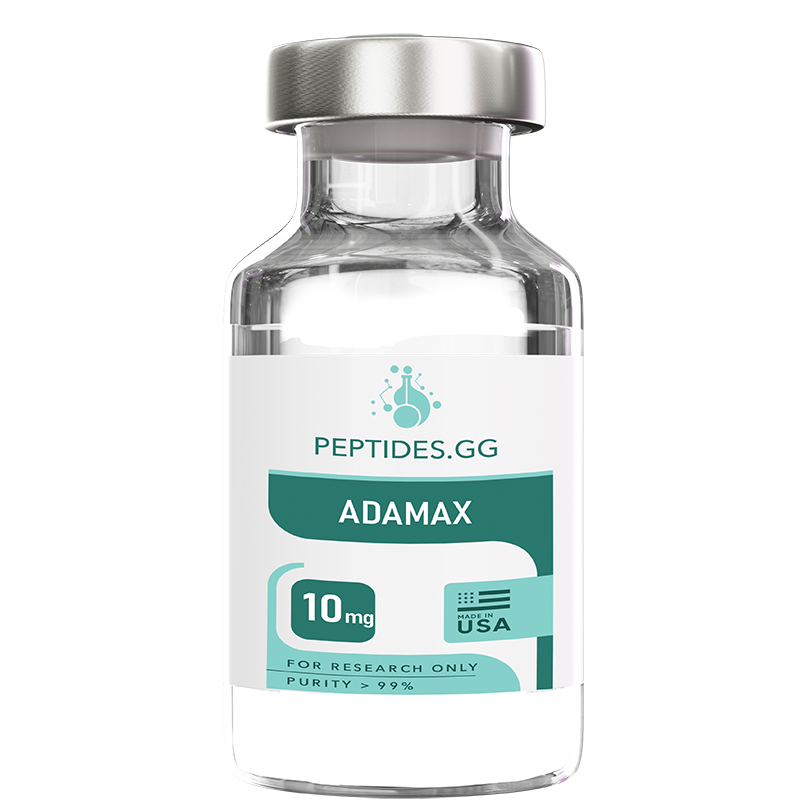
Adamax serves as a valuable research tool for investigating neuroprotective mechanisms, microtubule stabilization, and cognitive preservation in laboratory settings.
Research Disclaimer: Peptides.GG sells this and all other peptides for Research Only and not for human consumption.
Adamax
$65.00
- Free Delivery on all orders over $200
- Earn 5% Store Credit with Every Order
- Same Day Shipping Before 1 PM PST
- 10% Discount for Cryptocurrency Payments
14-day money-back guarantee
If you are not satisfied with the product, simply return it and we will refund your money

Adamax serves as a valuable research tool for investigating neuroprotective mechanisms, microtubule stabilization, and cognitive preservation in laboratory settings.
Research Disclaimer: Peptides.GG sells this and all other peptides for Research Only and not for human consumption.
Frequently Asked Questions About Adamax
What is Adamax?
Adamax is a synthetic neuroprotective octapeptide (also referred to as NAP, AL-108, or davunetide) identified as the smallest active fragment of activity-dependent neuroprotective protein (ADNP). It is supplied strictly as a research compound for laboratory use investigating neuroprotection and microtubule biology, and is not for human consumption.
What is the amino acid sequence of Adamax?
Adamax is an eight-residue peptide with the sequence Asn-Ala-Pro-Val-Ser-Ile-Pro-Gln (NAPVSIPQ). Its molecular formula is C₃₇H₆₆N₁₀O₁₅ and its molecular weight is 910.03 Da. The N-terminal asparagine and C-terminal glutamine are reported to be critical for its activity.
What is Adamax studied for in research?
In preclinical and in vitro research, Adamax is used to investigate microtubule stabilization, tau phosphorylation and aggregation in tauopathy models, neuroprotection against oxidative stress and excitotoxicity, cognitive-function paradigms, and neurodevelopmental processes downstream of ADNP. Supplied for laboratory research use only; not for human consumption.
What is Adamax derived from?
Adamax (NAP) is derived from activity-dependent neuroprotective protein (ADNP), a vasoactive intestinal peptide (VIP)-responsive gene product essential for brain development. Structure-activity studies identified the eight-residue NAPVSIPQ sequence as the smallest fragment retaining ADNP’s neuroprotective activity, giving researchers a tractable tool for mechanistic study.
What size is Adamax available in?
Adamax is supplied as a 10 mg lyophilized (freeze-dried) powder. The lyophilized format is preferred for research because it limits solution-phase degradation during storage and allows precise gravimetric preparation of research concentrations at the point of use.
How is Adamax stored and handled in the laboratory?
Adamax is a white to off-white lyophilized powder soluble in water, bacteriostatic water, and phosphate-buffered saline. The lyophilized powder is kept sealed, cold (-20°C to -80°C), and protected from light and moisture until use. Each batch is third-party tested with a Certificate of Analysis.
What is the half-life of Adamax in research models?
In preclinical research, Adamax has a reported plasma half-life of approximately 1-2 hours following systemic administration, though its biological effects can persist longer through cellular internalization and protein binding. C-terminal amidation contributes to its metabolic stability, and following intranasal administration peak brain concentrations are reported at roughly 30-60 minutes. These values are reported for research models only.
How is Adamax administered in research studies?
Laboratory studies have investigated several routes. Intranasal delivery is frequently used because it shows documented blood-brain-barrier penetration and CNS uptake in rodent models, making it suitable for brain-focused research, while systemic routes are also used. These are experimental administration routes in animal and in vitro research only; Adamax is not for human use.
What concentrations of Adamax are used in research?
Published research uses a range of concentrations depending on the experimental model and route: in vitro studies typically employ nanomolar to micromolar ranges, while in vivo research in animal models varies by route and paradigm. Appropriate research concentrations are established empirically for each experimental system. Supplied for laboratory research use only; not for human consumption.
Related products
-

PE-22-28
$40.00 Select options This product has multiple variants. The options may be chosen on the product pageSize: 10mg
-
Methylene Blue
$24.99 – $30.99 Select options This product has multiple variants. The options may be chosen on the product pageSize: 10mg/ML 50ml, 12mg x 60 Capsules
-
VIP
$55.00 – $99.00 Select options This product has multiple variants. The options may be chosen on the product pageChoose Option: 5mg, 10mg
Research Overview
Adamax serves as a valuable research tool for investigating neuroprotective mechanisms, microtubule stabilization, and cognitive preservation in laboratory settings. This synthetic octapeptide was identified through structure-activity relationship studies of activity-dependent neuroprotective protein (ADNP), a vasoactive intestinal peptide (VIP)-responsive gene product critical for brain development and function. VIP-related neuropeptide research intersects with studies using Pinealon, a pineal-derived bioregulatory tripeptide targeting neuroprotective gene expression. Research applications focus on understanding Adamax’s unique neuroprotective mechanisms distinct from classical neurotrophic factors. Cognitive enhancement research employs multiple peptide tools including Noopept for glutamatergic synaptic plasticity studies and Selank for GABAergic anxiolytic mechanisms, providing distinct pharmacological approaches to neurological research.
The peptide’s development stemmed from investigations into ADNP’s protective functions during neural development and stress responses. ADNP-deficient animal models demonstrate severe developmental abnormalities and cognitive impairment, establishing ADNP’s essential role in brain formation and function. Adamax (NAP) was identified as the smallest active fragment maintaining ADNP’s neuroprotective activity, providing researchers with a tractable tool for mechanistic investigation.
Laboratory studies investigate Adamax’s effects on neuronal survival, neurite outgrowth, synaptic maintenance, and cognitive function markers in preclinical models. Research demonstrates the peptide’s ability to protect neurons against diverse insults including oxidative stress, excitotoxicity, protein aggregation, and inflammatory challenges. These broad protective effects make Adamax valuable for investigating common neuroprotective pathways across neurodegenerative conditions.
Molecular Characteristics
Complete Specifications:
- Chemical Name: Adamax, NAP, AL-108, Davunetide
- Molecular Weight: 910.03 Da
- Molecular Formula: C₃₇H₆₆N₁₀O₁₅
- Amino Acid Sequence: Asn-Ala-Pro-Val-Ser-Ile-Pro-Gln (NAPVSIPQ)
- Parent Protein: Activity-Dependent Neuroprotective Protein (ADNP)
- Peptide Classification: Neuroprotective octapeptide
- Appearance: White to off-white lyophilized powder
- Solubility: Water, bacteriostatic water, phosphate buffered saline
- Net Charge: Neutral at physiological pH
The peptide’s 8-amino acid structure incorporates the essential neuroprotective core of ADNP. Two proline residues (positions 3 and 7) contribute to conformational properties important for biological activity. The sequence includes hydrophobic residues (valine, isoleucine) and polar residues (asparagine, serine, glutamine) creating amphipathic character potentially relevant for protein-protein interactions. The N-terminal asparagine and C-terminal glutamine are critical for activity, as modifications to these residues significantly reduce neuroprotective efficacy in research models.
Pharmacokinetic Profile in Research Models
Adamax pharmacokinetic characterization in preclinical research reveals important properties for experimental design:
Absorption and Distribution:
- Intranasal bioavailability: Documented CNS penetration in rodent models
- Blood-brain barrier penetration: Confirmed through various administration routes
- Peak brain concentrations: 30-60 minutes post-intranasal administration
- Regional distribution: Widespread CNS distribution with accumulation in vulnerable brain regions
- Peripheral tissue distribution: Detected in liver, kidney, and other organs
Metabolism and Elimination:
- Plasma half-life: Approximately 1-2 hours following systemic administration
- Metabolic stability: Moderate peptidase resistance, C-terminal amidation enhances stability
- Primary metabolism: Enzymatic cleavage at specific peptide bonds
- Biological effects: Sustained beyond plasma detection through protein binding and cellular internalization
- Elimination route: Renal clearance of peptide and metabolites
Pharmacodynamic Considerations:
- Rapid cellular uptake documented in neuronal cultures
- Intracellular localization: Cytoplasmic and associated with microtubule structures
- Duration of neuroprotection: Hours to days depending on injury model and administration
- Cumulative effects: Repeated administration enhances neuroprotective outcomes
These pharmacokinetic characteristics inform research protocol design, particularly regarding intranasal delivery for CNS research, administration frequency, and timing of outcome assessments in experimental models.
Research Applications
Microtubule Stabilization Research
Adamax serves as a research tool for investigating microtubule dynamics and stabilization mechanisms:
- Tubulin Interaction Studies: Investigation of direct or indirect interactions with α/β-tubulin
- Microtubule Assembly Research: Analysis of tubulin polymerization and microtubule formation enhancement
- Microtubule-Associated Protein Modulation: Studies on MAP2, tau, and other MAP interactions
- Axonal Transport Research: Investigation of cargo transport along microtubules and motor protein function
- Microtubule Dynamics Analysis: Research on microtubule stability, catastrophe, and rescue events
Research protocols employ cell-free tubulin polymerization assays, live-cell imaging of microtubule dynamics, immunofluorescence analysis of microtubule networks, and axonal transport assays to characterize Adamax’s microtubule-related effects.
Tau Protein and Tauopathy Research
Laboratory studies investigate Adamax in tau-related research applications:
- Tau Phosphorylation Studies: Analysis of tau hyperphosphorylation modulation and kinase/phosphatase balance
- Tau Aggregation Research: Investigation of paired helical filament formation and neurofibrillary tangle prevention
- Tau-Microtubule Binding: Studies on tau-microtubule interaction enhancement and microtubule stabilization
- Tau Pathology Models: Research in cellular and animal models of tauopathy and Alzheimer’s disease
- Tau Clearance Mechanisms: Investigation of tau degradation and autophagy pathway modulation
Experimental models include tau-overexpressing cell lines, tau transgenic animal models, and post-mortem tissue analysis to evaluate Adamax’s effects on tau pathology and related cognitive deficits.
Neuroprotection Mechanism Studies
Adamax facilitates investigation of neuroprotective mechanisms against diverse insults:
- Oxidative Stress Protection: Research on ROS modulation, antioxidant enzyme expression, and oxidative damage prevention
- Excitotoxicity Studies: Investigation of glutamate-induced neurotoxicity protection and calcium homeostasis
- Apoptosis Pathway Research: Analysis of cell death signaling, caspase activation, and survival pathway enhancement
- Protein Aggregation Models: Studies on protection against β-amyloid, α-synuclein, and other toxic protein aggregates
- Inflammatory Modulation: Investigation of neuroinflammation, microglial activation, and cytokine profile effects
Laboratory protocols employ diverse injury models in primary neuronal cultures, organotypic brain slices, and in vivo injury models to characterize Adamax’s broad neuroprotective spectrum.
Cognitive Function Research
Research applications extend to cognitive enhancement and preservation studies:
- Memory Formation Research: Investigation of learning, consolidation, and retrieval processes
- Spatial Cognition Studies: Analysis using Morris water maze, Barnes maze, and radial arm maze paradigms
- Recognition Memory: Research employing novel object recognition and object location tasks
- Cognitive Aging Models: Studies on age-related cognitive decline prevention and reversal
- Neurodegenerative Cognition: Investigation in Alzheimer’s, Parkinson’s, and other neurodegenerative models
Experimental protocols correlate Adamax’s molecular effects (microtubule stabilization, neuroprotection, synaptic preservation) with cognitive performance outcomes across diverse behavioral paradigms.
Neurodevelopmental Research Applications
Adamax’s derivation from developmentally essential ADNP enables neurodevelopmental investigations:
- Neural Differentiation Studies: Research on neuronal precursor differentiation and maturation
- Neurite Outgrowth Research: Investigation of axon and dendrite extension, branching, and pathfinding
- Synaptic Development: Studies on synaptogenesis, synaptic pruning, and circuit formation
- Neural Migration Research: Analysis of neuronal migration during brain development
- ADNP Function Investigation: Studies using ADNP deficiency models to understand protein function
Research protocols examine Adamax’s ability to rescue developmental deficits in ADNP-deficient models and its effects on normal developmental processes in cultured neurons and developing brain preparations.
Neurodegenerative Disease Model Research
Laboratory studies investigate Adamax across multiple neurodegenerative disease models:
- Alzheimer’s Disease Models: Research in APP/PS1, 3xTg-AD, and other Alzheimer’s transgenic models
- Parkinson’s Disease Research: Studies in MPTP, 6-OHDA, and α-synuclein models
- Amyotrophic Lateral Sclerosis: Investigation in SOD1 and TDP-43 ALS models
- Huntington’s Disease Research: Studies in mHtt transgenic models
- Traumatic Brain Injury: Research in controlled cortical impact and fluid percussion injury models
Experimental approaches examine Adamax’s effects on pathological protein accumulation, neuronal loss, neuroinflammation, and functional deficits across these diverse neurodegenerative conditions.
Laboratory Handling and Storage Protocols
Lyophilized Powder Storage:
- Store at -20°C to -80°C in original sealed vial
- Protect from light exposure and moisture
- Desiccated storage environment required
- Stability data available for 12+ months at -20°C
Stability Considerations:
Adamax demonstrates moderate stability in solution. C-terminal amidation (when present in specific formulations) enhances metabolic stability. Standard peptide handling protocols should be followed to maintain biological activity throughout experimental procedures.
Quality Assurance and Analytical Testing
Each Adamax batch undergoes comprehensive analytical characterization:
Purity Analysis:
- High-Performance Liquid Chromatography (HPLC): ≥98% purity
- Analytical method: Reversed-phase HPLC with UV detection at 215nm
- Multiple peak integration to ensure accurate purity determination
Structural Verification:
- Electrospray Ionization Mass Spectrometry (ESI-MS): Confirms molecular weight 910.03 Da
- Amino acid analysis: Verifies sequence composition
- Peptide content determination: Quantifies actual peptide content by weight
- N-terminal and C-terminal sequencing: Confirms sequence integrity
Contaminant Testing:
- Bacterial endotoxin: <5 EU/mg (LAL method)
- Heavy metals: Below detection limits per USP standards
- Residual solvents: TFA and acetonitrile within acceptable limits
- Water content: Karl Fischer titration (<8%)
Documentation:
- Certificate of Analysis (COA) provided with each batch
- Third-party analytical verification available upon request
- Stability data documented for recommended storage conditions
- Batch-specific QC results traceable by lot number
Research Considerations
Experimental Design Factors:
Researchers should consider several factors when designing Adamax experiments:
1. Administration Route: Intranasal delivery demonstrates effective CNS penetration in research models and may be preferred for brain-focused studies. Systemic routes also show efficacy but may require higher concentrations.
2. Concentration Selection: Determine appropriate concentrations based on research objectives. In vitro studies typically employ nM to μM ranges, while in vivo administration varies by model and route.
3. Temporal Considerations: Adamax’s neuroprotective effects may be both preventative and therapeutic. Timing relative to injury/insult significantly impacts outcomes.
4. Model Selection: Choose appropriate disease models, injury paradigms, or developmental systems based on specific research questions.
5. Endpoint Assessment: Multiple endpoints may be necessary to capture Adamax’s diverse effects: molecular (microtubule stability, tau phosphorylation), cellular (neuronal survival, neurite outgrowth), and functional (cognitive performance, motor function).
Mechanism Investigation:
Adamax’s mechanisms of action involve multiple converging pathways:
- Microtubule stabilization through enhanced tubulin polymerization or MAP interaction
- Tau protein phosphorylation modulation and aggregation prevention
- Activation of survival signaling pathways (PI3K/Akt, ERK/MAPK)
- Regulation of autophagy and protein clearance mechanisms
- Modulation of inflammatory responses and oxidative stress pathways
- Enhancement of neurotrophic factor expression (BDNF, GDNF)
Multi-level experimental approaches combining molecular, cellular, and behavioral assays provide comprehensive mechanistic insights into Adamax’s neuroprotective actions.
Compliance and Safety Information
Regulatory Status:
Adamax is provided as a research chemical for in-vitro laboratory studies and preclinical research only. This product has not been approved by the FDA for human therapeutic use, dietary supplementation, or medical applications. Note: Clinical trials have been conducted under investigational new drug protocols, but this research product is for laboratory use only.
Intended Use:
- In-vitro cell culture studies (neuronal cultures, cell lines)
- In-vivo preclinical research in approved animal models
- Laboratory investigation of biological mechanisms
- Academic and institutional research applications
NOT Intended For:
- Human consumption or administration
- Therapeutic treatment or diagnosis
- Dietary supplementation
- Veterinary therapeutic applications without appropriate oversight
Safety Protocols:
Researchers should follow standard laboratory safety practices when handling Adamax:
- Use appropriate personal protective equipment (lab coat, gloves, safety glasses)
- Handle in well-ventilated areas or fume hood
- Follow institutional biosafety guidelines
- Dispose of waste according to local regulations for biological/chemical waste
- Consult material safety data sheet (MSDS) for additional safety information
—