
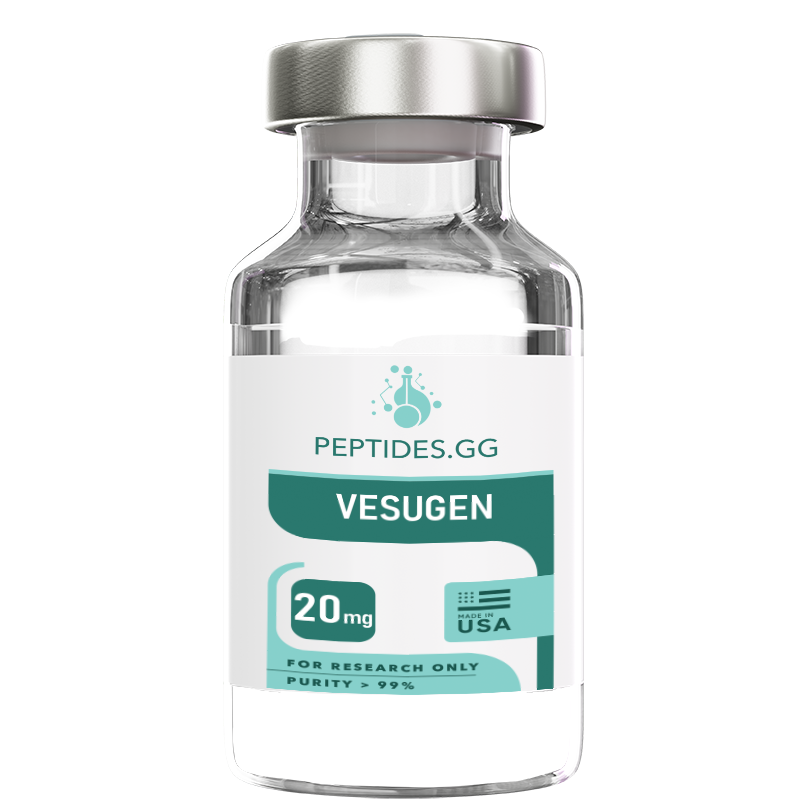
Vesugen serves as a research tool for investigating vascular system-specific bioregulation and blood vessel tissue function in laboratory settings.
Research Disclaimer: Peptides.GG sells this and all other peptides for Research Only and not for human consumption.
Vesugen (Bioregulator)
$60.00
- Free Delivery on all orders over $200
- Earn 5% Store Credit with Every Order
- Same Day Shipping Before 1 PM PST
- 10% Discount for Cryptocurrency Payments
14-day money-back guarantee
If you are not satisfied with the product, simply return it and we will refund your money
Vesugen serves as a research tool for investigating vascular system-specific bioregulation and blood vessel tissue function in laboratory settings.
Research Disclaimer: Peptides.GG sells this and all other peptides for Research Only and not for human consumption.
Frequently Asked Questions About Vesugen (Bioregulator)
What is Vesugen?
Vesugen is a defined synthetic tripeptide (Lys-Glu-Asp; KED) studied as a Khavinson-class short-peptide bioregulator for vascular and endothelial research. It is produced by solid-phase peptide synthesis and supplied strictly as a research compound for laboratory use; not for human consumption.
What is the molecular profile of Vesugen?
Vesugen is a single defined-sequence synthetic tripeptide with the amino acid sequence Lys-Glu-Asp (KED). Its molecular formula is C₁₅H₂₆N₄O₈ and its molecular weight is 390.39 Da. It is produced by solid-phase peptide synthesis and verified by HPLC (≥98% purity) and ESI-MS confirming the 390.39 Da mass.
What is Vesugen studied for in research?
In preclinical and in vitro research, Vesugen is used as a vascular bioregulator research tool to investigate vascular and endothelial tissue and related tissue-specific peptide-signaling pathways. Supplied for laboratory research use only; not for human consumption.
Why is Vesugen considered a vascular bioregulator?
The Khavinson bioregulation hypothesis proposes that short, organ-specific peptides act as endogenous molecular messengers that influence tissue homeostasis through targeted gene-regulatory interactions. Vesugen is studied within this framework as a vascular bioregulator — a research tool for investigating signaling in vascular and endothelial tissue.
What size is Vesugen available in?
Vesugen is supplied as a lyophilized (freeze-dried) powder in 20mg. The lyophilized format is preferred for research because it eliminates solution-phase degradation during storage and allows precise gravimetric preparation of research concentrations at the point of use.
How is Vesugen stored and handled in the laboratory?
Vesugen is supplied as white to off-white lyophilized powder. It is soluble in sterile water and physiological buffer systems; limited solubility in non-polar organic solvents. For research handling, the lyophilized powder is kept sealed, cold, and protected from light until use. Each batch is third-party tested and supplied with a certificate of analysis.
Related products
-

Thymosin Alpha-1
$55.00 – $95.00 Select options This product has multiple variants. The options may be chosen on the product pageSize: 5mg, 10mg
-
Vilon (Bioregulator)
$60.00 Select options This product has multiple variants. The options may be chosen on the product pageSize: 20mg
-
Cortagen
$45.00 Select options This product has multiple variants. The options may be chosen on the product pageSize: 20mg
Research Overview
Vesugen is a synthetic peptide bioregulator corresponding to the Lys-Glu-Asp (KED) tripeptide, a short peptide developed within the Khavinson peptide bioregulation research program at the St. Petersburg Institute of Bioregulation and Gerontology. As a defined single-sequence peptide produced by solid-phase peptide synthesis, Vesugen has the molecular formula C₁₅H₂₆N₄O₈ and a molecular weight of 390.39 Da, providing a chemically homogeneous, sequence-verified tool for vascular research. The KED tripeptide is classified within the Khavinson short-peptide framework as a vascular bioregulator, and is studied as a tool for investigating how a defined peptide signal modulates endothelial and smooth muscle cell biology. Laboratory research examines its interactions with blood vessel wall cell populations at transcriptional, proteomic, and functional levels, taking advantage of the analytical precision afforded by a single, well-characterized peptide sequence.
Scientific interest in Vesugen is grounded in the fundamental importance of vascular endothelial homeostasis to circulatory physiology. The blood vessel wall is a dynamic, metabolically active tissue whose functional integrity depends on coordinated intercellular signaling between endothelial cells, vascular smooth muscle cells, pericytes, and adventitial fibroblasts. Peptide bioregulation research proposes that short peptides such as KED serve as local informational molecules capable of modulating gene expression in tissue-specific cells, and Vesugen is examined in this framework as a vascular-targeted bioregulatory tool. Researchers studying vessel wall biology frequently include Vesugen in experimental panels alongside compounds targeting the heart and vasculature, such as Cardiogen, enabling comparative investigation of cardiac versus vascular bioregulatory peptide mechanisms.
Preclinical research using Vesugen spans several areas of vascular biology, including endothelial function, angiogenesis, vessel wall integrity, and cardiovascular aging. Investigations into vascular endothelial phenotype and nitric oxide signaling use Vesugen as a molecular probe to examine how a defined peptide signal interacts with established regulatory axes in endothelial cells. The peptide is also studied alongside repair-associated peptides such as BPC-157, which exhibits documented angiogenic and tissue-protective properties in preclinical models, and regenerative matrix-targeting peptides such as GHK-Cu, allowing researchers to position Vesugen within a broader landscape of vascular-active peptide research tools.
Molecular Characteristics
Complete Specifications:
- Classification: Synthetic peptide bioregulator (Khavinson short peptide)
- Source/Origin: Synthetic (solid-phase peptide synthesis)
- Amino Acid Sequence: Lys-Glu-Asp (KED)
- Molecular Formula: C₁₅H₂₆N₄O₈
- Molecular Weight: 390.39 Da
- Appearance: White to off-white lyophilized powder
- Solubility: Soluble in sterile water and physiological buffer systems; limited solubility in non-polar organic solvents
The molecular architecture of Vesugen is that of a defined, three-residue peptide assembled from L-lysine, L-glutamic acid, and L-aspartic acid in a fixed Lys-Glu-Asp sequence. Because every preparation is the same synthetic molecule rather than a collection of fragments, Vesugen provides a chemically uniform reference point for mechanistic research: its activity can be attributed to a single, structurally unambiguous sequence rather than to an undefined population of components. The KED tripeptide is the same sequence supplied as Vesilute, and researchers use this defined sequence to interrogate how a short vascular bioregulatory peptide engages receptor and signaling machinery in endothelial cell systems with reproducible stoichiometry and concentration control.
At 390.39 Da, the KED tripeptide sits firmly in the low-molecular-weight range characteristic of Khavinson short peptides, a size class proposed to engage intracellular and nuclear targets directly and to traverse cell membranes more readily than larger peptides. Identity and integrity are confirmed analytically: reverse-phase HPLC establishes purity, while electrospray ionization mass spectrometry (ESI-MS) confirms the expected 390.39 Da monoisotopic/average mass, giving researchers a precise, reproducible molecular standard for every lot of research-grade material.
Pharmacokinetic Profile in Research Models
Bioavailability and Vascular Tissue Distribution
- Intravenous and subcutaneous administration routes are used in rodent research models; endothelial cell exposure is assessed by measuring the KED peptide in aortic and peripheral vessel wall homogenates following systemic administration
- Vascular tissue distribution studies employ autoradiographic imaging of radiolabeled peptide or immunofluorescent detection of the exogenous peptide within vessel wall cross-sections from research animals
- Endothelial cell uptake kinetics in vitro are characterized using HUVEC and primary aortic endothelial cell monolayers treated with fluorescently labeled Vesugen; confocal microscopy tracks subcellular localization over time
- As a low-molecular-weight tripeptide, Vesugen is expected to distribute broadly and penetrate tissues efficiently, a property researchers exploit when designing exposure protocols for vessel wall and endothelial compartments
Tissue-Specific Activity Dynamics
- Human umbilical vein endothelial cells (HUVECs), primary aortic endothelial cells, and vascular smooth muscle cell lines are the standard in vitro platforms for characterizing Vesugen-induced transcriptional and functional responses
- Ex vivo aortic ring preparations allow researchers to study Vesugen effects on vessel wall contractility, endothelium-dependent relaxation responses, and angiogenic sprouting in intact tissue models that preserve cellular architecture
- Time-course RNA sequencing at multiple intervals (6, 24, 48, 72 hours) maps kinetics of early gene responses versus sustained transcriptional program changes in endothelial cells exposed to the peptide
- Nitric oxide production assays using DAF-FM diacetate fluorescence and Griess reagent quantification of nitrite/nitrate in conditioned medium characterize Vesugen effects on endothelial NOS (eNOS) activity dynamics
Metabolic Considerations
- As a short synthetic peptide, Vesugen is subject to serum protease activity in biological matrices; plasma stability is assessed by LC-MS/MS time-course assays tracking the abundance of the intact KED tripeptide
- Endothelial cell peptide catabolism is assessed by intracellular HPLC assay following uptake incubation, establishing the effective intracellular exposure window for gene regulatory effects
- Renal filtration is the primary elimination route for the low-molecular-weight tripeptide, with rapid systemic clearance typical of small peptides observed in animal pharmacokinetic studies
- Metabolite characterization by high-resolution mass spectrometry identifies degradation products of the KED sequence, supporting mechanistic interpretation of in vivo efficacy data by distinguishing intact peptide effects from those of catabolites
Research Applications
Vascular Endothelial Function Research
- Endothelial nitric oxide synthase (eNOS) expression, phosphorylation status (Ser1177, Thr495), and enzyme activity profiling in Vesugen-treated primary endothelial cell cultures under basal and shear stress conditions
- Endothelial cell monolayer permeability assays using FITC-dextran transwell flux measurements and TEER quantification to characterize Vesugen effects on barrier integrity in inflammatory challenge models
- Cell adhesion molecule expression profiling (ICAM-1, VCAM-1, E-selectin) in Vesugen-treated endothelial cells challenged with pro-inflammatory cytokines (TNF-α, IL-1β) to assess modulatory effects on inflammatory adhesion programs
- Reactive oxygen species generation and antioxidant enzyme expression (SOD1, catalase, glutathione peroxidase) in endothelial cultures exposed to oxidative stressors alongside Vesugen treatment
Endothelial function research encompasses NO bioavailability, barrier integrity, and inflammatory activation — three interconnected processes governing vascular homeostasis. Vesugen provides researchers with a defined, single-sequence tool to probe how a vascular bioregulatory peptide modulates these programs at the transcriptional and enzymatic levels, with the chemical homogeneity of the synthetic KED tripeptide allowing observed effects to be attributed unambiguously to one molecular species.
Vessel Wall Integrity and Extracellular Matrix Studies
- Collagen and elastin synthesis assays in vascular smooth muscle cells and endothelial cells following Vesugen treatment, with quantification by Sircol collagen assay and Fastin elastin assay to characterize matrix production responses
- Matrix metalloproteinase (MMP-2, MMP-9) activity quantification by gelatin zymography and ELISA in conditioned medium from Vesugen-treated vascular cell cultures to assess effects on matrix remodeling enzyme expression
- Basement membrane integrity studies using laminin and collagen IV immunostaining in ex vivo vessel preparations from Vesugen-treated research animals to characterize in vivo effects on vascular matrix architecture
- Mechanical property assessment by atomic force microscopy in Vesugen-conditioned vascular cell monolayers to characterize changes in cytoskeletal stiffness and cell-substrate adhesion strength
Angiogenesis Research
- Endothelial cell tube formation assays on Matrigel basement membrane preparations to assess Vesugen effects on capillary-like network formation, quantified by automated image analysis of tube length, branching points, and mesh area
- Scratch wound migration assays and transwell Boyden chamber migration assays in HUVEC monolayers to characterize Vesugen influence on endothelial cell motility under defined gradient conditions
- VEGF, VEGFR-2, Ang-1/2, and Tie-2 expression profiling in Vesugen-treated endothelial cells by qPCR and Western blot to map effects on core angiogenic signaling networks
- Ex vivo aortic ring sprouting assays in three-dimensional collagen gel matrices to examine Vesugen effects on microvessel outgrowth from intact vessel wall tissue under defined culture conditions
Angiogenesis research examines the mechanisms by which new blood vessel networks form from pre-existing vasculature — a process relevant to wound healing, tissue repair, and pathological vascular remodeling models. Vesugen is positioned in this context as a defined vascular bioregulatory peptide that may interact with growth factor-driven angiogenic programs, with comparative studies against peptides such as BPC-157 and GHK-Cu enabling mechanistic disambiguation across structurally distinct vascular-active peptides.
Cardiovascular Aging and Vascular Senescence Models
- Replicative senescence models in human endothelial cells at high passage number, examining Vesugen effects on senescence marker expression (p21, p16, SA-β-galactosidase) and SASP cytokine secretion profiles
- Aged rodent aorta gene expression comparisons between Vesugen-treated and vehicle-control cohorts using bulk RNA sequencing to identify transcriptional signatures associated with vascular bioregulatory peptide exposure
- Telomere length measurement by quantitative FISH in endothelial cells from aged research animals enrolled in Vesugen preclinical protocols to assess telomeric status as a cellular aging biomarker
- Mitochondrial function assays (Seahorse XF analysis of oxygen consumption rate and extracellular acidification rate) in Vesugen-treated aged endothelial cells to characterize bioenergetic correlates of vascular bioregulatory peptide activity
Laboratory Handling and Storage Protocols
Lyophilized Storage
- Store lyophilized Vesugen at −20°C in sealed, desiccated, light-protected conditions to preserve peptide integrity over the long term
- Avoid prolonged exposure to temperatures above 25°C; brief ambient-temperature handling during aliquoting is acceptable when the vial cap remains sealed until equilibration is complete
- Pre-aliquot bulk lyophilized material into single-experiment quantities before use to eliminate repeated freeze-thaw cycling of the primary stock
- Lyophilized Vesugen is stable for up to 24 months at −20°C under recommended storage conditions with packaging integrity maintained throughout the storage period
Quality Assurance and Analytical Testing
- Purity Analysis (HPLC): Each production lot of Vesugen is characterized by reverse-phase HPLC, confirming purity of ≥98% as a single principal peptide peak and verifying the absence of non-peptide contaminant peaks. Lot-to-lot chromatographic consistency is assessed against an established reference standard for the KED sequence.
- Mass Spectrometry (ESI-MS): Electrospray ionization mass spectrometry confirms the molecular identity of each production lot by verifying the expected 390.39 Da mass of the Lys-Glu-Asp tripeptide, establishing unambiguous structural confirmation across batches.
- Identity Confirmation: Peptide identity is verified by amino acid sequence analysis confirming the Lys-Glu-Asp (KED) sequence, ensuring that each lot corresponds to the defined synthetic tripeptide rather than any related sequence.
- Endotoxin Testing: Endotoxin levels are confirmed below 1 EU/mg by the Limulus amebocyte lysate (LAL) assay, a critical specification for endothelial cell culture applications where endotoxin contamination activates TLR4-NF-κB signaling and directly confounds inflammatory and barrier function endpoint measurements.
- Certificate of Analysis: A batch-specific certificate of analysis accompanies each research shipment, providing HPLC chromatogram, ESI-MS mass confirmation, endotoxin test results, and all relevant quality documentation required for institutional research compliance records.
Research Considerations
Investigators designing Vesugen-based experiments should address the following experimental design factors:
- Confirm endothelial cell identity and passage number before initiating Vesugen exposure studies; high-passage endothelial cells exhibit senescence-associated transcriptional drift that can substantially alter baseline gene expression and confound bioregulatory peptide response profiles
- Validate Vesugen peptide stability in serum-containing versus serum-free endothelial culture media prior to concentration-response experiments, as serum protease activity significantly reduces the effective peptide concentration during extended time courses
- Include vehicle-only and scrambled-sequence peptide controls alongside active treatment groups to distinguish sequence-specific biological effects from non-specific responses to trace buffer components
- Reconstitute from a single well-characterized lot and confirm concentration spectrophotometrically or by quantitative amino acid analysis to anchor normalization across independently conducted experiments; the defined synthetic sequence supports tight reproducibility between lots
- Design parallel studies with Vesilute, which is the same KED tripeptide sequence, to cross-validate findings across independently sourced synthetic preparations of the defined peptide
Mechanistic investigations into Vesugen’s interactions with vascular biology may examine:
- eNOS phosphorylation dynamics and Akt/PI3K upstream signaling activation by phospho-proteomic mass spectrometry in endothelial cells following Vesugen exposure at defined time points
- Epigenetic landscape characterization by ATAC-seq and ChIP-seq for H3K27ac and H3K4me3 modifications at endothelial gene regulatory loci in Vesugen-treated versus vehicle-control endothelial cells
- Receptor identification studies using photoaffinity labeling or proximity labeling (BioID, TurboID) strategies to identify the endothelial cell surface or nuclear binding partners of the KED tripeptide
- Single-cell transcriptomics in ex vivo vessel preparations to resolve endothelial, smooth muscle, and pericyte cell-type-specific transcriptional responses within the intact vascular wall microenvironment
Compliance and Safety Information
- Regulatory Status: Vesugen is supplied exclusively as a research compound for laboratory use. It has not been evaluated or approved by the FDA, EMA, or any other regulatory authority for human or veterinary medical use.
- Intended Use: This material is intended solely for in vitro laboratory research and preclinical investigations conducted by qualified scientific personnel within institutionally approved research frameworks.
- NOT Intended For: Human consumption, in vivo administration to humans, veterinary use, food, drug, cosmetic, or household applications. Not for use outside of professional research laboratory settings.
- Safety Protocols: Handle according to institutional biosafety guidelines. Wear appropriate personal protective equipment (gloves, lab coat, eye protection) when handling lyophilized powders and solutions. Consult the material safety data sheet (MSDS) provided with each shipment. Dispose of all research materials in accordance with applicable institutional and governmental regulations governing peptide research compounds.