

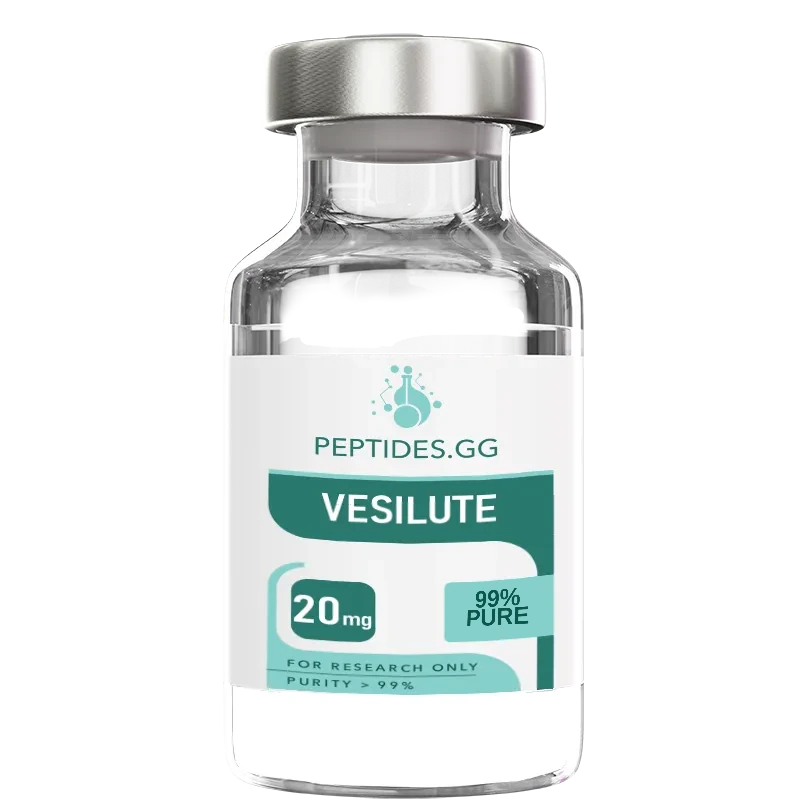
The Vesilute peptide serves as a research tool for investigating urinary system bioregulation and bladder-specific peptide signaling. This short bioregulatory peptide enables research into tissue-specific gene expression and urological function modulation.
Research Disclaimer: Peptides.GG sells this and all other peptides for Research Only and not for human consumption.
Vesilute Peptide
$60.00
- Free Delivery on all orders over $200
- Earn 5% Store Credit with Every Order
- Same Day Shipping Before 1 PM PST
- 10% Discount for Cryptocurrency Payments
14-day money-back guarantee
Not satisfied? Return any unopened product within 14 days of delivery for a full refund — we send the return label.
The Vesilute peptide serves as a research tool for investigating urinary system bioregulation and bladder-specific peptide signaling. This short bioregulatory peptide enables research into tissue-specific gene expression and urological function modulation.
Research Disclaimer: Peptides.GG sells this and all other peptides for Research Only and not for human consumption.
Frequently Asked Questions About Vesilute
What is Vesilute?
Vesilute is a synthetic dipeptide belonging to the Khavinson class of short-chain peptide bioregulators, composed of the amino acid sequence Glutamic acid-Aspartic acid (Glu-Asp, ED). Developed within the peptide bioregulation research program associated with Professor Vladimir Khavinson at the St. Petersburg Institute of Bioregulation and Gerontology, it is the tissue-specific bioregulator associated with the urinary bladder and lower urogenital tract. Supplied for laboratory research use only; not for human consumption.
What is the amino acid sequence of Vesilute?
Vesilute is a single defined-sequence synthetic dipeptide with the amino acid sequence Glu-Asp (ED). Its molecular formula is C₉H₁₄N₂O₇, its molecular weight is 262.22 Da, and its CAS number is 3918-84-1. It is produced by solid-phase peptide synthesis and verified by HPLC (≥98% purity) and ESI-MS.
What is Vesilute studied for in research?
In preclinical and in vitro research, Vesilute is used as a urinary-bladder bioregulator research tool to investigate urothelial barrier function, detrusor (bladder wall) smooth-muscle biology, and lower-urinary-tract tissue-specific gene-expression pathways. Supplied for laboratory research use only; not for human consumption.
Why is Vesilute considered a bladder (urinary-tract) bioregulator?
The Khavinson bioregulation hypothesis proposes that short, organ-specific peptides act as endogenous molecular messengers that influence tissue homeostasis through targeted gene-regulatory interactions. Vesilute (Glu-Asp) is studied within this framework as the bioregulator associated with urinary-bladder and lower-urogenital tissue. It is distinct from Vesugen (Lys-Glu-Asp, KED), the separate Khavinson peptide directed at vascular tissue.
What size is Vesilute available in?
Vesilute is supplied as a lyophilized (freeze-dried) powder in 20mg. The lyophilized format is preferred for research because it eliminates solution-phase degradation during storage and allows precise gravimetric preparation of research concentrations at the point of use.
How is Vesilute stored and handled in the laboratory?
Vesilute is supplied as white to off-white lyophilized powder. It is soluble in sterile water and aqueous buffers; limited solubility in organic solvents. For research handling, the lyophilized powder is kept sealed, cold, and protected from light until use. Each batch is third-party tested and supplied with a certificate of analysis.
Related products
-

Pancragen
$60.00 Select options This product has multiple variants. The options may be chosen on the product pageSize: 20mg
-
Chonluten
$50.00 Select options This product has multiple variants. The options may be chosen on the product pageSize: 20mg
-
Thymogen
$60.00 Select options This product has multiple variants. The options may be chosen on the product pageSize: 20mg
Research Overview
The Vesilute peptide is a synthetic dipeptide belonging to the Khavinson class of short-chain peptide bioregulators, composed of the amino acid sequence Glutamic acid-Aspartic acid (Glu-Asp, ED). Developed within the peptide bioregulation research program associated with Professor Vladimir Khavinson at the St. Petersburg Institute of Bioregulation and Gerontology, Vesilute is the tissue-specific bioregulator assigned to the urinary bladder and lower urogenital tract. Its name derives from the Latin vesica (bladder). As a defined two-residue synthetic compound, its chemical identity is fully characterized and invariant across production lots, making it a tractable probe for studying how minimal peptide signals may encode bladder-tissue-specific information.
Vesilute should not be confused with Vesugen, the distinct Khavinson tripeptide Lys-Glu-Asp (KED) directed at vascular endothelium — the two are separate compounds for separate tissues. The scientific interest in Vesilute arises from the broader Khavinson hypothesis that short peptides derived from or mimicking organ-specific signals may exhibit selective affinity for homologous cell types, modulating gene transcription in a tissue-targeted manner. Laboratory studies investigate how the Glu-Asp sequence interacts with chromatin structures and transcription-factor networks relevant to urothelial and bladder smooth-muscle biology.
Preclinical research framing for Vesilute centers on lower-urinary-tract tissue: urothelial barrier maintenance, detrusor (bladder wall) smooth-muscle biology, and age-associated bladder dysfunction. Its compact molecular architecture — only two amino acids — facilitates cellular-uptake studies and makes it a tractable subject for mechanistic modeling. Researchers studying urogenital tissue frequently include Vesilute in comparative panels alongside the prostate bioregulator Prostamax, enabling cross-tissue analysis of bioregulatory peptide activity within the urogenital system in in vitro and in vivo preclinical models.
Molecular Characteristics
Complete Specifications:
- CAS Number: 3918-84-1
- Molecular Weight: ~262.22 Da
- Molecular Formula: C₉H₁₄N₂O₇
- Sequence: Glu-Asp (ED); L-α-glutamyl-L-aspartic acid
- Peptide Length / Classification: Dipeptide (Glu-Asp); urinary-bladder / urogenital bioregulator
- Appearance: White to off-white lyophilized powder
- Solubility: Soluble in sterile water and aqueous buffers; limited solubility in organic solvents
The molecular architecture of Vesilute is defined by two acidic residues — glutamic acid and aspartic acid — each contributing a carboxylate side chain that, together with the free N- and C-termini, gives the Glu-Asp dipeptide a net negative charge at physiological pH. This acidic, highly polar character is considered analytically relevant to its proposed interactions with DNA-binding proteins and chromatin-associated regulatory elements in bladder-tissue cell nuclei. At approximately 262 Da, Vesilute is one of the smallest synthetic bioregulatory peptides in the Khavinson series; this minimal molecular mass places it within an optimal range for passive-diffusion and cellular-uptake studies, and its simple two-residue structure supports solid-phase synthesis at high purity for reproducible research-grade preparations.
Pharmacokinetic Profile in Research Models
Absorption and Distribution
- In vitro membrane-permeability assays are used to characterize passive-diffusion behavior consistent with Vesilute's low molecular weight and acidic charge profile
- Radiolabeled tracer studies in rodent models examine tissue-distribution patterns with particular emphasis on accumulation within bladder wall, urothelium, and lower-urinary-tract tissue
- Plasma protein binding is an active area of inquiry; preliminary findings suggest low-to-moderate binding that supports free-peptide availability in experimental systems
- Blood-brain barrier penetration is considered minimal based on structural analysis, relevant when designing multi-tissue research panels
Bioactivity Dynamics
- Gene-expression studies in urothelial and bladder smooth-muscle cell cultures are used to profile transcriptional responses to Vesilute exposure across a range of laboratory concentrations
- Research timelines in cell-culture experiments typically span 24–72 hours to capture early and late transcriptional responses within bladder-tissue cell populations
- Concentration-response relationships are a primary focus, with researchers characterizing effective concentration ranges for downstream pathway activation
- Pulse-chase experiments examine the reversibility of observed cellular effects following Vesilute washout in culture systems
Metabolic Considerations
- Dipeptides of this class are generally susceptible to aminopeptidase and dipeptidyl-peptidase activity in plasma and tissue homogenates; researchers account for this through stability assays prior to in vivo work
- Mass-spectrometry fragmentation patterns of Vesilute metabolites are characterized to distinguish intact peptide signal from degradation products in biological matrices
- Lyophilization and controlled handling protocols minimize pre-experimental degradation and support reproducibility across research cohorts
Research Applications
Urothelial Barrier and Bladder Epithelium Research
- Investigation of urothelial barrier integrity using transepithelial electrical resistance (TEER) assays in bladder epithelial monolayer culture systems
- Assessment of tight-junction and uroplakin gene/protein expression (e.g., ZO-1, claudins, uroplakins) relevant to the urothelial permeability barrier
- Examination of the glycosaminoglycan (GAG) layer and umbrella-cell markers in models of urothelial protection and repair
- Research into urothelial inflammatory signaling (e.g., NF-κB-associated pathways) in models of bladder mucosal stress
Urothelial barrier function is central to lower-urinary-tract health, protecting the bladder wall from urinary solutes and pathogens. Vesilute serves as a molecular probe in these investigations, allowing researchers to characterize transcriptional and proteomic changes within urothelial cell populations under conditions designed to mimic mucosal stress, oxidative challenge, or inflammatory stimulation.
Detrusor Smooth Muscle and Bladder Function Research
- Contractility and calcium-signaling studies in detrusor (bladder wall) smooth-muscle cell cultures exposed to Vesilute
- Gene-expression profiling of smooth-muscle contractile and phenotypic-modulation markers under normoxic and stressed research conditions
- Bladder-strip and ex vivo bladder-tissue preparations providing a tissue-level model for studying bioregulatory peptide effects on detrusor responses
- Overactive-bladder and bladder-outlet-obstruction rodent models providing in vivo contexts for age- and stress-associated bladder dysfunction research
Detrusor smooth-muscle biology governs bladder storage and voiding function. Vesilute's proposed bladder-tissue affinity makes it a relevant research tool for mapping signaling cascades that regulate smooth-muscle phenotype and contractile gene programs in the lower urinary tract.
Bladder Aging and Lower-Urinary-Tract Senescence Studies
- Replicative-senescence assays in primary urothelial and bladder smooth-muscle cells examining senescence-associated secretory phenotype (SASP) biomarkers following Vesilute treatment in aged cell populations
- Telomere-length analysis as a surrogate marker of replicative aging in bladder-tissue cultures maintained with Vesilute versus vehicle control
- Epigenetic-clock analysis using DNA-methylation arrays to assess aging-associated methylation signatures in Vesilute-exposed bladder-tissue samples
- Aged rodent bladder models providing in vivo contexts for examining bioregulatory peptide effects on age-associated lower-urinary-tract gene-expression programs
Lower-urinary-tract aging is a growing field within gerontology and urology. The prostate bioregulator Prostamax is frequently used in parallel with Vesilute in multi-tissue urogenital aging studies, enabling researchers to compare bladder and prostate aging trajectories under bioregulatory peptide influence.
Bladder Wall Remodeling and Extracellular Matrix Research
- Collagen and elastin gene-expression profiling in bladder smooth-muscle cells and fibroblasts exposed to Vesilute under normoxic and hypoxic research conditions
- Matrix metalloproteinase (MMP) activity assays examining extracellular-matrix remodeling enzymes in bladder-tissue preparations
- Atomic-force-microscopy studies measuring biomechanical properties of cell monolayers and extracellular-matrix gels in the presence of bioregulatory peptide signals
- Lysyl-oxidase (crosslinking enzyme) expression analysis relevant to collagen maturation and bladder-wall compliance in fibrosis and aging models
Laboratory Handling and Storage Protocols
Lyophilized Storage
- Store lyophilized Vesilute at −20°C in a frost-free freezer, protected from light and moisture
- Desiccant pouches should be included in storage containers to minimize ambient humidity exposure during long-term archiving
- Avoid repeated freeze-thaw cycling of lyophilized material; aliquot powder into single-use research quantities prior to first use
- Lyophilized product is stable for up to 24 months under recommended conditions when packaging integrity is maintained
Quality Assurance and Analytical Testing
The analytical methods below are those commonly used to characterize and verify the identity, purity, and quality of research compounds in this class:
- Purity Analysis (HPLC): Vesilute is characterized by reverse-phase high-performance liquid chromatography (RP-HPLC) with UV detection at 220 nm. Purity ≥99% is confirmed, ensuring suitability for reproducible laboratory investigations.
- Structural Verification (ESI-MS): Electrospray ionization mass spectrometry (ESI-MS) confirms the molecular weight and sequence integrity for this compound, providing identity confirmation for the Glu-Asp dipeptide structure.
- Contaminant Testing: Testing for residual solvents, heavy metals, and endotoxin (LAL assay) is available among these methods. Endotoxin control is particularly important for cell-based assays where lipopolysaccharide contamination could confound urothelial or inflammatory endpoint measurements.
- Documentation: A certificate of analysis (CoA) is provided with each research order, documenting purity, mass spectrometric data, and lot-specific test results. CoA documentation supports research reproducibility and regulatory compliance within institutional laboratory frameworks.
Research Considerations
Researchers designing Vesilute-based experiments should account for the following experimental-design factors:
- Establish appropriate vehicle controls matched to the solvent used for Vesilute to isolate peptide-specific effects from solvent-induced responses in bladder-tissue cell cultures
- Characterize cell passage number and senescence status of urothelial and bladder smooth-muscle cell lines prior to use, as replicative age significantly influences baseline gene-expression profiles
- Include positive-control peptides or known urothelial/smooth-muscle regulators in experimental panels to validate assay sensitivity and contextual biological responsiveness
- Account for potential serum-protein interactions when using Vesilute in serum-containing culture media; consider parallel serum-free experiments to clarify binding effects
- Pre-validate batch-to-batch consistency using a standardized cellular bioassay when transitioning between research lots to ensure experimental continuity
Mechanistic investigations into Vesilute's bladder-tissue biology interactions may examine:
- Interaction with nuclear transcription factors including NF-κB, AP-1, and Nrf2 pathways implicated in urothelial inflammatory and oxidative-stress responses
- Chromatin immunoprecipitation (ChIP) assays to identify genomic loci exhibiting altered histone-modification patterns in Vesilute-treated bladder-tissue cell populations
- Single-cell RNA sequencing to characterize transcriptional heterogeneity in urothelial and detrusor responses to bioregulatory peptide exposure
- Protein-protein interaction assays to map the molecular partners through which the Glu-Asp sequence exerts its proposed transcriptional modulatory effects
Compliance and Safety Information
- Regulatory Status: Vesilute is supplied exclusively as a research compound for laboratory use. It has not been evaluated or approved by the FDA, EMA, or any other regulatory authority for human or veterinary medical use.
- Intended Use: This material is intended solely for in vitro laboratory research and preclinical investigations by qualified scientific personnel operating within institutionally approved research programs.
- NOT Intended For: Human consumption, in vivo administration to humans, veterinary use, food, drug, cosmetic, or household applications. Not for use by individuals outside of professional research settings.
- Safety Protocols: Handle according to institutional biosafety guidelines. Use appropriate personal protective equipment (gloves, lab coat, eye protection) when handling lyophilized powders or solutions. Consult the material safety data sheet (MSDS) provided with shipment. Dispose of research materials in compliance with applicable institutional and governmental regulations.