
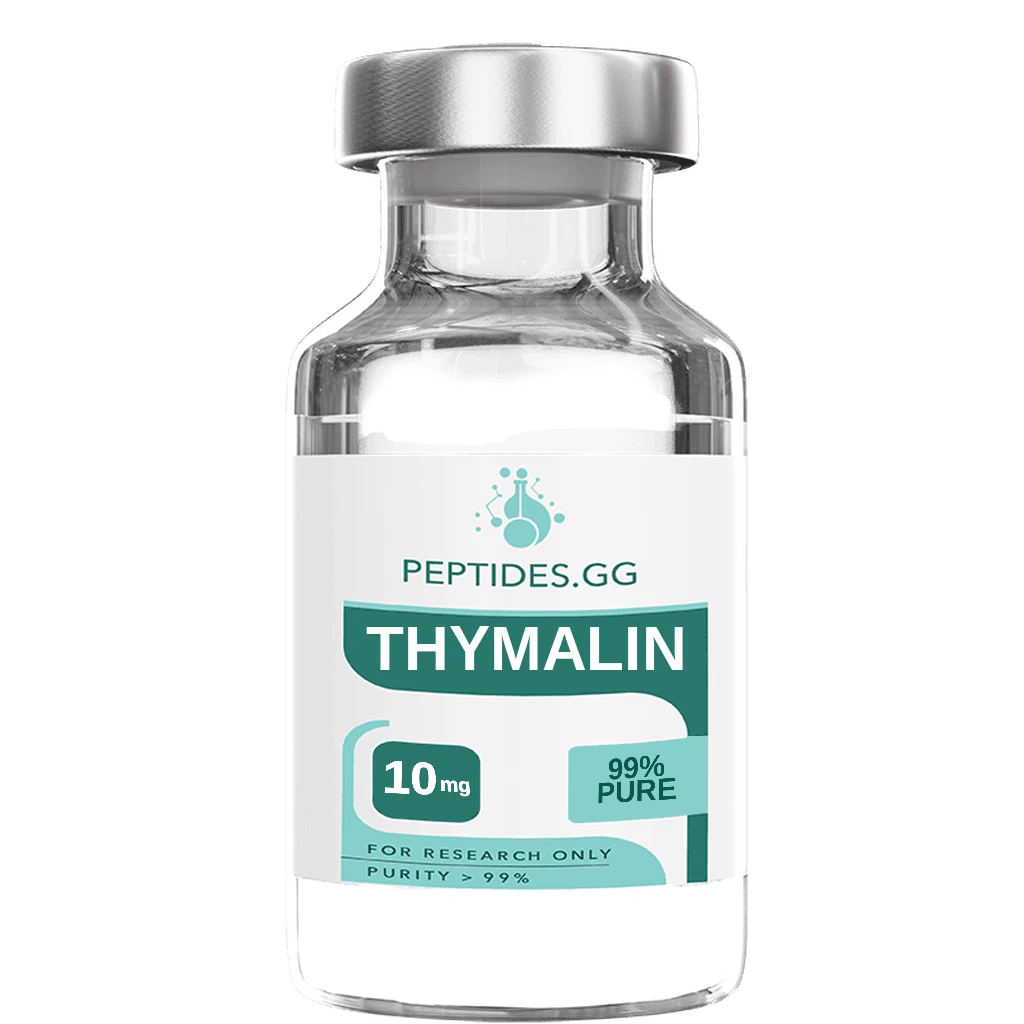
The Thymalin peptide complex is a thymus-derived polypeptide preparation from the Khavinson bioregulator family, supplied as a lyophilized research chemical for in vitro laboratory investigation. It is a distinct product from the synthetic nonapeptide Thymulin. Third-party lab tested.
Peptides.GG is a chemical supplier and is not a compounding pharmacy under 503A or 503B. Statements have not been evaluated by the US FDA. Products are not intended to diagnose, treat, cure, or prevent any disease. For research use only — not for human consumption.
Thymalin Peptide
$45.00
- Free Delivery on all orders over $200
- Earn 5% Store Credit with Every Order
- Same Day Shipping Before 1 PM PST
- 10% Discount for Cryptocurrency Payments
14-day money-back guarantee
If you are not satisfied with the product, simply return it and we will refund your money
The Thymalin peptide complex is a thymus-derived polypeptide preparation from the Khavinson bioregulator family, supplied as a lyophilized research chemical for in vitro laboratory investigation. It is a distinct product from the synthetic nonapeptide Thymulin. Third-party lab tested.
Peptides.GG is a chemical supplier and is not a compounding pharmacy under 503A or 503B. Statements have not been evaluated by the US FDA. Products are not intended to diagnose, treat, cure, or prevent any disease. For research use only — not for human consumption.
Frequently Asked Questions About Thymalin
What is Thymalin?
Thymalin is a polypeptide complex extracted from calf thymus, characterized in the 1970s by Khavinson and Morozov at the Saint Petersburg Institute of Bioregulation and Gerontology. It is the natural-extract parent of the synthetic thymic dipeptides Thymogen (Glu-Trp) and Vilon (Lys-Glu). It is supplied strictly as a research compound for laboratory use and is not for human consumption.
Is Thymalin the same as Thymulin?
No. Thymulin is a single synthetic nonapeptide (pGlu-Ala-Lys-Ser-Gln-Gly-Gly-Ser-Asn, 858.9 Da) also known as serum thymic factor. Thymalin is a mixture of low-molecular-weight peptides extracted from thymus tissue. PubChem lists the two names as synonyms of one record, which is a name collision, not a chemical identity. Peptides.GG carries them as separate products.
What is the CAS number or molecular weight of Thymalin?
Thymalin has no single CAS registry number, molecular formula, or molecular weight because it is a peptide mixture rather than one compound. Registry numbers found online for "Thymalin" belong to Thymulin. The composition of a given lot is described by its Certificate of Analysis.
What are the active constituents of Thymalin?
Published work from the Khavinson group identifies two active dipeptides within the complex: Lys-Glu (KE, later supplied synthetically as Vilon) and Glu-Trp (EW, supplied synthetically as Thymogen). Glu-Trp was first isolated from Thymalin by reversed-phase HPLC.
What is Thymalin studied for in laboratory research?
In preclinical and in vitro research, Thymalin is used as a reference thymic-peptide preparation to investigate differentiation of hematopoietic stem cells toward CD28-positive T cells, cytokine regulation (IL-1β, IL-6, TNF-α) in stimulated immune cell cultures, tissue-specific growth stimulation in organotypic thymus culture, and comparison of natural versus synthetic thymic peptides. Supplied for laboratory research use only; not for human consumption.
What size is Thymalin available in, and how is it stored?
Thymalin is supplied as a white to off-white lyophilized powder in a 10 mg size, where the mass refers to total peptide content. It is stored sealed at -20°C or below, desiccated and protected from light and moisture. A Certificate of Analysis accompanies the product.
Research References
Peer-reviewed studies and database records underpinning the research described on this page. Links open on PubMed, PubMed Central, or the publisher in a new tab.
- Morozov VG, Khavinson VK. Natural and synthetic thymic peptides as therapeutics for immune dysfunction. Int J Immunopharmacol. 1997. PMID: 9637345 →
- Khavinson VK, et al. Thymalin: Activation of Differentiation of Human Hematopoietic Stem Cells. Bull Exp Biol Med. 2020. PMID: 33237528 →
- Linkova N, et al. The Influence of KE and EW Dipeptides in the Composition of the Thymalin Drug on Gene Expression and Protein Synthesis Involved in the Pathogenesis of COVID-19. Int J Mol Sci. 2023. PMID: 37686182 →
- Avolio F, et al. Peptides Regulating Proliferative Activity and Inflammatory Pathways in the Monocyte/Macrophage THP-1 Cell Line. Int J Mol Sci. 2022. PMID: 35408963 →
- Ryzhak AP, et al. Polypeptides influence on tissue cell cultures regeneration of various age rats. Adv Gerontol. 2015. PMID: 26390619 →
- Zhukova GV, et al. Effect of Thymalin on the Tumor and Thymus under Conditions of Activation Therapy In Vivo. Bull Exp Biol Med. 2018. PMID: 29797130 →
- Khlystova ZS, et al. Age-related changes of thymalin content in human epidermis. Bull Exp Biol Med. 2002. PMID: 12447484 →
- Khavinson VKh. Peptides and Ageing. Neuro Endocrinol Lett. 2002. PMID: 12374906 →
Related products
-

Vesugen (Bioregulator)
$60.00 Select options This product has multiple variants. The options may be chosen on the product pageSize: 20mg
-
AOD9604
$30.00 – $80.00 Select options This product has multiple variants. The options may be chosen on the product pageSize: 2mg, 5mg, 10mg
Research Overview
The Thymalin peptide complex is isolated from calf thymus by mild acid extraction, first characterized in the 1970s by Vladimir Khavinson and Vyacheslav Morozov at what is now the Saint Petersburg Institute of Bioregulation and Gerontology. It is the founding member of the thymic branch of the Khavinson peptide family and the parent preparation from which the synthetic dipeptide Thymogen (Glu-Trp) was later isolated and reproduced. In the research literature Thymalin is used as a reference thymic-peptide preparation for investigating T-cell differentiation, cytokine regulation in immune cell cultures, and the organ-specific peptide bioregulation hypothesis.
Thymalin should not be confused with Thymulin, which is a single synthetic nonapeptide (serum thymic factor) with a defined sequence and molecular weight. The two share a name root and a thymic origin but are different materials, and this catalog carries them as separate products.
Composition and Molecular Characteristics
Thymalin is not a single molecule. It is a mixture of low-molecular-weight polypeptides recovered from thymus tissue, so it carries no single CAS registry number, molecular formula, or molecular weight, and none is stated here. Published work on its composition has identified two active dipeptide constituents: Lys-Glu (KE, the sequence later supplied synthetically as Vilon) and Glu-Trp (EW, supplied synthetically as Thymogen). Morozov and Khavinson reported the isolation of Glu-Trp from Thymalin by reversed-phase HPLC, and a 2023 study from the same institute examined the contribution of the KE and EW dipeptides to the activity of the complex.
A note on registry lookups: a name search for “Thymalin” in PubChem returns the record for nonathymulin (Thymulin), because the two names are listed as synonyms there. That record describes the nonapeptide pGlu-Ala-Lys-Ser-Gln-Gly-Gly-Ser-Asn, which is the material sold on this site as Thymulin, not the thymus extract sold on this page. Researchers characterizing this product should rely on the batch Certificate of Analysis rather than a registry record.
Place in the Khavinson Peptide Family
The Khavinson program produced two generations of research compounds. The first generation consists of organ-specific polypeptide complexes extracted from calf tissues: Thymalin from thymus, Epithalamin from pineal gland, Cortexin from cerebral cortex, and others. The second generation consists of short synthetic peptides designed from the amino-acid composition of those extracts, such as Epitalon (Ala-Glu-Asp-Gly), Pinealon (Glu-Asp-Arg), Cardiogen, Vilon (Lys-Glu), and Thymogen (Glu-Trp). Thymalin is the natural-extract counterpart to the synthetic thymic dipeptides, and comparative studies of the natural complex against its synthetic derivatives are a recurring design in this literature.
Research Applications
Hematopoietic stem cell differentiation
Khavinson and colleagues examined Thymalin in cultures of human hematopoietic stem cells and reported a two- to three-fold decrease in the stem-cell marker CD44 and the intermediate-stage marker CD117 alongside a 6.8-fold increase in CD28, a marker of mature T lymphocytes. The authors interpreted this as evidence that the complex promotes differentiation of CD117-positive progenitors toward CD28-positive T cells in vitro.
Cytokine regulation in immune cell cultures
In a lipopolysaccharide-stimulated model using human peripheral blood mononuclear cells, Thymalin and its KE and EW dipeptide constituents reduced the synthesis of IL-1β, IL-6, and TNF-α by 1.4 to 6 times. A separate study in the THP-1 monocyte/macrophage cell line compared Thymalin with four synthetic Khavinson peptides and found that all five modulated mitogen-activated kinase phosphorylation, reduced LPS-stimulated TNF and IL-6 expression in differentiated cells, and reduced monocyte adhesion to activated endothelial cells.
Organotypic tissue culture and B-cell markers
In organotypic cultures of thymus tissue from young and old rats, Thymalin was among seven tissue-specific polypeptide preparations that selectively stimulated growth of the matching tissue at 20 to 50 ng/mL, with increased PCNA and decreased p53 expression. Thymalin additionally activated expression of CD5 and CD20, markers of B-cell differentiation.
Thymus morphology in animal models
Work from the Rostov Research Institute of Oncology examined thymus microstructure in outbred rats bearing transplanted sarcoma 45 under an activation-therapy protocol and reported increased lymphoproliferative activity and higher counts of tissue basophils and plasma cells in the thymic lobules. Immunomorphological studies have also detected Thymalin-reactive material in human epidermis and fetal reticuloepithelium, with the layer of reactive cells thinning with age.
Natural versus synthetic thymic peptides
Morozov and Khavinson compared the natural Thymalin complex with the synthetic dipeptides Thymogen and Vilon across T-cell differentiation, cyclic nucleotide composition, and cytokine release in blood lymphocytes. The synthetic dipeptides reproduced several activities of the complex but differed from it in antioxidant response in thymocytes, a finding that keeps the natural extract in use as a comparator in this line of research.
Product Format and Storage
Thymalin is supplied as a white to off-white lyophilized (freeze-dried) powder in a 10 mg size, where the stated mass refers to the total peptide content of the vial. The lyophilized format limits solution-phase degradation during storage and supports precise gravimetric preparation of research standards at the point of use.
The sealed lyophilized powder is stored at -20°C or below, protected from light and moisture, and kept desiccated. A Certificate of Analysis accompanies the product.
Quality Assurance and Analytical Testing
Because Thymalin is a peptide mixture rather than a single compound, its analytical profile is a fingerprint rather than a single purity figure. The methods below are those commonly used to characterize a thymic polypeptide fraction of this class:
- Reversed-phase HPLC — chromatographic profile of the peptide fraction and total peptide content.
- Electrospray-ionization mass spectrometry — mass distribution of the constituent peptides.
- Amino-acid analysis — overall amino-acid composition of the fraction, the same measurement the Khavinson group used to design the synthetic dipeptides.
- Karl Fischer titration — residual moisture in the lyophilized powder.
- Residual solvent analysis by GC — solvents carried over from extraction and purification.
Compliance and Safety Information
Thymalin is offered strictly as a research chemical for in vitro laboratory investigation. It is not a drug, dietary supplement, cosmetic, or food, and it is not intended for human or veterinary use. Purchasers are responsible for ensuring that handling, storage, and disposal comply with the regulations applicable to their jurisdiction and institution.
Peptides.GG is a chemical supplier and is not a compounding pharmacy under 503A or 503B. Statements have not been evaluated by the US FDA. Products are not intended to diagnose, treat, cure, or prevent any disease. For research use only — not for human consumption.