

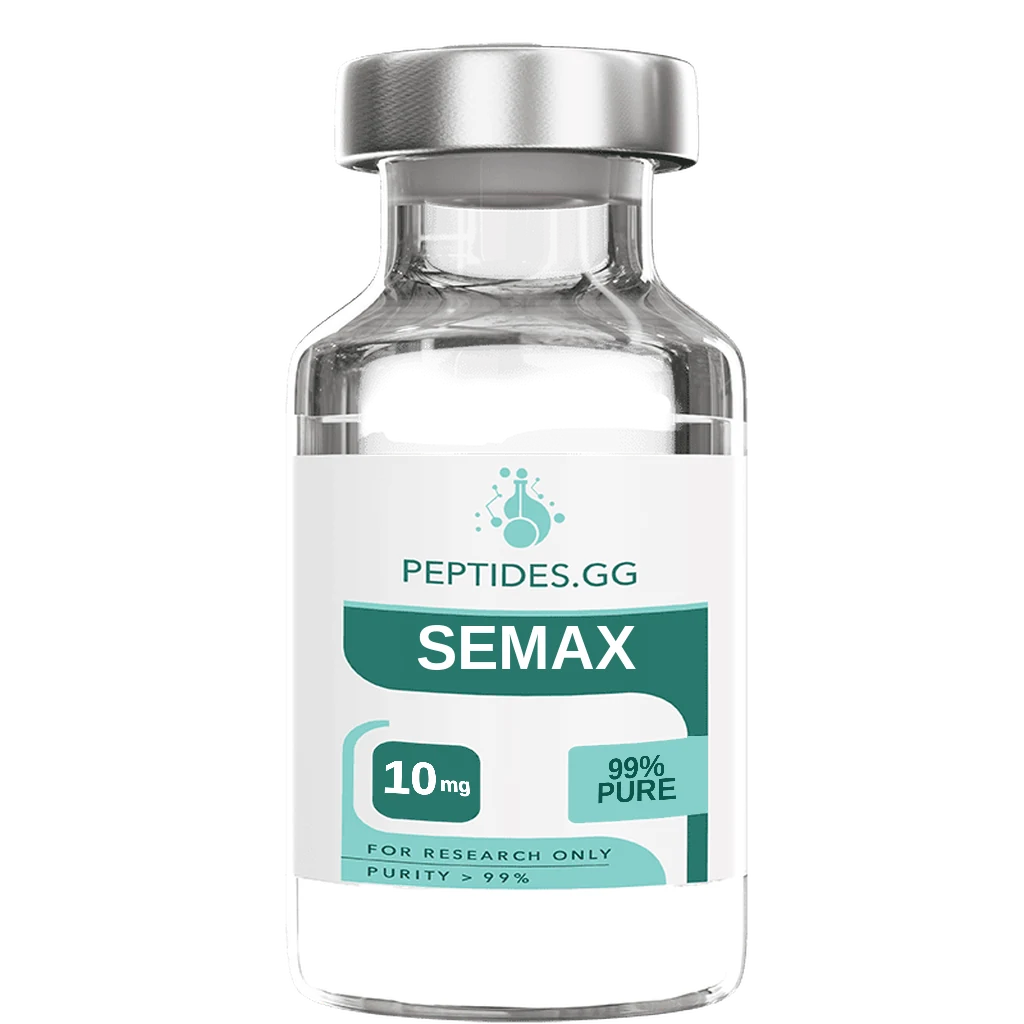
Semax is a synthetic heptapeptide based on the ACTH(4-10) fragment, supplied as a lyophilized research chemical for in vitro laboratory investigation. Third-party lab tested for purity.
Peptides.GG is a chemical supplier and is not a compounding pharmacy under 503A or 503B. Statements have not been evaluated by the US FDA. Products are not intended to diagnose, treat, cure, or prevent any disease. For research use only — not for human consumption.
Semax Peptide
$35.00
- Free Delivery on all orders over $200
- Earn 5% Store Credit with Every Order
- Same Day Shipping Before 1 PM PST
- 10% Discount for Cryptocurrency Payments
14-day money-back guarantee
Not satisfied? Return any unopened product within 14 days of delivery for a full refund — we send the return label.
Semax is a synthetic heptapeptide based on the ACTH(4-10) fragment, supplied as a lyophilized research chemical for in vitro laboratory investigation. Third-party lab tested for purity.
Peptides.GG is a chemical supplier and is not a compounding pharmacy under 503A or 503B. Statements have not been evaluated by the US FDA. Products are not intended to diagnose, treat, cure, or prevent any disease. For research use only — not for human consumption.
Frequently Asked Questions About Semax
What is Semax?
Semax is a synthetic heptapeptide with the sequence Met-Glu-His-Phe-Pro-Gly-Pro, derived from the ACTH(4-7) core of the adrenocorticotropic hormone fragment ACTH(4-10) and extended with a C-terminal Pro-Gly-Pro tripeptide. It is one of the most extensively published peptide research compounds in the neuroscience literature. It is supplied strictly as a research compound for laboratory use and is not for human consumption.
What is the molecular profile of Semax?
Semax has the sequence Met-Glu-His-Phe-Pro-Gly-Pro (MEHFPGP), molecular formula C₃₇H₅₁N₉O₁₀S, and an average molecular weight of 813.9 Da (monoisotopic 813.348 Da). Its CAS registry number is 80714-61-0. These values describe the free peptide; salt forms such as the acetate carry additional mass per mole.
How does Semax differ from N-Acetyl Semax Amidate?
They share the same heptapeptide backbone. N-Acetyl Semax Amidate carries two additional modifications — an N-terminal acetyl group and a C-terminal amide — which cap both ends of the molecule and are associated in research with greater resistance to aminopeptidase and carboxypeptidase breakdown. Semax is the unmodified parent sequence and is commonly used as the reference compound when the two are compared.
Why does Semax have a Pro-Gly-Pro extension?
The parent ACTH(4-10) fragment degrades very rapidly in serum, which limited its usefulness as a laboratory tool. Proline residues resist cleavage by most aminopeptidases and carboxypeptidases, so appending Pro-Gly-Pro to the ACTH(4-7) core acts as a stabilizing cap. The same strategy was used to create Selank from tuftsin.
What is Semax studied for in laboratory research?
In preclinical and in vitro research, Semax is used as a tool to investigate neurotrophic-factor expression including BDNF and NGF, neuroprotection in rodent models of cerebral ischemia and ischemia-reperfusion injury, activity in dopaminergic and serotonergic systems, and the enzymatic stability of short peptides. Supplied for laboratory research use only; not for human consumption.
What size is Semax available in, and how is it stored?
Semax is supplied as a white to off-white lyophilized powder in a 10 mg size. It is stored sealed at -20°C or below, desiccated and protected from light and moisture. Because the sequence contains an oxidation-sensitive methionine residue, exposure to air and elevated temperature is minimized during handling. A Certificate of Analysis accompanies the product.
Research References
Peer-reviewed studies and database records underpinning the research described on this page. Links open on PubMed, PubMed Central, or the publisher in a new tab.
- Dolotov OV, et al. Semax, an analog of ACTH(4-10) with cognitive effects, regulates BDNF and trkB expression in the rat hippocampus. Brain Res. 2006. PMID: 16996037 →
- Dolotov OV, et al. Semax, an analogue of adrenocorticotropin (4-10), binds specifically and increases levels of brain-derived neurotrophic factor protein in rat basal forebrain. J Neurochem. 2006. PMID: 16635254 →
- Shadrina M, et al. Comparison of the temporary dynamics of NGF and BDNF gene expression in rat hippocampus, frontal cortex, and retina under Semax action. J Mol Neurosci. 2010. PMID: 19662538 →
- Dmitrieva VG, et al. Semax and Pro-Gly-Pro activate the transcription of neurotrophins and their receptor genes after cerebral ischemia. Cell Mol Neurobiol. 2010. PMID: 19633950 →
- Sudarkina OY, et al. Brain Protein Expression Profile Confirms the Protective Effect of the ACTH(4-7)PGP Peptide (Semax) in a Rat Model of Cerebral Ischemia-Reperfusion. Int J Mol Sci. 2021. PMID: 34201112 →
- Eremin KO, et al. Semax, an ACTH(4-10) analogue with nootropic properties, activates dopaminergic and serotoninergic brain systems in rodents. Neurochem Res. 2005. PMID: 16362768 →
- Medvedeva EV, et al. The peptide semax affects the expression of genes related to the immune and vascular systems in rat brain focal ischemia: genome-wide transcriptional analysis. BMC Genomics. 2014. PMID: 24661604 →
- Potaman VN, et al. Degradation of ACTH/MSH(4-10) and its synthetic analog semax by rat serum enzymes: an inhibitor study. Peptides. 1993. PMID: 8392718 →
Related products
-

Vesugen (Bioregulator)
$60.00 Select options This product has multiple variants. The options may be chosen on the product pageSize: 20mg
-
AOD9604
$30.00 – $80.00 Select options This product has multiple variants. The options may be chosen on the product pageSize: 2mg, 5mg, 10mg
Research Overview
Semax is a synthetic heptapeptide developed in Russia in the 1980s at the Institute of Molecular Genetics, built from the adrenocorticotropic hormone fragment ACTH(4-7) and extended at the C-terminus with a proline-glycine-proline (Pro-Gly-Pro) tripeptide. The parent ACTH(4-10) fragment had long been of interest in neuroscience research for its behavioral and neurotrophic activity in animal models, but its very short plasma half-life limited its usefulness as a laboratory tool. The Pro-Gly-Pro extension was introduced specifically to slow enzymatic degradation, and the resulting molecule — Met-Glu-His-Phe-Pro-Gly-Pro — became one of the most extensively published peptide research compounds to come out of that program.
Semax is the parent molecule of the modified analogs in this catalog. N-Acetyl Semax Amidate carries the same heptapeptide backbone with an N-terminal acetyl group and a C-terminal amide, and the Selank / Semax Blend supplies Semax co-lyophilized with Selank, the structurally analogous tuftsin-derived heptapeptide. Researchers comparing the unmodified sequence against its stabilized derivatives use Semax itself as the reference compound.
Molecular Characteristics
Semax has the amino-acid sequence Met-Glu-His-Phe-Pro-Gly-Pro (MEHFPGP), a molecular formula of C₃₇H₅₁N₉O₁₀S, and an average molecular weight of 813.9 Da (monoisotopic 813.348 Da). Its CAS registry number is 80714-61-0. These values describe the free peptide; acetate and other salt forms carry additional mass per mole, which is worth noting when preparing gravimetric research standards.
The sequence contains a single methionine residue at the N-terminus, which accounts for the sulfur atom in the formula and represents the primary oxidation-sensitive site in the molecule. The C-terminal Pro-Gly-Pro motif is the defining structural feature: proline residues resist cleavage by most aminopeptidases and carboxypeptidases, so the extension acts as a built-in stabilizing cap on an otherwise rapidly degraded fragment. This is the same design strategy seen in Selank, where the identical Pro-Gly-Pro tail was appended to the tuftsin sequence.
Structural Lineage
From ACTH to Semax
Adrenocorticotropic hormone is a 39-residue peptide, and research through the 1970s established that its N-terminal fragments retained activity in learning and memory models while lacking the corticotropic activity of the full hormone. The ACTH(4-10) fragment (Met-Glu-His-Phe-Arg-Trp-Gly) became the focus of this work. Semax preserves the first four residues of that fragment — the Met-Glu-His-Phe core pharmacophore — and replaces the remainder with Pro-Gly-Pro.
Semax and its analogs
Because the unmodified peptide remains susceptible to degradation in serum, several capped derivatives have been characterized in the literature, including the N-acetylated and C-amidated form supplied here as N-Acetyl Semax Amidate. Comparative work across the unmodified peptide and its derivatives is a common experimental design in peptide-stability research, and laboratories running that comparison require the parent sequence as a control.
Research Applications
Neurotrophic factor expression
A substantial body of published rodent research examines Semax in relation to brain-derived neurotrophic factor (BDNF) and nerve growth factor (NGF) expression. Studies from Dolotov and colleagues reported changes in BDNF protein levels and trkB receptor expression in rat hippocampus and basal forebrain following Semax administration in animal models, and subsequent transcriptional work by Shadrina and colleagues compared the temporal dynamics of NGF and BDNF gene expression across hippocampus, frontal cortex, and retina.
Cerebral ischemia models
Semax and its Pro-Gly-Pro fragment have been investigated in rat models of cerebral ischemia and ischemia-reperfusion injury, with genome-wide transcriptional analyses examining effects on genes associated with immune and vascular processes in the ischemic brain. This is the single largest cluster of published Semax research and the context in which the compound is most frequently cited.
Monoaminergic and cholinergic systems
Additional laboratory work has examined Semax activity in dopaminergic and serotonergic systems in rodents, and its interaction with cholinergic signaling, positioning it alongside other nootropic-class research compounds in the catalog such as P21 and Selank.
Peptide stability research
Semax has served as a model compound for studying enzymatic degradation of short peptides. Work by Potaman and colleagues characterized its breakdown by rat serum enzymes relative to the unextended ACTH/MSH(4-10) fragment, providing a direct measure of the stabilizing contribution of the Pro-Gly-Pro extension.
Product Format and Storage
Semax is supplied as a white to off-white lyophilized (freeze-dried) powder in a 10 mg size. The lyophilized format limits solution-phase degradation during storage and supports precise gravimetric preparation of research standards at the point of use.
The sealed lyophilized powder is stored at -20°C or below, protected from light and moisture, and kept desiccated. As the sequence carries an oxidation-sensitive methionine residue, exposure to air and elevated temperature is minimized during handling. A Certificate of Analysis accompanies the product.
Quality Assurance and Analytical Testing
The analytical methods below are those commonly used to characterize and verify the identity, purity, and quality of a synthetic heptapeptide of this class:
- Reversed-phase HPLC — purity determination, with material of this grade characterized at ≥99% purity.
- Electrospray-ionization mass spectrometry — identity confirmation against the expected 813.9 Da molecular weight.
- Amino-acid analysis — composition verification against the MEHFPGP sequence.
- Karl Fischer titration — residual moisture in the lyophilized powder.
- Residual solvent analysis by GC — solvents carried over from synthesis and purification.
Compliance and Safety Information
Semax is offered strictly as a research chemical for in vitro laboratory investigation. It is not a drug, dietary supplement, cosmetic, or food, and it is not intended for human or veterinary use. Purchasers are responsible for ensuring that handling, storage, and disposal comply with the regulations applicable to their jurisdiction and institution.
Peptides.GG is a chemical supplier and is not a compounding pharmacy under 503A or 503B. Statements have not been evaluated by the US FDA. Products are not intended to diagnose, treat, cure, or prevent any disease. For research use only — not for human consumption.