
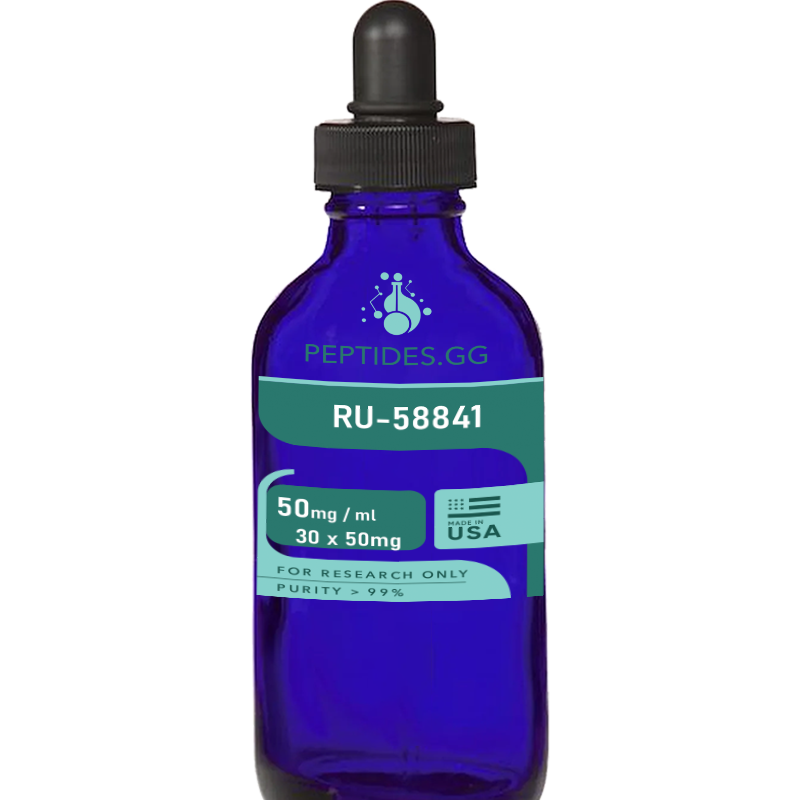
RU-58841 serves as a valuable research tool for investigating non-steroidal androgen receptor antagonism, dermal androgen signaling, and hair follicle biology in laboratory settings. This topical anti-androgen compound enables localized receptor binding research.
Research Disclaimer: Peptides.GG sells this and all other peptides for Research Only and not for human consumption.
RU-58841
$49.99 – $69.99
- Free Delivery on all orders over $200
- Earn 5% Store Credit with Every Order
- Same Day Shipping Before 1 PM PST
- 10% Discount for Cryptocurrency Payments
14-day money-back guarantee
If you are not satisfied with the product, simply return it and we will refund your money

RU-58841 serves as a valuable research tool for investigating non-steroidal androgen receptor antagonism, dermal androgen signaling, and hair follicle biology in laboratory settings. This topical anti-androgen compound enables localized receptor binding research.
Research Disclaimer: Peptides.GG sells this and all other peptides for Research Only and not for human consumption.
Frequently Asked Questions About RU-58841
What is RU-58841?
RU-58841 is a non-steroidal small-molecule topical androgen receptor (AR) antagonist of the hydantoin class, designed to bind the androgen receptor with high affinity while minimizing systemic absorption. It is supplied strictly as a research compound for laboratory use investigating follicular and skin androgen biology, and is not for human use.
What is the chemical structure of RU-58841?
RU-58841 has the molecular formula C₁₇H₁₈F₃N₃O₃, a molecular weight of 369.34 Da, and CAS number 154992-24-2; its chemical name is 4-(4,4-dimethyl-2,5-dioxo-3-(4-hydroxybutyl)-1-imidazolidinyl)-2-(trifluoromethyl)benzonitrile. Its structure features a central hydantoin core connected to a trifluoromethyl-benzonitrile pharmacophore, characteristic of non-steroidal anti-androgens.
What is RU-58841 studied for in research?
In preclinical and in vitro research, RU-58841 is used to investigate androgen-receptor structural biology, hair-follicle biology and androgenetic-alopecia models, topical drug-delivery and dermatokinetics, sebaceous-gland and sebum biology, and comparative anti-androgen pharmacology. Supplied for laboratory research use only; not for human use.
How does RU-58841 act on the androgen receptor?
RU-58841 competitively antagonizes the binding of dihydrotestosterone (DHT) to the androgen receptor, particularly at the hair-follicle dermal papilla. Its hydantoin core mimics steroidal ring geometry enough to occupy the AR ligand-binding domain, while electron-withdrawing groups disfavor the conformational change associated with receptor activation - producing antagonism rather than agonism, with relatively low affinity for related nuclear receptors.
What size is RU-58841 available in?
RU-58841 is supplied as a pre-formulated research solution in two presentations - 50 mg in 30 mL and 50 mg in 60 mL. Each batch is provided with a Certificate of Analysis documenting identity, purity, and concentration.
How is RU-58841 stored and handled in the laboratory?
RU-58841 solution is stored refrigerated (2-8°C) in a tightly sealed, light-protected container and should not be frozen, as the compound may precipitate on thawing. The alcoholic vehicle is flammable and requires appropriate safety controls; solutions are kept near neutral pH and away from UV exposure to limit hydantoin hydrolysis and photodegradation. Each lot is third-party tested with a Certificate of Analysis.
Related products
-

GHK-Cu
$53.00 – $65.00 Select options This product has multiple variants. The options may be chosen on the product pageSize: 50mg, 75mg, 100mg
-
Glutathione
$45.00 – $75.00 Select options This product has multiple variants. The options may be chosen on the product pageSize: 600mg, 1500mg
-
SNAP-8
$37.99 Select options This product has multiple variants. The options may be chosen on the product pageSize: 10mg, 20mg
Research Overview
RU-58841 is a non-steroidal small molecule compound classified as a topical androgen receptor antagonist, originally synthesized as part of a research program aimed at identifying selective anti-androgenic agents with favorable topical activity profiles. Unlike steroidal anti-androgens, RU-58841 belongs to the nonsteroidal aryl hydantoin (imidazolidinedione) class of compounds and was designed to bind the androgen receptor (AR) with high affinity while minimizing systemic absorption — a property that makes it a distinctive tool for localized androgen receptor research in skin tissue models. Its development history and pharmacological profile have made it a compound of sustained interest in dermatological and follicular biology research.
The primary research significance of RU-58841 lies in its capacity to competitively antagonize the binding of dihydrotestosterone (DHT) to the androgen receptor at the level of the hair follicle dermal papilla. DHT-mediated androgen receptor signaling is understood to play a central role in the miniaturization of hair follicles in androgenetic alopecia, and RU-58841 has been used extensively as a molecular tool to dissect this signaling axis in preclinical models. Laboratory investigations employing RU-58841 have examined follicular androgen receptor occupancy, downstream transcriptional changes in dermal papilla cells, and the structural biology of AR antagonism in a skin-relevant context. Researchers studying scalp biology and dermal remodeling often consider RU-58841 alongside compounds that influence tissue repair pathways, such as GHK-Cu, a copper peptide with well-characterized roles in extracellular matrix and follicular biology research.
RU-58841 is available for research purposes as a pre-formulated solution in concentrations suited to topical application research protocols. Its well-defined chemical structure, established AR binding kinetics, and extensive use in published preclinical literature make it a reference compound for investigators designing experiments in follicular androgen biology, skin receptor pharmacology, and topical drug delivery systems. The compound’s documented ability to remain largely localized at the site of application in preclinical dermal absorption studies has made it a frequently referenced model for evaluating topical anti-androgen delivery strategies.
Molecular Characteristics
Complete Specifications:
- CAS Number: 154992-24-2
- Molecular Weight: 369.34 Da
- Molecular Formula: C₁₇H₁₈F₃N₃O₃
- Chemical Name: 4-(4,4-dimethyl-2,5-dioxo-3-(4-hydroxybutyl)-1-imidazolidinyl)-2-(trifluoromethyl)benzonitrile
- Classification: Non-steroidal anti-androgen; topical androgen receptor antagonist
- Appearance: White to off-white crystalline solid; supplied as solution for research use
- Solubility: Poorly soluble in water; soluble in ethanol, DMSO, propylene glycol, and alcoholic vehicle systems used in topical research formulations
The molecular architecture of RU-58841 features a central hydantoin ring (imidazolidine-2,4-dione) core bearing a 4-hydroxybutyl chain and gem-dimethyl substitution, connected via an aromatic linker to a trifluoromethyl-benzonitrile pharmacophore. This structural arrangement is characteristic of the non-steroidal anti-androgen pharmacophore: the hydantoin core mimics steroidal A/B ring geometry well enough to fit within the AR ligand binding domain, while the electron-withdrawing trifluoromethyl and nitrile groups alter the receptor interaction profile to disfavor the conformational change associated with AR activation. The result is competitive antagonism rather than agonism — a property central to its utility as a research tool.
At 369.34 Da and with moderate lipophilicity (estimated log P in the range of 2–3), RU-58841 possesses physicochemical properties favorable for penetration of the stratum corneum in topical formulation research while retaining sufficient aqueous partitioning to allow distribution within dermal tissue compartments. The trifluoromethyl group confers metabolic stability advantages in skin tissue compared to unsubstituted analogs, as fluorine substitution at this position is known to resist cytochrome P450-mediated hydroxylation. This stability profile is a key variable in experiments comparing local versus systemic AR antagonism using RU-58841 as a reference compound.
Pharmacokinetic Profile in Research Models
Topical Absorption and Dermal Distribution
- Dermal absorption studies in excised human and murine skin demonstrate significant penetration into follicular structures with limited transdermal flux into systemic circulation
- Vehicle composition strongly influences RU-58841 skin penetration kinetics; ethanol-based and propylene glycol vehicles have been examined in published dermatokinetic studies
- Follicular shunting — preferential delivery to hair follicle compartments via the transfollicular route — has been investigated as a delivery advantage in minoxidil-like topical application models
- Radiolabeled compound studies in rodent scalp models document compound retention in dermal papilla tissue following topical application
Androgen Receptor Binding Dynamics
- Competitive radioligand binding assays report Ki values in the low nanomolar range for human androgen receptor, comparable in affinity to DHT in some assay formats
- Receptor occupancy in dermal papilla cell models persists for extended periods consistent with slow off-rate kinetics from the AR ligand binding domain
- Reporter gene assays using androgen-responsive elements confirm antagonist (not agonist) transcriptional activity at concentrations active in binding assays
- AR selectivity profiling studies show substantially lower affinity for progesterone, glucocorticoid, and mineralocorticoid receptors, supporting its classification as a relatively selective AR antagonist in research contexts
Metabolic Considerations
- In vitro microsomal stability studies indicate slower hepatic metabolism compared to first-generation steroidal anti-androgens, attributed in part to the trifluoromethyl group’s metabolic blocking effect
- Cutaneous metabolism by skin-resident enzymes is an important variable in topical pharmacokinetics; CYP-mediated oxidation of the hydroxybutyl chain has been identified in skin microsome incubation studies
- Systemic plasma concentrations remain low in murine topical application models relative to the applied amount, supporting the localized activity profile observed in follicular biology research
- Urinary metabolite profiling in rodent studies is used to track systemic exposure and metabolic conversion as outcome variables in topical anti-androgen delivery research
Research Applications
Androgen Receptor Biology and Structural Studies
- X-ray crystallography and cryo-EM studies using RU-58841 as a co-crystallization ligand to characterize the antagonist-bound AR ligand binding domain conformation
- Molecular dynamics simulation studies validating and extending crystallographic binding poses to predict compound-receptor interaction energetics
- Structure-activity relationship investigations comparing RU-58841 analogs with modified pharmacophore elements to map essential AR binding contacts
- Fluorescence polarization and surface plasmon resonance assays characterizing binding kinetics of RU-58841 with wild-type and mutant androgen receptor constructs
As a well-characterized non-steroidal AR antagonist with published binding kinetics, RU-58841 is widely used as a reference compound in structural studies aimed at understanding the molecular basis of androgen receptor antagonism — knowledge with broad relevance to receptor biology research across multiple tissue types.
Hair Follicle Biology and Androgenetic Alopecia Models
- Organ culture studies using isolated human hair follicles treated with DHT ± RU-58841 to map androgen-dependent gene expression changes in dermal papilla cells
- In vivo murine androgenetic alopecia models (stump-tailed macaque, testosterone-treated mice) employing RU-58841 as a topical AR blockade reference compound
- Transcriptomic profiling of dermal papilla cells under DHT challenge with RU-58841 rescue to identify androgen-regulated gene networks in follicular biology
- Immunohistochemical studies examining AR nuclear localization in follicular compartments as a readout of RU-58841 antagonism efficacy in tissue sections
- Wnt/β-catenin pathway investigation in dermal papilla cells under androgen receptor blockade conditions using RU-58841 as the blocking agent
Hair follicle biology research using RU-58841 has produced a substantial body of literature characterizing the molecular consequences of androgen receptor blockade in follicular units. These investigations have helped define the transcriptional architecture of DHT-dependent follicular miniaturization and the signaling pathways that oppose it.
Topical Drug Delivery and Dermatokinetic Research
- Franz diffusion cell studies evaluating percutaneous absorption of RU-58841 from varied vehicle systems (ethanol, propylene glycol, liposomal formulations)
- Tape-stripping experiments quantifying compound concentration gradients through stratum corneum layers after topical application
- Nanoparticle and lipid carrier formulation studies using RU-58841 as a model payload to optimize follicular targeting efficiency
- Comparative vehicle optimization studies examining the influence of penetration enhancers (oleic acid, terpenes) on RU-58841 skin flux parameters
RU-58841’s physicochemical properties — moderate lipophilicity, small molecular size, and topical-preferential distribution — make it a frequently selected model compound in dermal drug delivery research, independent of its androgen receptor pharmacology. Investigators in formulation science use it to benchmark new delivery technologies against an established reference.
Sebaceous Gland and Sebum Production Research
- Sebocyte culture studies examining androgen-stimulated lipid synthesis and its modulation by RU-58841-mediated AR blockade
- In vivo sebum production measurement studies using gravimetric and instrumental methods (Sebumeter) in androgen-challenged rodent skin models
- Gene expression profiling of androgen-responsive sebaceous gland markers (FADS, FASN, SCD1) under RU-58841 treatment conditions
- Research examining RU-58841 alongside Glutathione in skin oxidative stress and sebum lipid peroxidation assay designs
Sebaceous gland function is substantially regulated by androgen receptor signaling, and RU-58841 has been applied in sebocyte research as a tool to isolate the contribution of AR-mediated transcription to lipogenic activity in this cell type — a question relevant to acne biology and skin barrier research.
Comparative Anti-Androgen Pharmacology
- Head-to-head comparison studies of RU-58841, flutamide, bicalutamide, and enzalutamide in standardized AR reporter assay systems to establish relative potency profiles
- Research examining the complementary mechanisms of AR blockade (RU-58841) and 5α-reductase inhibition in dual-target follicular biology models
- Studies evaluating RU-58841 in combination with growth factor peptides such as BPC-157 in tissue repair and follicular modeling assay systems
- Selectivity profiling studies distinguishing androgen receptor antagonism from off-target activity at related nuclear receptors in recombinant assay systems
Comparative pharmacology studies position RU-58841 within the broader landscape of anti-androgen research compounds, establishing its niche as a topically selective AR antagonist reference molecule against which newer compounds and delivery technologies can be benchmarked.
Laboratory Handling and Storage Protocols
Solution Storage (Pre-formulated)
- Store RU-58841 solution at 2–8°C (refrigerated) in tightly sealed original container, protected from light and heat exposure
- Do not freeze pre-formulated alcoholic solutions as precipitation of the compound may occur upon thawing
- Keep away from open flames and ignition sources; ethanol-based vehicle is flammable and requires appropriate laboratory safety controls
- Inspect for precipitation or color change before each use; discard if solution clarity is compromised
Preparation of Research Working Solutions
- For in vitro cell culture applications, prepare DMSO stock solutions (10–50 mM) and dilute into aqueous culture medium; final DMSO concentration should remain below 0.1% to avoid vehicle cytotoxicity artifacts
- For dermal absorption studies, the supplied vehicle formulation can be applied directly to skin model systems; document vehicle composition for reproducibility
- Prepare fresh working dilutions from stock solutions at each experimental session; limit storage of diluted solutions beyond 48 hours at 4°C
- Verify solution concentration by UV absorbance (compound exhibits absorbance in the 250–310 nm range) when quantitative accuracy is required for concentration-response experiments
Stability Considerations
- RU-58841 is susceptible to hydrolysis of the hydantoin ring under strongly acidic or basic aqueous conditions; maintain working solutions near neutral pH
- UV exposure accelerates photodegradation; conduct all handling under subdued laboratory lighting and store in amber glassware
- Elevated temperature storage (above 25°C) accelerates degradation; a cold chain should be maintained throughout shipping and storage
- Shelf life of opened solution is typically 6–12 months when stored under recommended conditions; validate by HPLC if product age exceeds 6 months
Quality Assurance and Analytical Testing
- Purity Analysis (HPLC): Each production lot is analyzed by reverse-phase HPLC with UV detection, with purity verified at ≥98% to ensure minimal presence of synthetic impurities, degradation products, or residual starting materials
- Structural Verification (ESI-MS): Electrospray ionization mass spectrometry confirms the molecular ion at m/z 370.1 [M+H]⁺, verifying molecular weight and confirming structural identity consistent with the 4-(4,4-dimethyl-2,5-dioxo-3-(4-hydroxybutyl)-1-imidazolidinyl)-2-(trifluoromethyl)benzonitrile structure
- NMR Verification: ¹H and ¹⁹F NMR spectra are acquired to confirm regiochemistry, fluorine substitution pattern, and absence of structural isomers that HPLC and MS alone may not resolve
- Concentration Verification: Solution products are verified for compound concentration by calibrated UV-Vis spectrophotometry or HPLC quantitation against certified reference standards
- Certificate of Analysis: Full COA documentation including HPLC chromatogram, MS data, NMR spectra, and concentration verification is provided with each lot; available upon request prior to purchase
Research Considerations
Investigators designing experiments with RU-58841 should address the following experimental design factors:
- Vehicle Controls: The alcoholic vehicle used in RU-58841 solutions can independently affect skin barrier properties and cell viability in culture. Vehicle-matched controls are essential in all experimental designs to isolate compound-specific effects from vehicle effects.
- AR Expression Verification: Efficacy as an AR antagonist is contingent on AR expression in the target cell model. Researchers should confirm androgen receptor expression levels by western blot or immunofluorescence in their specific cell line or tissue model prior to initiating concentration-response studies.
- DHT Challenge Concentration: In antagonism studies, the concentration of DHT used to stimulate AR should be established from independent concentration-response curves, as DHT concentration will influence the apparent potency of RU-58841 in competitive assay formats.
- Hydantoin Hydrolysis Monitoring: In aqueous biological assay systems at physiological temperature, the hydantoin ring can hydrolyze over extended incubation periods. Researchers conducting experiments beyond 24 hours should validate compound integrity by HPLC at the end of the incubation period.
- Skin Model Selection: Dermatokinetic studies show significant variation across skin models (fresh excised skin, reconstructed epidermis, immortalized keratinocyte monolayers). Model selection should be justified based on the biological question, and comparability to other published data should be addressed explicitly in experimental design.
Priority mechanistic investigation areas for ongoing RU-58841 research include:
- Complete characterization of RU-58841 metabolites in skin tissue and correlation of metabolite activity with the parent compound’s AR antagonism profile
- Investigation of AR coactivator and corepressor recruitment dynamics in dermal papilla cells under RU-58841 antagonism compared to other AR antagonist scaffolds
- Exploration of potential off-target activity at skin-expressed GPCRs and other nuclear receptors at concentrations exceeding AR-selective ranges
- Systems-level transcriptomic analysis of androgen-regulated networks in follicular units using RU-58841 as a selective AR blockade tool
Compliance and Safety Information
- Regulatory Status: RU-58841 is supplied exclusively as a research chemical for in vitro and preclinical in vivo laboratory investigation. It has not been approved by the FDA, EMA, or any regulatory authority for use in humans or as a pharmaceutical or veterinary product.
- Intended Use: This compound is intended solely for use by qualified researchers in licensed laboratory facilities. All experimental use must comply with applicable institutional oversight, chemical safety protocols, and local regulatory requirements governing research chemicals.
- NOT Intended For: Human topical application, self-experimentation, veterinary use, or any application outside a controlled, licensed laboratory research setting. This product is not a cosmetic, drug, dietary supplement, or medical device.
- Safety Protocols: Handle with appropriate PPE including nitrile gloves, safety glasses, and a lab coat. The solution vehicle is flammable — keep away from ignition sources and conduct handling in a well-ventilated environment. Consult the Safety Data Sheet (SDS) prior to use for full hazard characterization.
- Disposal: Dispose of unused compound and solutions in compliance with institutional chemical waste management protocols. Do not drain solutions containing organic solvents into general waste streams.