
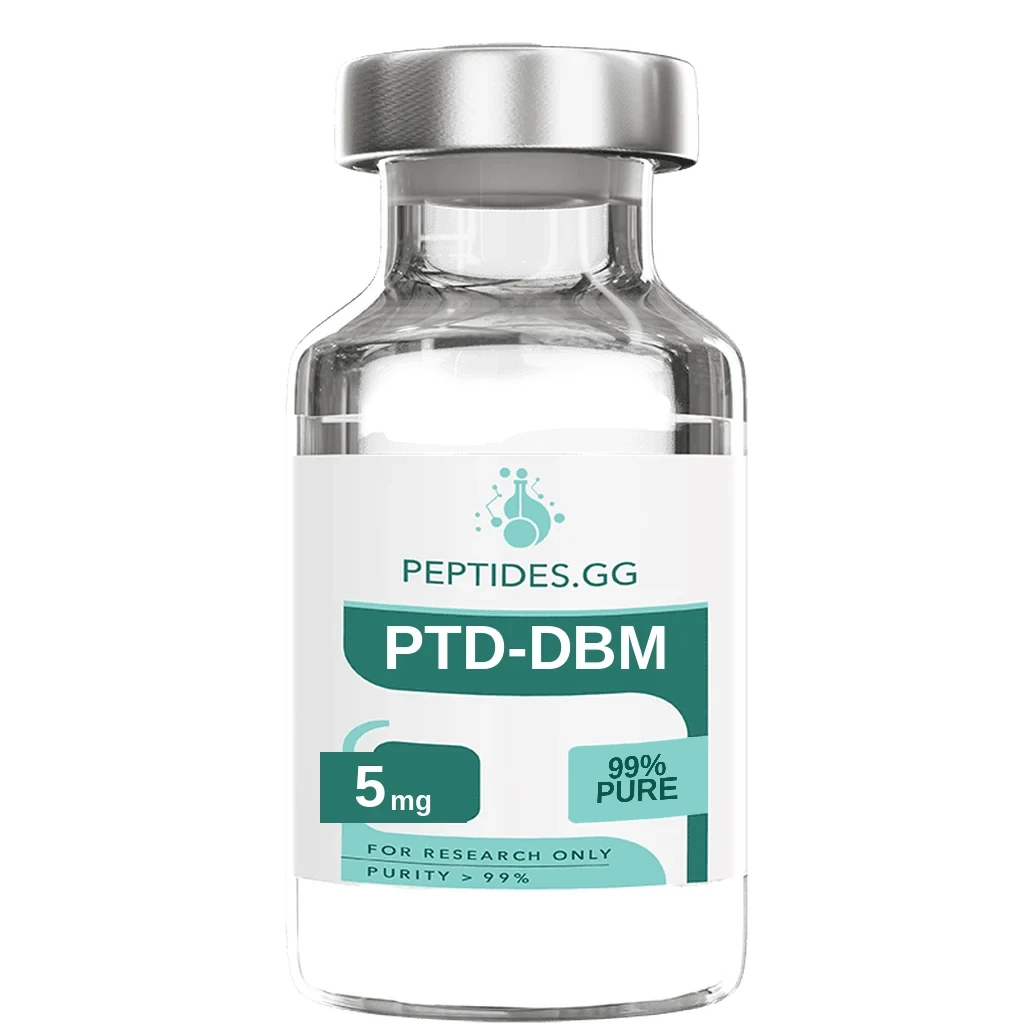
The PTD-DBM peptide is a synthetic cell-penetrating agent that targets the CXXC5–Dishevelled interaction in the Wnt/β-catenin pathway, supplied as a lyophilized research chemical for in vitro laboratory investigation. Third-party lab tested for purity.
Peptides.GG is a chemical supplier and is not a compounding pharmacy under 503A or 503B. Statements have not been evaluated by the US FDA. Products are not intended to diagnose, treat, cure, or prevent any disease. For research use only — not for human consumption.
PTD-DBM Peptide
$80.00
- Free Delivery on all orders over $200
- Earn 5% Store Credit with Every Order
- Same Day Shipping Before 1 PM PST
- 10% Discount for Cryptocurrency Payments
14-day money-back guarantee
If you are not satisfied with the product, simply return it and we will refund your money
The PTD-DBM peptide is a synthetic cell-penetrating agent that targets the CXXC5–Dishevelled interaction in the Wnt/β-catenin pathway, supplied as a lyophilized research chemical for in vitro laboratory investigation. Third-party lab tested for purity.
Peptides.GG is a chemical supplier and is not a compounding pharmacy under 503A or 503B. Statements have not been evaluated by the US FDA. Products are not intended to diagnose, treat, cure, or prevent any disease. For research use only — not for human consumption.
Frequently Asked Questions About PTD-DBM
What is PTD-DBM?
PTD-DBM (Protein-Transduction-Domain–Dishevelled-Binding Motif) is a synthetic cell-penetrating peptide used as a research tool to modulate Wnt/β-catenin signaling by disrupting the CXXC5–Dishevelled protein interaction. Supplied for laboratory use only, not for human consumption.
What is the molecular profile of PTD-DBM?
PTD-DBM has the sequence RRRRRRRR-GGGG-RKTGHQICKFRKC (a polyarginine transduction domain, a tetraglycine linker, and the Dishevelled-binding motif). Its molecular formula is C₁₂₄H₂₂₅N₆₁O₂₈S₂ in the reduced (free-thiol) form, with an average molecular weight of approximately 3082.6 Da; the oxidized (intramolecular disulfide) form is two hydrogen atoms lighter. CAS 1609454-11-6.
How does PTD-DBM work?
CXXC5 acts as a negative-feedback brake on Wnt/β-catenin signaling by binding the protein Dishevelled (Dvl). PTD-DBM competitively occupies that binding interface, relieving the CXXC5-mediated inhibition so Wnt signaling can proceed. The polyarginine domain enables the peptide to enter cells in vitro.
What is PTD-DBM studied for?
In preclinical (rodent) and in vitro research it is investigated for hair-follicle neogenesis and wound-healing models, where Wnt/β-catenin activation is central. It is a research compound only.
What size is PTD-DBM available in?
PTD-DBM is supplied as a lyophilized powder in a 5 mg size, packaged for precise gravimetric preparation of research concentrations.
How is PTD-DBM stored and handled?
PTD-DBM is a lyophilized powder kept sealed, cold, and protected from light and moisture until use. Because it contains two cysteine residues, the disulfide state should be noted when characterizing material. Each batch is third-party tested with a Certificate of Analysis.
Related products
-

Vesugen (Bioregulator)
$60.00 Select options This product has multiple variants. The options may be chosen on the product pageSize: 20mg
-
AOD9604
$30.00 – $80.00 Select options This product has multiple variants. The options may be chosen on the product pageSize: 2mg, 5mg, 10mg
Research Overview
The PTD-DBM peptide (Protein-Transduction-Domain–Dishevelled-Binding Motif) is a synthetic cell-penetrating peptide developed as a research tool for modulating Wnt/β-catenin signaling. It fuses a polyarginine protein-transduction domain — which carries the peptide across cell membranes — to a Dishevelled-binding motif that competitively disrupts the interaction between the protein CXXC5 and Dishevelled (Dvl).
Structure and Mechanism
The peptide comprises three parts: a polyarginine cell-penetrating segment, a tetraglycine linker, and the Dishevelled-binding motif (full sequence R₈-GGGG-RKTGHQICKFRKC). CXXC5 functions as a negative-feedback regulator of Wnt/β-catenin signaling by binding Dishevelled; by occupying that protein–protein interface, PTD-DBM relieves the CXXC5-mediated inhibition and allows Wnt signaling to proceed. This competitive-disruption mechanism is the basis for its use as a research tool in tissue-regeneration models.
Research Applications
In published preclinical (rodent) research, PTD-DBM has been investigated for hair-follicle neogenesis and wound-healing models, contexts in which Wnt/β-catenin activation plays a central role. It is used alongside other dermatological-research compounds such as RU-58841 in comparative laboratory work.
Laboratory Handling
PTD-DBM is supplied as a lyophilized powder. The peptide contains two cysteine residues, so the disulfide state (reduced free-thiol versus oxidized) should be noted when characterizing material. The powder is kept sealed, cold, and protected from light and moisture until use. Each batch is third-party tested with a Certificate of Analysis.