
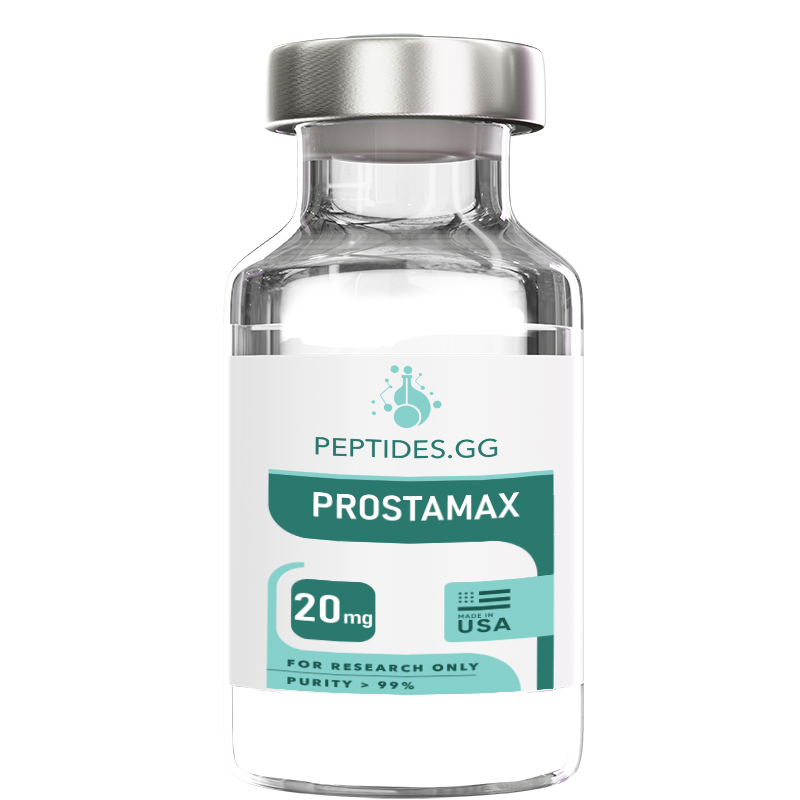
Prostamax serves as a research tool for investigating prostate-specific bioregulation and prostatic tissue function in laboratory settings.
Research Disclaimer: Peptides.GG sells this and all other peptides for Research Only and not for human consumption.
Prostamax (Bioregulator)
$60.00
- Free Delivery on all orders over $200
- Earn 5% Store Credit with Every Order
- Same Day Shipping Before 1 PM PST
- 10% Discount for Cryptocurrency Payments
14-day money-back guarantee
If you are not satisfied with the product, simply return it and we will refund your money

Prostamax serves as a research tool for investigating prostate-specific bioregulation and prostatic tissue function in laboratory settings.
Research Disclaimer: Peptides.GG sells this and all other peptides for Research Only and not for human consumption.
Frequently Asked Questions About Prostamax (Bioregulator)
What is Prostamax?
Prostamax is a defined synthetic tetrapeptide (Lys-Glu-Asp-Pro; KEDP) studied as a Khavinson-class short-peptide bioregulator for prostatic research. It is produced by solid-phase peptide synthesis and supplied strictly as a research compound for laboratory use; not for human consumption.
What is the molecular profile of Prostamax?
Prostamax is a single defined-sequence synthetic tetrapeptide with the amino acid sequence Lys-Glu-Asp-Pro (KEDP). Its molecular formula is C₂₀H₃₃N₅O₉ and its molecular weight is 487.50 Da; its CAS number is 473578-47-1. It is produced by solid-phase peptide synthesis and verified by HPLC (≥98% purity) and ESI-MS confirming the 487.50 Da mass.
What is Prostamax studied for in research?
In preclinical and in vitro research, Prostamax is used as a prostate bioregulator research tool to investigate prostate and genitourinary tissue and related tissue-specific peptide-signaling pathways. Supplied for laboratory research use only; not for human consumption.
Why is Prostamax considered a prostate bioregulator?
The Khavinson bioregulation hypothesis proposes that short, organ-specific peptides act as endogenous molecular messengers that influence tissue homeostasis through targeted gene-regulatory interactions. Prostamax is studied within this framework as a prostate bioregulator — a research tool for investigating signaling in prostate and genitourinary tissue.
What size is Prostamax available in?
Prostamax is supplied as a lyophilized (freeze-dried) powder in 20mg. The lyophilized format is preferred for research because it eliminates solution-phase degradation during storage and allows precise gravimetric preparation of research concentrations at the point of use.
How is Prostamax stored and handled in the laboratory?
Prostamax is supplied as white to off-white lyophilized powder. It is soluble in sterile water and physiological buffer systems; limited solubility in non-polar organic solvents. For research handling, the lyophilized powder is kept sealed, cold, and protected from light until use. Each batch is third-party tested and supplied with a certificate of analysis.
Related products
-

Bronchogen (Bioregulator)
$55.00 Select options This product has multiple variants. The options may be chosen on the product pageSize: 20mg
-
Testagen (Bioregulator)
$60.00 Select options This product has multiple variants. The options may be chosen on the product pageSize: 20mg
-
Livagen (Bioregulator)
$60.00 Select options This product has multiple variants. The options may be chosen on the product pageSize: 20mg
Research Overview
Prostamax is a synthetic peptide bioregulator (Khavinson short peptide) corresponding to the tetrapeptide Lys-Glu-Asp-Pro (KEDP), developed within the framework of peptide bioregulation science pioneered at the St. Petersburg Institute of Bioregulation and Gerontology. Produced by solid-phase peptide synthesis as a single, fully defined sequence, Prostamax carries the molecular formula C₂₀H₃₃N₅O₉ and a molecular weight of 487.50 Da. This defined composition is associated in the bioregulation literature with prostate-directed signaling and is hypothesized to carry informational cues relevant to prostatic epithelial homeostasis. Laboratory investigations classify Prostamax as a tissue-specific bioregulator, examining how the KEDP tetrapeptide interacts with prostate-derived cell populations at the transcriptional, proteomic, and signaling levels.
Scientific interest in Prostamax is rooted in the broader field of peptide bioregulation, which posits that short organ-directed peptides serve as intercellular communication molecules capable of modulating gene expression in a tissue-selective manner. The prostate gland is a hormonally sensitive secretory organ whose epithelial-stromal architecture undergoes significant remodeling across the lifespan, making it a compelling target for bioregulatory research. Prostamax is studied in this context alongside synthetic hormonal modulators and receptor-selective ligands to dissect the specific contributions of bioregulatory peptide signaling to prostate biology. Researchers examining prostate-associated aging phenotypes frequently position Prostamax within experimental panels that include compounds such as Testagen and Epitalon, enabling multi-tissue bioregulatory comparisons across androgen-sensitive organ systems.
Preclinical investigations employing Prostamax span several subfields relevant to prostate biology, including studies of epithelial secretory function, stromal-epithelial crosstalk, androgen receptor-dependent transcription, and age-associated alterations in glandular architecture. The defined, single-sequence character of the KEDP tetrapeptide allows researchers to attribute observed responses to one chemically precise signal, in contrast to studies employing multi-component tissue preparations. Prostamax is also studied alongside metabolic regulators and longevity-associated peptides including Ovagen and Livagen, which target distinct organ systems, allowing researchers to compare tissue-specificity paradigms across the bioregulator compound class.
Molecular Characteristics
Complete Specifications:
- Classification: Synthetic peptide bioregulator (Khavinson short peptide)
- Source/Origin: Synthetic (solid-phase peptide synthesis)
- Amino Acid Sequence: Lys-Glu-Asp-Pro (KEDP)
- Molecular Formula: C₂₀H₃₃N₅O₉
- Molecular Weight: 487.50 Da
- CAS Number: 473578-47-1
- Appearance: White to off-white lyophilized powder
- Solubility: Soluble in sterile water and physiological buffer systems; limited solubility in non-polar organic solvents
The molecular character of Prostamax is that of a chemically defined, single-sequence synthetic peptide. As the tetrapeptide Lys-Glu-Asp-Pro, it presents one precise primary structure on every production lot, eliminating the compositional ambiguity associated with multi-component preparations. This structural definition is considered analytically significant because every observed biological response can be attributed to a single, fully characterized molecule rather than to an undefined collection of fragments. Mass spectrometric analysis of Prostamax preparations confirms the expected molecular mass of 487.50 Da, providing an unambiguous identity check that is reproducible across production lots when consistent synthetic protocols are applied.
At 487.50 Da, the KEDP tetrapeptide occupies the low-molecular-weight range characteristic of Khavinson short peptides, a size that supports both cellular uptake through endocytic pathways and direct engagement at cell-surface targets. Its compact size may facilitate membrane penetration and intracellular access, while its defined polar side chains govern interactions with extracellular and surface components on prostatic epithelial and stromal cells. Researchers characterizing Prostamax activity often employ HPLC purification followed by bioassay in defined cell systems to map how the tetrapeptide drives specific transcriptional or functional responses in prostate-derived cell lines.
Pharmacokinetic Profile in Research Models
Bioavailability and Tissue Distribution
- Subcutaneous and intraperitoneal administration routes are standard in rodent preclinical models; systemic peptide distribution is assessed by LC-MS/MS measurement of the intact KEDP tetrapeptide in plasma and tissue homogenates
- Prostate tissue accumulation studies use radiolabeled peptide or immunohistochemical detection of the exogenous tetrapeptide following systemic administration in intact male rodent research models
- The low molecular weight of the defined tetrapeptide supports rapid systemic distribution and clearance kinetics, which are quantified directly because a single molecular species is being tracked rather than a distribution of fragments
- Plasma protein binding profiling using ultrafiltration assays characterizes the free versus bound peptide fraction available for tissue uptake in research model systems
Tissue-Specific Activity Dynamics
- Primary prostatic epithelial cell cultures and prostate-derived cell lines (LNCaP, PC-3, DU145) serve as standard in vitro systems for characterizing concentration- and time-dependent transcriptional responses to Prostamax exposure
- Organotypic prostate slice cultures preserve epithelial-stromal architecture and allow investigators to study paracrine signaling dynamics following Prostamax application under conditions more representative of native tissue organization
- Time-course RNA sequencing experiments at 6, 24, 48, and 72 hours post-treatment map the kinetics of early-response gene induction versus late-phase transcriptional programs in prostatic epithelial cells
- Androgen receptor nuclear translocation assays quantify whether the KEDP tetrapeptide interacts with or modulates AR signaling axes independently of canonical androgen ligand availability
Metabolic Considerations
- As a short peptide, Prostamax is subject to serum protease degradation; plasma stability is characterized using incubation-time-course assays followed by LC-MS/MS quantification of the intact 487.50 Da tetrapeptide
- Proteolytic processing of the KEDP tetrapeptide yields its constituent amino acids, which reenter normal biosynthetic pathways; metabolic clearance profiling therefore tracks loss of the intact parent peptide as the primary readout
- Renal filtration is the primary elimination route for the low-molecular-weight tetrapeptide; urinary recovery assays in rodent models are used to construct mass balance profiles
- Lysosomal processing studies in prostatic epithelial cells characterize intracellular peptide catabolism rates following endocytic uptake, informing the effective intracellular exposure window for gene regulatory activity
Research Applications
Prostate Epithelial Function Research
- Secretory protein expression profiling (PSA, PAP, prostatic acid phosphatase isoforms) in prostate epithelial cultures exposed to Prostamax to characterize effects on secretory program gene expression
- Tight junction integrity assays using transepithelial electrical resistance (TEER) measurements and claudin/occludin immunofluorescence in polarized prostatic epithelial monolayers
- Luminal-to-basal cell identity marker analysis (CK8, CK18 versus CK5, p63) to investigate whether Prostamax influences cell fate positioning within the prostatic epithelial hierarchy
- Secretory vesicle biogenesis and exosome release quantification in Prostamax-treated luminal epithelial cells to characterize effects on the prostatic secretory apparatus
Prostate epithelial function encompasses secretory activity, barrier integrity, and cell identity maintenance — processes that are tightly regulated by both hormonal signals and local paracrine factors. Prostamax serves as a research tool for investigating how a defined bioregulatory peptide signal modulates these core epithelial programs at the transcriptional and cellular level.
Stromal-Epithelial Interaction Studies
- Co-culture systems pairing primary prostatic stromal fibroblasts with luminal epithelial cells, with Prostamax applied to interrogate bidirectional paracrine signaling responses in both compartments
- Extracellular matrix protein deposition assays (collagen I, fibronectin, laminin) in prostatic stromal cells exposed to Prostamax to characterize effects on stromal remodeling gene programs
- Growth factor secretion profiling (FGF7, TGF-β1, HGF) in conditioned medium from Prostamax-treated stromal cells applied to epithelial reporter systems
- Three-dimensional prostate organoid models incorporating both epithelial and stromal compartments to study Prostamax effects on tissue architecture formation and maintenance in Matrigel-based culture systems
The prostatic stroma exerts essential inductive and maintenance signals on the overlying epithelium throughout adult life. Research examining Prostamax in stromal-epithelial co-culture systems enables investigators to probe whether the KEDP tetrapeptide preferentially engages one compartment or acts on both to coordinate tissue-level functional responses.
Androgen-Dependent Regulation Research
- Androgen receptor (AR) transcriptional activity reporter assays in LNCaP cells comparing Prostamax effects in androgen-replete versus androgen-depleted culture conditions
- ChIP-seq mapping of AR chromatin occupancy at androgen-response elements in prostate epithelial cells following Prostamax treatment to identify loci where bioregulatory peptide signaling intersects with androgen-driven transcriptional programs
- 5α-reductase isoform expression analysis and dihydrotestosterone (DHT) metabolism profiling in prostate cells exposed to Prostamax at defined concentrations
- Androgen-independent signaling pathway activation (PI3K/AKT, MAPK/ERK) assays in prostate cell lines treated with Prostamax to characterize AR-bypass mechanisms potentially modulated by bioregulatory peptide inputs
Prostate Aging and Tissue Homeostasis Models
- Aged rodent prostate tissue histology and gene expression comparisons between Prostamax-treated and vehicle-control animal cohorts using bulk RNA sequencing and single-cell transcriptomics
- Senescence marker profiling (p16INK4a, p21, SA-β-galactosidase activity, SASP cytokine secretion) in aging prostate epithelial cell cultures following bioregulatory peptide exposure
- Luminal-to-basal cell ratio quantification by flow cytometry in prostate tissue dissociates from aged research animals enrolled in Prostamax preclinical protocols
- DNA damage response pathway activity (γH2AX foci, ATM/ATR signaling) in prostate cell populations exposed to genotoxic stress conditions alongside Prostamax treatment
Age-related changes in the prostate represent a major area of preclinical investigation. Prostamax is studied in aged animal models and senescence-stressed cell culture systems to examine whether a defined organ-directed bioregulatory peptide signal retains the capacity to modulate tissue maintenance programs in the context of established aging phenotypes. These investigations complement research utilizing longevity-associated peptides such as Epitalon and gonadal tissue regulators including Testagen.
Laboratory Handling and Storage Protocols
Lyophilized Storage
- Store lyophilized Prostamax at −20°C in a sealed, desiccated container protected from light to preserve the integrity of the peptide over the long term
- Avoid repeated temperature excursions above ambient; brief room-temperature handling during aliquoting is acceptable if the vial cap remains sealed until equilibration is complete
- Pre-aliquot bulk lyophilized material into single-experiment quantities before use to eliminate freeze-thaw cycling of the primary stock
- Lyophilized Prostamax is stable for up to 24 months at −20°C under recommended conditions with packaging integrity maintained throughout storage
Quality Assurance and Analytical Testing
- Purity Analysis (HPLC): Each production lot of Prostamax is characterized by reverse-phase HPLC with UV detection, confirming peptide purity of ≥98% and verifying the absence of process-related impurity peaks. As a defined single-sequence peptide, characterization is anchored to a quantitative purity threshold for the KEDP tetrapeptide.
- Mass Spectrometric Confirmation (ESI-MS): Electrospray ionization mass spectrometry is applied to each production lot to confirm the expected molecular weight of 487.50 Da, providing an unambiguous identity verification of the Lys-Glu-Asp-Pro sequence and establishing lot-specific reference data for research traceability.
- Endotoxin Testing: Endotoxin levels are confirmed below 1 EU/mg by the Limulus amebocyte lysate (LAL) assay, a critical specification for prostate epithelial and stromal cell culture applications where endotoxin contamination can activate TLR4-dependent inflammatory signaling and confound biological endpoint measurements.
- Identity Confirmation: Lot-specific documentation confirms the synthetic origin and amino acid sequence (Lys-Glu-Asp-Pro), with synthesis and purification methodology recorded in compliance with applicable standards for research-grade peptides.
- Certificate of Analysis: A batch-specific certificate of analysis accompanies each research shipment, providing HPLC chromatogram, MS confirmation data, endotoxin results, and all relevant quality documentation required for institutional research compliance records.
Research Considerations
Investigators designing Prostamax-based experiments should address the following experimental design factors:
- Select prostate cell models with defined androgen receptor status and confirm luminal versus basal identity before initiating Prostamax exposure studies, as bioregulatory peptide responses may differ substantially between cell subtypes
- Validate peptide stability in serum-containing versus serum-free culture media prior to concentration-response experiments, as protease activity in serum can significantly reduce the effective peptide concentration over experimental time courses
- Include vehicle-matched controls and heat-inactivated Prostamax controls to distinguish peptide-specific biological effects from non-specific responses to buffer components or trace contaminants
- Confirm reconstituted peptide identity and purity against the certificate of analysis, and include a common reference lot in all experimental runs for normalization across independently conducted studies
- Apply statistical power calculations during the experimental design phase to ensure adequate biological replicates for detecting expected effect magnitudes based on RNA-seq or proteomic pilot data
Mechanistic investigations into Prostamax’s interactions with prostate tissue biology may examine:
- Androgen receptor co-regulator recruitment and chromatin remodeling at androgen response elements in epithelial cells following peptide exposure, using ChIP-seq with AR and histone modification antibodies
- Epigenetic landscape characterization by ATAC-seq in Prostamax-treated versus vehicle-treated prostatic epithelial cells to identify chromatin accessibility changes at regulatory gene loci
- Secretome profiling by mass spectrometry of conditioned medium from Prostamax-treated prostate cultures to identify paracrine factors released in response to peptide stimulation
- Single-cell transcriptomics in organoid or tissue dissociate models to resolve cell-type-specific transcriptional responses within the diverse prostatic epithelial hierarchy
Compliance and Safety Information
- Regulatory Status: Prostamax is supplied exclusively as a research compound for laboratory use. It has not been evaluated or approved by the FDA, EMA, or any other regulatory authority for human or veterinary medical use.
- Intended Use: This material is intended solely for in vitro laboratory research and preclinical investigations conducted by qualified scientific personnel within institutionally approved research frameworks.
- NOT Intended For: Human consumption, in vivo administration to humans, veterinary use, food, drug, cosmetic, or household applications. Not for use outside of professional research laboratory settings.
- Safety Protocols: Handle according to institutional biosafety guidelines. Wear appropriate personal protective equipment (gloves, lab coat, eye protection) when handling lyophilized powders and solutions. Consult the material safety data sheet (MSDS) provided with each shipment. Dispose of all research materials in accordance with applicable institutional and governmental regulations governing peptide research compounds.