
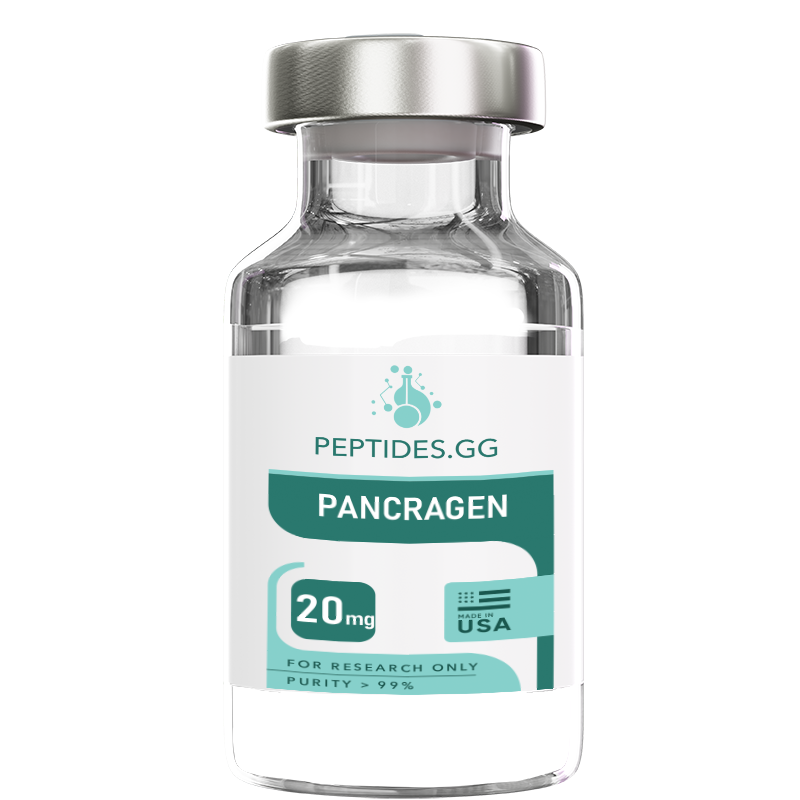
Pancragen serves as a research tool for investigating pancreas-specific bioregulation and pancreatic tissue function in laboratory settings.
Research Disclaimer: Peptides.GG sells this and all other peptides for Research Only and not for human consumption.
Pancragen
$60.00
- Free Delivery on all orders over $200
- Earn 5% Store Credit with Every Order
- Same Day Shipping Before 1 PM PST
- 10% Discount for Cryptocurrency Payments
14-day money-back guarantee
If you are not satisfied with the product, simply return it and we will refund your money
Pancragen serves as a research tool for investigating pancreas-specific bioregulation and pancreatic tissue function in laboratory settings.
Research Disclaimer: Peptides.GG sells this and all other peptides for Research Only and not for human consumption.
Frequently Asked Questions About Pancragen
What is Pancragen?
Pancragen is a defined synthetic tetrapeptide (Lys-Glu-Asp-Trp; KEDW) studied as a Khavinson-class short-peptide bioregulator for pancreatic research. It is produced by solid-phase peptide synthesis and supplied strictly as a research compound for laboratory use; not for human consumption.
What is the molecular profile of Pancragen?
Pancragen is a single defined-sequence synthetic tetrapeptide with the amino acid sequence Lys-Glu-Asp-Trp (KEDW). Its molecular formula is C₂₆H₃₆N₆O₉ and its molecular weight is 576.61 Da. It is produced by solid-phase peptide synthesis and verified by HPLC (≥98% purity) and ESI-MS confirming the 576.61 Da mass.
What is Pancragen studied for in research?
In preclinical and in vitro research, Pancragen is used as a pancreatic bioregulator research tool to investigate pancreatic tissue and related tissue-specific peptide-signaling pathways. Supplied for laboratory research use only; not for human consumption.
Why is Pancragen considered a pancreatic bioregulator?
The Khavinson bioregulation hypothesis proposes that short, organ-specific peptides act as endogenous molecular messengers that influence tissue homeostasis through targeted gene-regulatory interactions. Pancragen is studied within this framework as a pancreatic bioregulator — a research tool for investigating signaling in pancreatic tissue.
What size is Pancragen available in?
Pancragen is supplied as a lyophilized (freeze-dried) powder in 20mg. The lyophilized format is preferred for research because it eliminates solution-phase degradation during storage and allows precise gravimetric preparation of research concentrations at the point of use.
How is Pancragen stored and handled in the laboratory?
Pancragen is supplied as white to off-white lyophilized powder. It is soluble in water, phosphate buffered saline, cell culture media. For research handling, the lyophilized powder is kept sealed, cold, and protected from light until use. Each batch is third-party tested and supplied with a certificate of analysis.
Related products
-

Pinealon
$35.00 – $60.00 Select options This product has multiple variants. The options may be chosen on the product pageSize: 10mg, 20mg
-
Cardiogen
$50.00 Select options This product has multiple variants. The options may be chosen on the product pageSize: 20mg
-
Ovagen
$60.00 Select options This product has multiple variants. The options may be chosen on the product pageSize: 20mg
Research Overview
Pancragen serves as a research tool for investigating pancreas-specific bioregulation and pancreatic tissue function in laboratory settings. This synthetic peptide bioregulator is a defined Khavinson short peptide, the tetrapeptide Lys-Glu-Asp-Trp (KEDW), produced by solid-phase peptide synthesis rather than isolated from tissue. Pancreatic function research intersects with metabolic peptide studies using Semaglutide for GLP-1 receptor-mediated beta-cell biology and Tirzepatide for dual incretin receptor effects on insulin secretion. The short-peptide bioregulator concept proposes that defined peptide sequences can act as signaling molecules that influence cellular function in corresponding target tissues.
Pancragen research applications extend across multiple areas of pancreatic biology including endocrine islet function, exocrine acinar cell regulation, insulin and glucagon secretion, digestive enzyme production, and pancreatic aging processes. Laboratory protocols examine these effects in cell culture systems, islet preparations, and preclinical animal models to understand pancreatic tissue regulation at molecular and cellular levels.
The peptide’s pancreas-directed research focus provides interest in tissue selectivity and targeted cellular regulation. Studies investigate how the KEDW tetrapeptide interacts with both endocrine and exocrine pancreatic cells, the mechanisms underlying tissue-specific effects, and potential applications in understanding pancreatic function and metabolic regulation. Research models include islet cell cultures, acinar cell systems, and various pancreatic function assessment protocols.
Molecular Characteristics
Defined Composition:
- Classification: Synthetic peptide bioregulator (Khavinson short peptide)
- Source/Origin: Synthetic (solid-phase peptide synthesis)
- Amino Acid Sequence: Lys-Glu-Asp-Trp (KEDW)
- Molecular Formula: C₂₆H₃₆N₆O₉
- Molecular Weight: 576.61 Da
- Form: White to off-white lyophilized powder
- Solubility: Water, phosphate buffered saline, cell culture media
Pancragen is a single, chemically defined molecular entity: the tetrapeptide Lys-Glu-Asp-Trp. As a short, sequence-defined peptide, it offers reproducible composition from batch to batch, supporting consistent bioregulatory research in models of both endocrine and exocrine pancreatic function.
Bioregulator Peptide Research Background
Pancragen belongs to the research category of short peptide bioregulators (cytomaxes/cytogens) developed to investigate tissue-specific cellular regulation. Research on pancreatic bioregulators like the KEDW tetrapeptide investigates these mechanisms in both endocrine (insulin-secreting beta cells, glucagon-secreting alpha cells) and exocrine (digestive enzyme-secreting acinar cells) contexts, examining how defined peptide signals might modulate pancreatic function and glucose homeostasis in experimental models.
Research Applications
Pancreatic Beta Cell Research
Pancragen serves as a research tool for investigating insulin-producing beta cell function:
- Insulin Secretion Studies: Investigation of glucose-stimulated insulin secretion (GSIS) and secretagogue responses
- Beta Cell Gene Expression: Research on insulin, PDX1, MAFA, and other beta cell-specific genes
- Glucose Sensing Research: Examination of GLUT2, glucokinase, and metabolic glucose sensing mechanisms
- Cell Viability and Survival: Studies on beta cell resistance to apoptosis, oxidative stress, and inflammatory damage
- Beta Cell Proliferation: Investigation of beta cell replication and mass expansion mechanisms
Laboratory protocols employ isolated islets of Langerhans, beta cell lines (MIN6, INS-1, βTC), and primary islet cell cultures to characterize Pancragen effects.
Alpha Cell and Glucagon Regulation
Research applications extend to counter-regulatory hormone function:
- Glucagon Secretion Research: Examination of alpha cell glucagon release in response to hypoglycemia
- Alpha Cell Gene Expression: Studies on glucagon, ARX, and alpha cell identity markers
- Glucose Sensing in Alpha Cells: Investigation of inverse glucose sensing mechanisms
- Alpha-Beta Cell Communication: Research on paracrine signaling within islets
- Counter-Regulatory Function: Studies on glucagon’s role in glucose homeostasis
Experimental approaches include isolated alpha cell studies, islet co-culture systems, and glucagon secretion assays.
Exocrine Pancreas Research
Laboratory studies investigate Pancragen in digestive enzyme production contexts:
- Acinar Cell Function: Research on digestive enzyme synthesis, storage, and secretion
- Pancreatic Enzyme Studies: Investigation of amylase, lipase, and protease expression and activity
- Zymogen Granule Research: Examination of enzyme packaging and regulated secretion mechanisms
- Secretin and CCK Responses: Studies on hormonal regulation of exocrine secretion
- Pancreatic Ductal Function: Research on bicarbonate secretion and fluid production
Research protocols include acinar cell cultures, pancreatic enzyme assays, and secretion measurement systems.
Pancreatic Islet Aging Research
Pancragen serves as a tool for investigating age-related changes in pancreatic function:
- Beta Cell Senescence: Examination of aging markers in islet cells and functional decline
- Age-Related Insulin Secretion: Studies on declining GSIS capacity with aging
- Islet Mass Changes: Research on age-related reduction in beta cell mass
- Oxidative Stress in Islets: Investigation of mitochondrial dysfunction and ROS accumulation
- Regenerative Capacity: Analysis of declining islet repair and replication with aging
Research protocols employ aging models, senescence-associated marker analysis, and comparative studies across age groups.
Diabetes Research Models
Laboratory studies examine Pancragen in metabolic dysfunction contexts:
- Type 1 Diabetes Models: Research on autoimmune beta cell destruction and preservation strategies
- Type 2 Diabetes Models: Investigation of beta cell dysfunction, insulin resistance interactions
- Glucotoxicity Studies: Examination of chronic hyperglycemia effects on islet function
- Lipotoxicity Research: Studies on fatty acid-induced beta cell dysfunction
- Islet Inflammation: Investigation of cytokine effects (IL-1β, TNF-α, IFN-γ) on beta cells
Experimental approaches include cytokine-treated islets, high glucose exposure, and palmitate toxicity models.
Pancreatic Regeneration Research
Pancragen research applications include tissue repair and renewal:
- Beta Cell Regeneration: Investigation of beta cell neogenesis from progenitors
- Transdifferentiation Studies: Research on alpha-to-beta cell conversion mechanisms
- Ductal Cell Differentiation: Examination of pancreatic progenitor potential
- Acinar-to-Beta Conversion: Studies on cellular plasticity in pancreatic compartments
- Islet Transplantation Research: Investigation of islet survival and function post-transplantation
Research models include lineage tracing, injury-regeneration protocols, and islet transplantation studies.
Laboratory Handling and Storage Protocols
Lyophilized Powder Storage:
- Store at 2-8°C (refrigerated) in original sealed vial
- Protect from light exposure and moisture
- Do not freeze lyophilized powder
- Stable for 24 months refrigerated as unopened vial
Quality Assurance and Analytical Testing
Identity and Purity Analysis:
- HPLC: purity ≥98%
- Identity confirmation by ESI-MS (576.61 Da)
- Amino acid analysis
- Peptide content determination
Purity and Contaminant Testing:
- Protein purity by Bradford or BCA assay
- Bacterial endotoxin: <10 EU/mg
- Sterility testing
- Water content: <8%
Synthesis and Batch Verification:
- Solid-phase peptide synthesis (defined KEDW sequence)
- Sequence verification
- Standardized synthesis and purification protocols
- Batch-to-batch consistency testing
Research Considerations
Experimental Design Factors:
1. Concentration Selection: Typically 0.1-10 μg/mL in cell culture
2. Treatment Duration: 24-72 hours for gene expression; shorter for acute secretion studies
3. Cell Type Specificity: Verify pancreatic selectivity through comparative studies
4. Islet Culture Challenges: Maintain proper oxygenation and glucose concentrations
5. Defined Sequence: A single tetrapeptide entity supports reproducible, controlled experiments
Control Groups:
- Vehicle control
- Non-specific peptide control
- Positive controls (glucose, GLP-1, etc.)
- Tissue-specific comparisons
Mechanism Investigation:
- Transcription factor regulation (PDX1, MAFA, NEUROD1)
- Insulin signaling pathway modulation
- Glucose sensing mechanism effects
- Calcium signaling in beta cells
- Mitochondrial function regulation
Compliance and Safety Information
Regulatory Status:
Pancragen is for in-vitro laboratory studies and preclinical research only. Not approved for human therapeutic use, dietary supplementation, or medical applications.
Intended Use:
- In-vitro cell culture research
- Islet and pancreatic tissue studies
- In-vivo preclinical research in approved animal models
- Academic and institutional research
NOT Intended For:
- Human consumption or administration
- Therapeutic treatment or diagnosis
- Dietary supplementation
- Veterinary applications without oversight
- Medical or clinical applications
—