

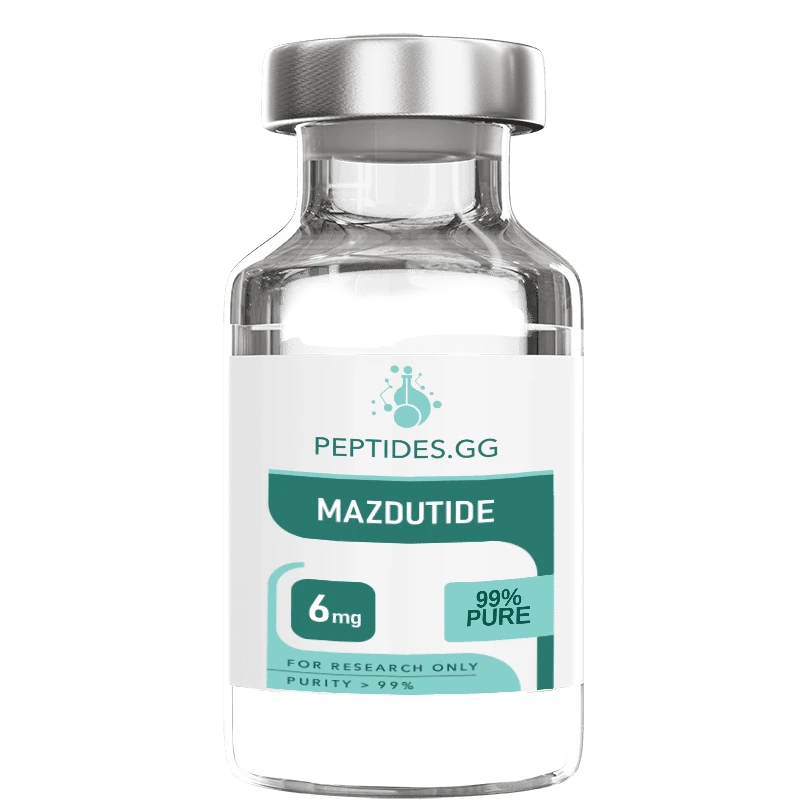
The Mazdutide peptide serves as a valuable research tool for investigating coordinated GLP-1 and glucagon receptor activation in laboratory settings.
Research Disclaimer: Peptides.GG sells this and all other peptides for Research Only and not for human consumption.
Mazdutide Peptide
$100.00
- Free Delivery on all orders over $200
- Earn 5% Store Credit with Every Order
- Same Day Shipping Before 1 PM PST
14-day money-back guarantee
Not satisfied? Return any unopened product within 14 days of delivery for a full refund — we send the return label.
The Mazdutide peptide serves as a valuable research tool for investigating coordinated GLP-1 and glucagon receptor activation in laboratory settings.
Research Disclaimer: Peptides.GG sells this and all other peptides for Research Only and not for human consumption.
Frequently Asked Questions About Mazdutide
What is mazdutide?
Mazdutide is a synthetic peptide studied as a research tool for coordinated activation of two metabolic-hormone receptors: the GLP-1 receptor and the glucagon receptor. It is built on the oxyntomodulin framework — a long-acting oxyntomodulin (OXM) analog and GLP-1R/GCGR dual agonist — making it a model compound for investigating dual incretin-and-glucagon receptor pharmacology in experimental systems. It is supplied strictly as a research compound for laboratory use and is not for human consumption.
What is the molecular profile of mazdutide?
Mazdutide is an acylated peptide with an approximate molecular weight of ~4,600 Da, classified as a GLP-1R/GCGR dual agonist and long-acting oxyntomodulin (OXM) analog. Its sequence carries amino-acid substitutions that enable recognition by both receptors, a fatty-acid acylation that provides albumin binding for an extended pharmacokinetic profile, and modifications conferring protease resistance, particularly against DPP-4 at the N-terminus. It is supplied as a white to off-white lyophilized powder, soluble in water and bacteriostatic water, and verified at ≥99% purity by reversed-phase HPLC.
How does mazdutide differ from a GLP-1/GIP dual agonist such as tirzepatide?
Both belong to the multi-receptor incretin class, but they pair different receptors. Tirzepatide combines GLP-1 and GIP receptor activity, whereas mazdutide pairs GLP-1 with the glucagon receptor (GCGR). In research models, mazdutide activates both of its targets with near-balanced potency and a modest bias toward the glucagon receptor, which makes it a useful comparative tool for studying how a GLP-1/glucagon combination behaves relative to a GLP-1/GIP combination. These mechanisms are studied in cell-culture and animal models, not in humans.
How does mazdutide act in research models?
In laboratory research, mazdutide simultaneously engages the GLP-1 receptor and the glucagon receptor — both Class B G-protein-coupled receptors — activating cAMP-dependent signaling at each. Studies use it to examine the integration of incretin-mediated and glucagon-mediated pathways, including glucose handling, energy expenditure, and hepatic lipid metabolism in experimental systems, and to compare balanced versus biased dual-agonism profiles. These mechanisms are investigated in cell-culture and animal models, not in humans.
What is the reported half-life of mazdutide in research models?
In preclinical pharmacokinetic studies, mazdutide is reported to have a plasma half-life of approximately ~120-140 hours (on the order of 5-6 days), a duration attributed to its fatty-acid acylation and resulting albumin binding, which limits clearance. This extended profile makes it suitable for weekly-administration designs in chronic research protocols. These are research-model observations and do not constitute human guidance.
What purity is mazdutide, and how is it stored?
Each batch of mazdutide is verified at ≥99% purity by reversed-phase HPLC, with identity confirmed by electrospray-ionization mass spectrometry against its approximate molecular weight and by amino-acid analysis. The lyophilized powder is kept sealed and desiccated at -20°C to -80°C, protected from light and moisture, with stability data available for 24+ months at -20°C. A Certificate of Analysis accompanies each batch, with third-party analytical verification available on request.
Research References
Peer-reviewed studies and database records underpinning the research described on this page. Links open on PubMed, PubMed Central, or the publisher in a new tab.
- Day JW, et al. A new glucagon and GLP-1 co-agonist eliminates obesity in rodents. Nat Chem Biol. 2009. PMID: 19597507 →
- Pocai A, et al. Glucagon-like peptide 1/glucagon receptor dual agonism reverses obesity in mice. Diabetes. 2009. PMID: 19602537 →
- Sánchez-Garrido MA, et al. GLP-1/glucagon receptor co-agonism for treatment of obesity. Diabetologia. 2017. PMID: 28733905 →
- Zhang H, et al. Structure of the full-length glucagon class B G-protein-coupled receptor. Nature. 2017. PMID: 28514451 →
- Jazayeri A, et al. Crystal structure of the GLP-1 receptor bound to a peptide agonist. Nature. 2017. PMID: 28562585 →
- Ji L, et al. IBI362 (LY3305677), a weekly-dose GLP-1 and glucagon receptor dual agonist, in Chinese adults with overweight or obesity: A randomised, placebo-controlled, multiple ascending dose phase 1b study. EClinicalMedicine. 2021. PMID: 34430840 →
- Jiang H, et al. A phase 1b randomised controlled trial of a glucagon-like peptide-1 and glucagon receptor dual agonist IBI362 (LY3305677) in Chinese patients with type 2 diabetes. Nat Commun. 2022. PMID: 35750681 →
- Ji L, et al. Safety and efficacy of a GLP-1 and glucagon receptor dual agonist mazdutide (IBI362) 9 mg and 10 mg in Chinese adults with overweight or obesity: A randomised, placebo-controlled, multiple-ascending-dose phase 1b trial. EClinicalMedicine. 2022. PMID: 36247927 →
- Ji L, et al. A phase 2 randomised controlled trial of mazdutide in Chinese overweight adults or adults with obesity. Nat Commun. 2023. PMID: 38092790 →
- Habegger KM, et al. The metabolic actions of glucagon revisited. Nat Rev Endocrinol. 2010. PMID: 20957001 →
Related products
-

MOTS-c
$49.00 – $190.00 Select options This product has multiple variants. The options may be chosen on the product pageSize: 10mg, 20mg, 40mg
-
Survodutide
$110.00 Select options This product has multiple variants. The options may be chosen on the product pageSize: 10mg
Research Overview
The Mazdutide peptide serves as a valuable research tool for investigating coordinated GLP-1 and glucagon receptor activation in laboratory settings. This synthetic peptide represents an alternative dual agonist strategy compared to GLP-1/GIP co-activation, combining incretin-mediated glucose lowering with glucagon receptor-mediated enhanced energy expenditure and hepatic lipid oxidation. Research applications encompass dual receptor pharmacology, glucose and lipid metabolism integration, energy balance investigation, and comparative analysis of different dual agonist approaches in experimental systems. Multi-receptor metabolic research employs Tirzepatide (GIP/GLP-1 dual agonist) and Retatrutide (triple agonist) for systematic comparison of receptor combination strategies, while Semaglutide provides the single-receptor GLP-1 reference.
The peptide’s development addresses the research question of optimal hormone receptor combinations for metabolic regulation. While GLP-1 and GIP are both incretins secreted postprandially, glucagon is counter-regulatory and promotes catabolic processes. Laboratory studies investigate mazdutide’s effects on glucose homeostasis, energy expenditure, hepatic metabolism, adipose tissue lipolysis, and integrated metabolic outcomes. Research protocols examine whether glucagon receptor activation provides complementary benefits to GLP-1 receptor activation for superior metabolic regulation.
Mazdutide research demonstrates the feasibility of dual GLP-1/glucagon agonism combining anabolic (GLP-1) and catabolic (glucagon) pathways. The peptide’s structure enables simultaneous activation of both receptors with near-balanced potency (a modest bias toward the glucagon receptor), avoiding unopposed glucagon effects while leveraging beneficial metabolic actions. This pharmacological profile makes mazdutide a valuable comparative tool when investigating optimal multi-hormone receptor activation strategies.
Molecular Characteristics
Complete Specifications:
- Molecular Weight: ~4,600 Da (approximate)
- Peptide Classification: GLP-1R/GCGR dual agonist; long-acting oxyntomodulin (OXM) analog; acylated peptide
- Appearance: White to off-white lyophilized powder
- Solubility: Water, bacteriostatic water, phosphate buffered saline
- Receptor Targets: GLP-1 receptor, Glucagon receptor (near-balanced dual agonist with a modest glucagon-receptor bias)
The peptide’s structure incorporates modifications enabling recognition by both GLP-1 and glucagon receptors despite significant sequence differences between native hormones. Strategic amino acid substitutions at critical positions enable dual receptor binding and activation. Fatty acid acylation at a specific site provides albumin binding for extended pharmacokinetic profile. Additional modifications confer protease resistance, particularly against DPP-4 at the N-terminus. This molecular architecture represents sophisticated peptide engineering balancing two distinct receptor pharmacophores.
Pharmacokinetic Profile in Research Models
Mazdutide pharmacokinetic characterization in preclinical research reveals important properties:
Absorption and Bioavailability:
- Subcutaneous bioavailability: High (>75% in preclinical models)
- Sustained absorption from injection site
- Weekly administration potential in chronic studies
- Multiple routes investigated: SC, IV, IP
Distribution and Elimination:
- Plasma half-life: ~120-140 hours (approximately 5-6 days)
- Limited distribution due to albumin binding
- Plasma protein binding: >99%
- Proteolytic degradation pathway
- Steady-state after 4 weeks
Receptor Pharmacology:
- GLP-1R activation: High potency agonist
- GCGR activation: High potency agonist
- Near-balanced dual agonist: comparable EC₅₀ values at both receptors, with a modest (~1.6-fold) affinity bias toward the glucagon receptor
- Full agonism: Robust cAMP activation at both receptors
These properties enable chronic administration protocols investigating sustained dual receptor activation effects on glucose metabolism, energy expenditure, and body composition.
Research Applications
GLP-1/Glucagon Dual Receptor Pharmacology Studies
Mazdutide serves as a research tool for investigating GLP-1 and glucagon receptor co-activation:
- Dual Receptor Synergy: Analysis of combined GLP-1R/GCGR activation vs. individual receptor effects
- Receptor Balance Studies: Investigation of optimal activation ratios using selective antagonists
- Comparative Dual Agonist Research: Comparison to GLP-1/GIP dual agonists (tirzepatide) to assess different dual agonist strategies
- Signal Transduction: Examination of cAMP pathway integration, downstream signaling convergence/divergence
- Receptor Selectivity: Analysis of balanced vs. biased dual agonism profiles
Research addresses whether GLP-1/glucagon co-activation provides advantages over GLP-1/GIP dual agonism for specific metabolic outcomes.
Enhanced Energy Expenditure Research
Given glucagon receptor activation, substantial research focuses on energy expenditure:
- Metabolic Rate: Investigation of oxygen consumption, energy expenditure, and thermogenesis
- Brown Adipose Tissue: Examination of BAT activation, UCP1 expression, and mitochondrial function
- Substrate Oxidation: Studies on fat vs. carbohydrate oxidation and metabolic flexibility
- Physical Activity: Research on spontaneous activity and exercise capacity
- Hepatic Metabolism: Investigation of enhanced fatty acid oxidation and ketogenesis
Research investigates whether glucagon receptor-mediated energy expenditure enhancement contributes to superior weight loss outcomes.
Hepatic Metabolism and Lipid Oxidation Studies
Laboratory studies investigate mazdutide’s hepatic effects:
- Fatty Acid Oxidation: Examination of β-oxidation enhancement, CPT1 activity, and ketone production
- Hepatic Steatosis: Research on triglyceride reduction, lipid droplet clearance, and NAFLD improvement
- Gluconeogenesis: Studies on hepatic glucose production and fasting glucose regulation
- Insulin-Glucagon Balance: Investigation of opposing signaling pathway integration
- Mitochondrial Function: Research on hepatic mitochondrial capacity and oxidative metabolism
Experimental models examine whether glucagon receptor-mediated enhanced lipid oxidation improves hepatic steatosis despite caloric intake.
Glucose Homeostasis with Balanced Glucagon Activity
Despite glucagon receptor agonism, research investigates glucose regulation:
- Glucose-Lowering Mechanisms: Examination of net glucose effects balancing GLP-1R and GCGR activation
- Beta Cell Function: Research on insulin secretion, beta cell protection, and survival pathways
- Alpha Cell Regulation: Studies on glucagon secretion despite GCGR agonism
- Glucose Tolerance: Investigation of oral and IV glucose tolerance in dual agonist context
- Hypoglycemia Risk: Assessment of glucose nadir and counterregulatory responses
Research addresses the critical question of maintaining glucose control while activating glucagon receptors.
Adipose Tissue and Body Composition Research
Research applications extend to adipose tissue investigation:
- Lipolysis Enhancement: Examination of triglyceride breakdown, hormone-sensitive lipase activation
- Fat Mass Reduction: Studies on adipose depot reduction kinetics and distribution
- Lean Mass Preservation: Investigation of muscle mass maintenance during weight loss
- Adipose Tissue Function: Research on inflammatory markers, adipokine secretion
- Browning: Studies on beige adipocyte formation in white adipose depots
Laboratory protocols investigate whether dual GLP-1/glucagon agonism provides superior body composition outcomes.
Comparative Dual Agonist Research
Mazdutide enables comparison of different dual agonist strategies:
- GLP-1/Glucagon vs. GLP-1/GIP: Direct comparison of metabolic outcomes with different dual agonist approaches
- Energy Balance Differences: Examination of appetite (both) vs. expenditure (glucagon > GIP) effects
- Hepatic Effects: Comparison of hepatic outcomes with different second receptor activation
- Glucose Regulation: Assessment of glycemic control with different dual agonist combinations
- Optimal Strategy: Research determining best dual agonist approach for specific metabolic objectives
This comparative research provides insights into optimal multi-hormone receptor activation strategies.
Laboratory Handling and Storage Protocols
Lyophilized Powder Storage:
- Store at -20°C to -80°C in sealed vial
- Protect from light and moisture
- Desiccated environment required
- Stability: 24+ months at -20°C
Stability Considerations:
Good stability due to structural modifications and albumin binding propensity.
Quality Assurance and Analytical Testing
The analytical methods below are those commonly used to characterize and verify the identity, purity, and quality of research compounds in this class:
Purity Analysis:
- HPLC: ≥99% purity
- Related substances: <2% total
Structural Verification:
- ESI-MS: MW confirmation
- Peptide content: 80-85% typical
- Sequence verification
Contaminant Testing:
- Bacterial endotoxin — Limulus amebocyte lysate (LAL) method
- Residual solvents: Per ICH
- Water content: <6%
Biological Activity:
- GLP-1R activation verification
- GCGR activation verification
- Dual agonist profile confirmation
Documentation:
- Certificate of Analysis included
- Third-party verification available
Research Considerations
Experimental Design:
1. concentration Selection: Balance GLP-1R and GCGR activation to maintain glucose control while enhancing energy expenditure
2. Glucose Monitoring: Essential due to glucagon receptor agonism; monitor for both hyper- and hypoglycemia
3. Comparator Selection: Include GLP-1 selective agonist, GLP-1/GIP dual agonist, and separate GLP-1 + glucagon co-administration
4. Mechanism Dissection: Use selective antagonists or receptor knockout models to assign effects to specific receptors
5. Temporal Assessment: Distinguish acute glucagon effects from chronic integrated metabolic outcomes
Mechanism Investigation:
- GLP-1R: Insulin secretion, appetite suppression, beta cell protection
- GCGR: Enhanced energy expenditure, hepatic lipid oxidation, lipolysis
- Integration: Net effects balancing anabolic and catabolic pathways
Compliance and Safety Information
Regulatory Status:
Mazdutide is provided as a research chemical for laboratory research only. Not approved for human use or therapeutic applications.
Intended Use:
- In-vitro and in-vivo preclinical research
- Dual receptor pharmacology studies
- Comparative metabolic research
- Academic research only
NOT Intended For:
- Human consumption
- Therapeutic use
- Dietary supplementation
- Non-research applications
Safety Protocols:
- Standard laboratory PPE
- Well-ventilated handling areas
- Institutional guideline compliance
- Proper waste disposal
—